
Utensils & kitchen tools · Rolling pin
Rolling pin
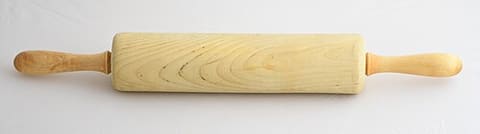
A smooth cylinder rolled over dough and pastry to flatten it to an even thickness.
Useful to have · Manual · 169 recipes
Photo: Jonatan Svensson Glad, via Wikimedia Commons (CC-BY-SA-4.0)
What it is
A long cylinder of wood, marble, metal or silicone. Western pins may have handles or be a plain dowel, or taper at the ends (French pins) for easy turning. Indian belan are slim and tapered, used on a round board (chakla) for chapati and puri. Rolling-pin guides or rings help keep thickness even.
What it’s for: Flattening dough evenly and quickly to a chosen thickness and shape.
How to use it
- Lightly flour the work surface and the pin.
- Roll from the centre outwards, lifting and turning the dough a quarter turn every few strokes.
- Keep pressure even to avoid thin spots.
- Roll pastry around the pin to lift it into a tin.
Good to know
- Tasks
- rolling pastry, rolling chapati, roti and puri, rolling pizza and cookie dough, crushing biscuits and nuts, flattening meat
- Cooking methods
- Oven-baked
- Materials
- wood, marble, stainless steel, silicone
- Care and cleaning
- Scrape off dough and wipe with a damp cloth; do not soak wooden pins. Dry fully before storing.
- Limitations
- Sticky doughs need flour or baking paper; uneven pressure gives uneven thickness.
If you don’t have one
- Wine bottle — A clean, dry, straight-sided bottle can roll dough in a pinch.
Equipment guide
How it works: Rolling distributes pressure along a line, spreading dough evenly and pushing air pockets out. A heavier pin does more of the work; a tapered pin pivots for round shapes like rotis.
| Material | Good | Watch out |
|---|---|---|
| Wood | Does not scratch pans, stays cool to hold, feels warm and quiet in use. | Absorbs water and smells if soaked; cracks if put in the dishwasher; needs occasional oiling. |
| Marble | Stays cool for butter-rich pastry. | Heavy; breakable. |
| Stainless steel | Durable, non-reactive, dishwasher-safe, does not hold smells. | Can scratch non-stick pans; conducts heat, so all-metal handles get hot. |
| Silicone-coated | Less sticking. | Can be light. |
- Straight (rod or dowel) pin
- Even pressure; the pastry chef's choice.
- Tapered (French) pin
- Easy to turn for rounds.
- Handled (American) pin
- Rollers on bearings; easy for beginners.
- Belan with chakla
- Thin Indian pin with a round board for rotis and puris.
Buying guidance
Starting out: A straight wooden pin about 45–50 cm long, or a belan and chakla for flatbreads.
- Length longer than the pastry you roll
- Diameter about 4–5 cm
- Smooth, unvarnished hardwood
- Spacer rings for even thickness
No brands or prices — check current reviews before buying.
Techniques:BakingDumLayering and sealingKneading
Related tools
Recipes that use it
Agege bread
 Nigerian · 3 h 35 min · 210 kcal · Vegetarian
Alfajores de maicena
 Argentine · 1 h 50 min · 170 kcal · Contains egg
Aloo paratha
 Punjabi · 1 h 15 min · 430 kcal · Vegetarian
Amritsari kulcha
Punjabi · 3 h 10 min · 358 kcal · VegetarianAnda paratha
Indian · 55 min · 334 kcal · Contains egg
Apple pie
 American · 4 h 45 min · 551 kcal · Contains egg
Aussie meat pie
 Australian · 2 h 50 min · 596 kcal
Bakarkhani (Hyderabadi style)
Indian · 2 h · 266 kcal · Vegetarian
Baked beef empanadas
Argentine · 2 h 20 min · 498 kcalBakewell tart
 British · 2 h 25 min · 423 kcal · Contains egg
Baleadas
 Honduran · 1 h 10 min · 433 kcal
Bang bang chicken
 Sichuan · 50 min · 224 kcal
157 more
- Batbout (Moroccan pan pocket bread) · Moroccan
- Baursak · Kazakh
- Bazlama (Turkish stovetop flatbread) · Turkish
- Beshbarmak · Kazakh
- Bint al sahn · Yemeni
- Bolani · Afghan
- Butter tarts · Canadian
- Buuz (Mongolian steamed dumplings) · Mongolian
- Cannoli siciliani · Italian
- Cantonese egg tarts · Cantonese
- Chana paratha · Indian
- Chana samosa (Chhattisgarh street-style) · Indian
- Cheese corn paratha · Indian
- Cheese paratha · Indian
- Chicken keema paratha · Indian
- Chicken momo · Nepalese
- Chilli cheese paratha · Indian
- Chin chin · Nigerian
- Chocolate babka · Polish
- Chole bhature · Punjabi
- Chuchvara · Uzbek
- Cinnamon rolls with cream cheese frosting · American
- Coconut paratha · Indian
- Colțunași cu brânză · Moldovan
- Cornish pasty · British
- Croissants · French
- Curry puffs · Singaporean
- Da pan ji (Xinjiang big plate chicken) · Chinese
- Dal dhokli · Gujarati
- Dal paratha · Indian
- Danish pastries (spandauer) · Danish
- Dholl puri · Mauritian
- Dresden Christmas stollen · German
- Dry fruit paratha · Indian
- Dushbara · Azerbaijani
- Empanadas salteñas · Argentine
- English egg custard tart · British
- English muffins · British
- Fatayer bi sabanekh (spinach triangles) · Lebanese
- Flour tortillas · Mexican
- Fresh egg pasta (pasta all'uovo) · Italian
- Fry jacks · Belizean
- Fuchka · Bangladeshi
- Gabout · Kuwaiti
- Galette des rois · French
- Garlic butter naan (yeast-free, pan-cooked) · Indian
- Ghadichi poli (layered triangle chapati) · Indian
- Goan poi · Goan
- Gobi paratha · Punjabi
- Gol gappay · Pakistani
- Göy qutabı · Azerbaijani
- Gua bao (Taiwanese pork belly buns) · Taiwanese
- Guava duff · Bahamian
- Gur paratha · Punjabi
- Gutap · Turkmen
- Halwa puri · Pakistani
- High-protein paneer paratha · Indian
- Hojaldras · Panamanian
- Hua juan (steamed scallion flower rolls) · Chinese
- Ichlekli · Turkmen
- Ispanaklı gözleme · Turkish
- Jamaican beef patties · Jamaican
- Jamaican coco bread · Jamaican
- Kalduny · Belarusian
- Kanelbullar (Swedish cinnamon buns) · Swedish
- Karjalanpiirakka · Finnish
- Kenyan chapati · Kenyan
- Kerala pathiri · South Indian
- Khachapuri adjaruli · Georgian
- Khao piak sen · Lao
- Khari biscuit · Indian
- Khinkali · Georgian
- Khoya paratha · Indian
- Khuushuur (Mongolian fried meat pastries) · Mongolian
- Kıymalı pide · Turkish
- Kleicha · Iraqi
- Klepe (Bosnian meat dumplings) · Bosnian
- Koeksisters · South African
- Korvapuusti (Finnish cinnamon rolls) · Finnish
- Kouign-amann · French
- Lachha paratha · Indian
- Lagman · Uzbek
- Lahmacun · Turkish
- Lavash · Armenian
- Lokše · Slovak
- Luchi · Bengali
- Manakish za'atar · Lebanese
- Mandazi · Kenyan
- Mantı · Turkish
- Mantou (steamed buns) · Chinese
- Margoog · Qatari
- Matar paratha · Indian
- Medialunas (Argentine croissants) · Argentine
- Melktert · South African
- Methi paratha · Punjabi
- Methi thepla · Gujarati
- Missi roti · Punjabi
- Mix veg paratha · Indian
- Mooli paratha · Punjabi
- Mughlai paratha · Bengali
- Mushroom cheese paratha · Fusion
- Naan (home-oven method) · Indian
- Oromo · Kyrgyz
- Pain au chocolat · French
- Palak paratha · Punjabi
- Palmiers · French
- Paneer cheese paratha · Indian
- Paneer paratha · Punjabi
- Pastel com diabo dentro · Cape Verdean
- Pastel de feira · Brazilian
- Pastizzi · Maltese
- Patta gobhi paratha · Indian
- Pecan pie · Southern US
- Pelmeni · Russian
- Phulka (puffed roti) · Indian
- Pierogi ruskie · Polish
- Pita (pocket bread) · Middle Eastern
- Pizza paratha · Fusion
- Plăcinte cu brânză · Moldovan
- Pork baozi (steamed pork buns) · Chinese
- Potica (walnut roll) · Slovenian
- Puran poli · Indian
- Pyaaz paratha · Punjabi
- Quiche Lorraine · French
- Quick Yogurt Flatbread · International
- Rechta · Algerian
- Ricotta and spinach ravioli with butter and sage · Italian
- Rolex · Ugandan
- Rough puff pastry · British
- Rumali roti · Indian
- Salteñas · Bolivian
- Sattu paratha · Indian
- Scallion pancakes · Chinese
- Scottish oatcakes · British
- Sfeeha · Lebanese
- Sheermal · Indian
- Sklandrausis · Latvian
- Sopaipillas · Chilean
- Soya paratha · Indian
- Surinamese roti kip · Surinamese
- Swedish gingerbread biscuits (pepparkakor) · Swedish
- Swedish rye crispbread (knäckebröd) · Swedish
- Tandoori roti · Punjabi
- Tarte au citron (French lemon tart) · French
- Tarte flambée · French
- Tarte Tatin · French
- Tequeños · Venezuelan
- Torta frita · Uruguayan
- Tortellini in brodo · Italian
- Tourtière · Canadian
- Tsuivan (Mongolian steamed noodles with meat) · Mongolian
- Uzbek manti · Uzbek
- Varenyky with sour cherries · Ukrainian
- Welsh cakes · British
- Xiaolongbao (soup dumplings) · Chinese
- Yakgwa (Korean honey cookies) · Korean
- Zagorski štrukli (baked cheese štrukli) · Croatian