
Khoya paratha
Vegetarian
खोया पराठा · khoya paratha
A rich festive paratha filled with crumbled khoya, sugar, cardamom and chopped almonds and pistachios, cooked slowly in ghee until the filling turns soft and fudgy.
Khoya paratha is an Indian bread, ready in about 1 hour 4 minutes and made with whole-wheat flour and khoya (mawa). It serves 6 and is rated intermediate to cook.
No licensed photograph of this dish yet.
- Prep
- 20 min
- Cook
- 24 min
- Rest
- 20 min
- Total
- 1 h 4 min
- Serves
- 6
- Level
- Intermediate
- Calories
- 422
Ingredients
For the dough
For the filling
For cooking
Method
Step 1
Mix the atta (opens in a new tab) and salt, rub in the oil, then add the water a little at a time, kneading for about 5 minutes into a soft, smooth dough that no longer sticks to your fingers. Cover and rest for 20 minutes so it rolls out without springing back.
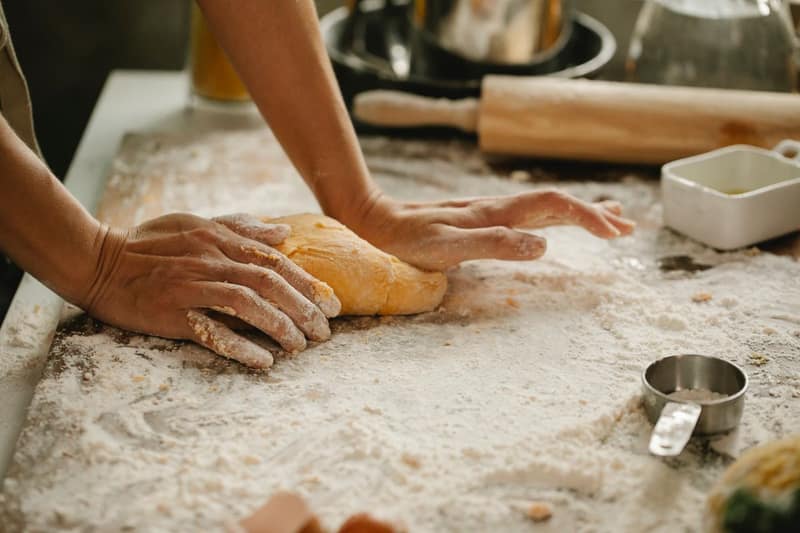
How it looks · Photo: Klaus Nielsen on Pexels Step 2
Warm the crumbled khoya (opens in a new tab) in a dry pan over low heat for 3–4 minutes until it softens and smells toasty. Cool slightly, then mix in the sugar (opens in a new tab), cardamom and nuts.
- 8 min
- low heat
- Frying pan / skillet (opens in a new tab)
Step 3
Divide the dough and the filling into 6 equal portions. Flatten a dough ball into a 10 cm cup, pack in one portion of filling, then pleat the edges up over it and pinch firmly to seal. Turn it seam-side down, press flat, dust with flour and roll lightly from the centre outwards into a 15–16 cm round.
If filling peeps through, patch the spot with a pinch of dry flour and keep rolling more gently.
Step 4
Lay a paratha on a hot tawa or heavy pan over medium-high heat. When small bubbles appear (about 30 seconds) flip it; after another 30 seconds brush the top with ghee (opens in a new tab), flip again and press the edges with a spatula (opens in a new tab) until golden-brown patches form. Brush and cook the second side the same way — 3 to 4 minutes per paratha in all.
- 24 min
- medium-low heat
- Griddle / tawa (opens in a new tab)
- Spatula (opens in a new tab)
Low heat lets the khoya melt through without the dough browning too fast.
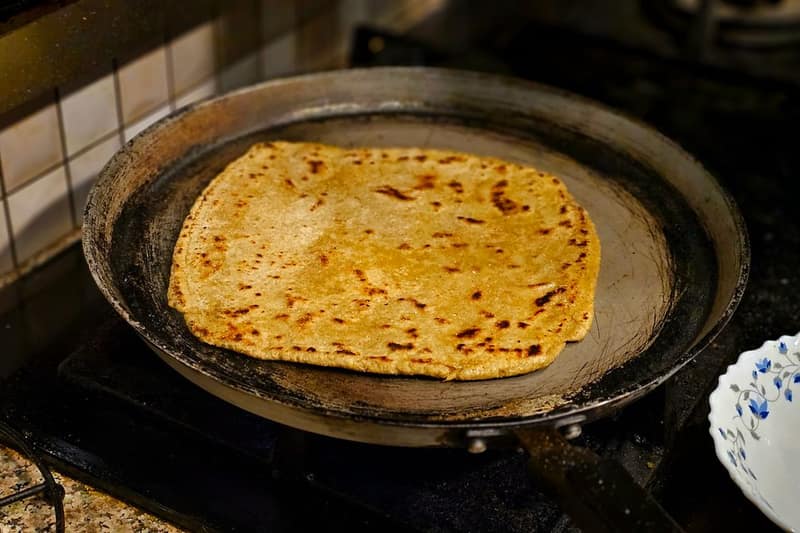
How it looks · Photo: Muhammad Khawar Nazir on Pexels
About this dish
- Origin
- North India, India · Origin uncertainMade for festivals in North Indian homes; regional origin is not documented.More food from India
- Dish
- Breakfast · Dessert · Breads & flatbreads · Sweets & confectionery
- Cooking method
- Pan-fried, Sautéed
- Taste
- sweet, rich, nutty
- Diet
- Vegetarian (lacto-ovo)Worked out from the ingredients. How labels work
All labels
Vegetarian (lacto-ovo) · Eggetarian · Lacto-vegetarian · Pescatarian · Flexitarian-friendly · Egg-free · Alcohol-free · Pork-free · Beef-free - Good for
- Festive & celebration
- Cook more with
- Whole-wheat flour · Sugar · Ground cardamom · Almonds · Pistachios · Ghee
- Techniques
- Pan-frying · Sautéing · Kneading
Allergens
- Contains: Milkfrom khoya (mawa), ghee
- Contains: Tree nutsfrom almonds, pistachios
- Contains: Wheatfrom whole-wheat flour
- Contains: Glutenfrom whole-wheat flour
Based on typical versions of these ingredients and not verified allergen-free. Brands differ and cross-contact happens, so always check labels. For severe allergies, follow your clinician’s advice.
Nutrition
422 kcal per serving
Estimated1 serving ≈ 135 g · recipe makes 6
Where the energy comes from
- Protein 13%
- Carbohydrate 50%
- Fat 38%
| Nutrient | Per serving | Per 100 g* |
|---|---|---|
| Energy | 422 kcal | 314 kcal |
| Protein | 13.9 g | 10.4 g |
| Carbohydrate | 54.7 g | 40.7 g |
| Net carbohydrate | 48.6 g | 36.1 g |
| Sugars | 17.7 g | 13.2 g |
| Added sugars | 8.3 g | 6.2 g |
| Fibre | 6.1 g | 4.5 g |
| Fat | 18.4 g | 13.7 g |
| Saturated fat | 8.6 g | 6.4 g |
| Trans fat | — | — |
| Cholesterol | 39 mg | 29 mg |
| Sodium | 282 mg | 210 mg |
| Salt equivalent | 0.7 g | 0.5 g |
Vitamins & minerals per serving
- Potassium
- 541 mg
- Calcium
- 244 mg
- Iron
- 2.2 mg
- Magnesium
- 101 mg
- Vitamin A (RAE)
- 116 µg
- Vitamin C
- 2 mg
- Vitamin D
- 2.4 µg
- Vitamin B12
- 0.8 µg
- Folate (DFE)
- 33 µg
How these numbers were made
- Calculated from USDA FoodData Central (SR Legacy) per-100 g values and the listed quantities.
- *Per 100 g of combined raw ingredients; the cooked dish may weigh more or less.
- Khoya (mawa): Whole milk powder (FDC 170876) scaled for khoya, which is milk cooked down to about 25% moisture (milk powder is about 2.5%).
- “—” means the value isn’t known for enough of the ingredients; it is never zero by default.
- Values are estimates for guidance, not for medical dosing. U.S. Department of Agriculture, Agricultural Research Service. FoodData Central, 2019. fdc.nal.usda.gov.
Good to know
Tips
- Use fresh, sweet-smelling khoya; it turns sour quickly in warm weather.
Common mistakes
- Adding sugar to hot khoya — it melts into syrup and leaks.
Serve with
- Serve warm as a festive breakfast or dessert.
Food safety
- Khoya is a perishable dairy product: keep it refrigerated and use it within a few days of buying.
Storage
- Refrigerate and eat within 2 days.
Reheating
- Reheat on a dry tawa over medium heat for about a minute a side until crisp and hot through.
Original editorial recipe · FriendsPantry editorial · Not yet independently reviewed · Added · Updated
Recipe DNA
How this dish is built
Built from the recipe’s own sections. Each band’s width is its share of the dish by weight. Choose a component to see what it does.
Structure
For the dough
- Whole-wheat flour300 g
- Salt0.5 tsp · 3 g
- Neutral vegetable oil2 tsp · 9.1 g
- Water189 ml · 189 g
Baker’s notes
Customise in Bread & BakeryTimeline and readiness cues
Mix and knead · about 44 min
Knead until smooth and soft; it should feel like an earlobe.
Rest · about 20 min
Covered so it doesn't dry out; relaxed dough rolls and shapes without springing back.
- Start to finish: about 1 h 4 min. Times are a guide — warmth changes everything; follow the cues.
The dough
| Ingredient | Role | Weight | Baker’s % |
|---|---|---|---|
| Whole-wheat flour | Flour | 300 g | 100% |
| Water | Water | 189 g | 63% |
| Neutral vegetable oil | Fat | 9 g | 3% |
| Salt | Salt | 3 g | 1% |
- Total flour
- 300 g
- Hydration
- 63%
- With milk, eggs…
- 63%
- Wholegrain
- 100%
Hydration = water ÷ flour × 100. Milk is about 87% water and eggs about 75%, so they’re shown separately as “with milk, eggs…”.
- Medium dough (55–65%) — soft and easy to knead; sandwich loaves and rolls.
- Salt 1% — on the low side (1.8–2.2% is typical for bread).
- 100% wholegrain — absorbs more water and gives a denser, nuttier loaf.
If something goes wrong
Gummy or wet crumb
Likely causes
- Under-baked
- Sliced while hot
- Hydration too high for the flour
What to do
- Bake to 93–96 °C inside (cakes: clean skewer)
- Cool completely on a rack before slicing
- Reduce water by 3–5% or use a stronger flour
Collapsed or sunken middle
Likely causes
- Oven door opened too early
- Too much leavening or sugar
- Under-baked centre
- Over-proofed yeast dough
What to do
- Don't open the oven for the first two-thirds of baking
- Measure leaveners exactly with spoons, levelled
- Test the centre before removing
- Proof less
Pale crust
Likely causes
- Oven too cool
- Too little sugar or no milk/egg for browning
- Over-fermented (yeast ate the sugars)
What to do
- Check the oven with a thermometer
- Brush with egg wash or milk
- Shorten the fermentation
Burnt bottom
Likely causes
- Tray too close to the heat
- Dark tray absorbs more heat
- Too much sugar in the dough
What to do
- Bake on the middle shelf
- Double up trays or use a light-coloured one
- Lower the temperature 10–15 °C and bake a little longer
Cracked or domed top
Likely causes
- Oven too hot (crust sets before the centre rises)
- Too much leavening
- Overmixed batter
What to do
- Lower the oven 10–15 °C
- Use the exact leavening amount
- Fold just until combined
Big holes or tunnels
Likely causes
- Overmixed batter (cakes, muffins)
- Air trapped while shaping bread
- Uneven proof
What to do
- Mix quick breads only until no dry flour shows
- Degas gently and shape tightly
- Proof covered in an even, warm place
Dry or crumbly
Likely causes
- Too much flour (scooped, not weighed)
- Over-baked
- Too little fat or sugar
What to do
- Weigh flour, or spoon it into the cup and level
- Check 5 minutes early
- Don't cut fat or sugar by more than a quarter without another moisture source
Reviews & corrections
Reviews come from signed-in cooks and appear after a moderator checks them. We never show made-up ratings.
You might also like
Dry fruit paratha
 Indian · 1 h 9 min · 392 kcal · Vegetarian
Coconut paratha
Indian · 1 h 9 min · 412 kcal · VegetarianGur paratha
Punjabi · 59 min · 350 kcal · Vegetarian
Aloo paratha
Punjabi · 1 h 15 min · 430 kcal · Vegetarian