
Indian techniques · advanced
Dum
Also: dum pukht, dum cooking
Slow cooking food in a tightly sealed pot over very low heat so it cooks in its own steam.
What it is
Dum means 'breath' and refers to cooking in a sealed vessel (a handi or degchi) whose lid is closed with a rope of dough or foil, over very low heat or embers, sometimes with coals on the lid. Biryani, dum aloo, dum ka murgh, nihari and pulao are classic dum dishes. Dum pukht is associated with Awadhi (Lucknow) cooking.
Why cooks use it: Trapped steam and aroma cook food gently and evenly, finish par-cooked rice, tenderise meat and let spices, saffron and rose or kewra infuse every layer without losing aroma to the air.
The science
With the lid sealed, moisture recirculates as steam and condenses back onto the food, keeping it moist at close to 100 °C inside the pot. Low base heat avoids scorching. Volatile aroma compounds stay inside the pot instead of evaporating.
How heat moves into foodStarch gelatinisationMoisture and textureAroma compounds and flavour
Step by step
Prepare the dish in a heavy pot with a well-fitting lid (layered rice and meat for biryani, or a gravy for dum aloo).
Make a soft dough of flour and water and roll it into a rope; press it around the rim and lay the lid on to seal (or use two layers of foil under the lid).
Set the pot on a hot tawa or heat diffuser over the lowest flame so heat reaches the base gently; or place it in the oven at about 150–160 °C.
Optionally cook on higher heat for the first 5 minutes to build steam, then turn to the lowest heat.
Cook undisturbed for the set time (about 20–45 minutes for biryani).
Turn off the heat and rest 5–10 minutes before breaking the seal; open away from you.
Heat and timing
- Dum 90–160 °C · Very low base heat; oven method about 150–160 °C. Inside the pot food sits close to 100 °C.
Time: 20–45 minutes for biryani with par-cooked rice; 1–2 hours for meat dishes.
How you know it’s right
- Faint steam escaping or the dough seal puffing slightly
- Strong aroma when the seal is broken
- Rice grains fully cooked, separate and long
- No burnt smell from the base
Common mistakes
- Lid not sealed, so steam escapes and rice stays hard
- Direct high heat that burns the bottom layer
- Opening the pot to check
- Too little moisture in the base layer
Troubleshooting
- Bottom layer burnt
- Use a tawa or diffuser under the pot and a heavier pot; add a little more liquid or gravy at the base next time.
- Rice undercooked on top
- Sprinkle a few tablespoons of hot water or milk, reseal and give it 10 more minutes.
- Rice mushy
- The rice was overcooked before layering; par-boil to about 70% doneness only.
Restaurant DNA
How professionals do it
Biryani kitchens traditionally cook large degs over wood or charcoal fires with coals placed on the lid, and judge doneness by experience, time and aroma rather than opening the pot.
At home
A heavy Dutch oven sealed with foil under the lid, set on a cast-iron tawa over low heat or in a 150–160 °C oven, gives reliable dum.
General professional practice — not any particular restaurant’s recipe.
Food safety
- Steam rushes out when the seal is broken; open the side away from you.
- For kacchi (raw-meat) biryani, the meat must be fully cooked: use tender cuts, small pieces and enough time, and check the meat before serving.
- Cool and refrigerate leftover biryani within 1 hour, as for any cooked rice.
Practise it
Dhakai kacchi biryani
 Bangladeshi · 6 h 35 min · 750 kcal
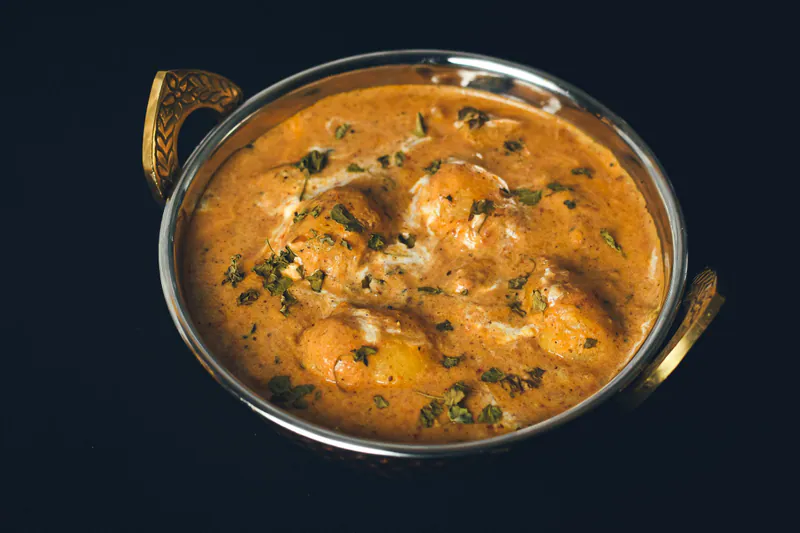
Punjabi dum aloo
 Punjabi · 55 min · 277 kcal · Vegetarian
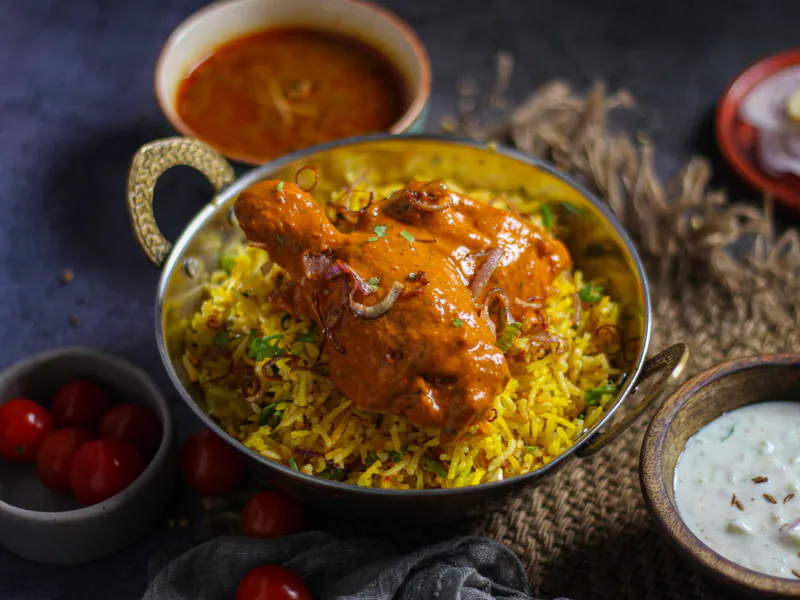
Sindhi biryani
 Pakistani · 2 h 15 min · 798 kcal