
Fresh egg pasta (pasta all'uovo)
Contains egg (no meat or fish)
Pasta fresca all'uovo
The basic Emilian egg dough — one egg to every 100 g of flour — kneaded until silky, rolled thin and cut into tagliatelle, fettuccine or pappardelle. The base for ravioli, tortellini and lasagne too.
Fresh egg pasta (pasta all'uovo) is an Italian pasta dish from Italy, ready in about 1 hour 13 minutes and made with all-purpose flour and egg. It serves 4 and is rated intermediate to cook.
No licensed photograph of this dish yet.
- Prep
- 40 min
- Cook
- 3 min
- Rest
- 30 min
- Total
- 1 h 13 min
- Serves
- 4
- Level
- Intermediate
- Calories
- 436
Method
Step 1
Heap the flour on a clean worktop and make a wide well in the middle. Crack the eggs (opens in a new tab) into the well and beat them with a fork, gradually drawing in flour from the inside walls until you have a thick paste.
Step 2
Use a bench scraper (opens in a new tab) to fold in the remaining flour, then knead with the heel of your hand for 8–10 minutes until the dough is smooth, elastic and slightly tacky but not sticky. Add a teaspoon of water if it stays crumbly, or a little flour if it sticks.
The dough should feel like firm playdough; it softens as it rests.
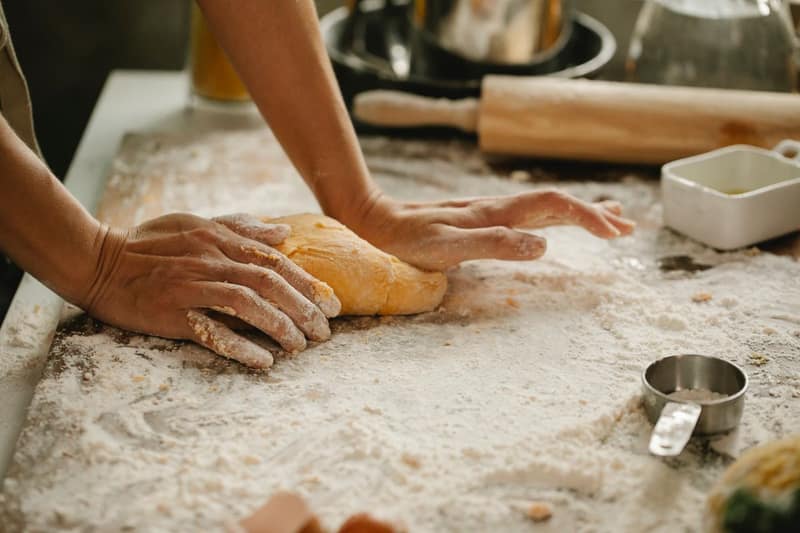
How it looks · Photo: Klaus Nielsen on Pexels Step 3
Wrap the dough and rest it at room temperature for 30 minutes so the gluten relaxes and it rolls out easily.
Step 4
Cut the dough into 4 pieces and keep the rest covered. Roll one piece on a lightly floured surface with a long rolling pin (opens in a new tab) (or pass it through a pasta machine) until it is about 1 mm thick — you should just see your hand through it.
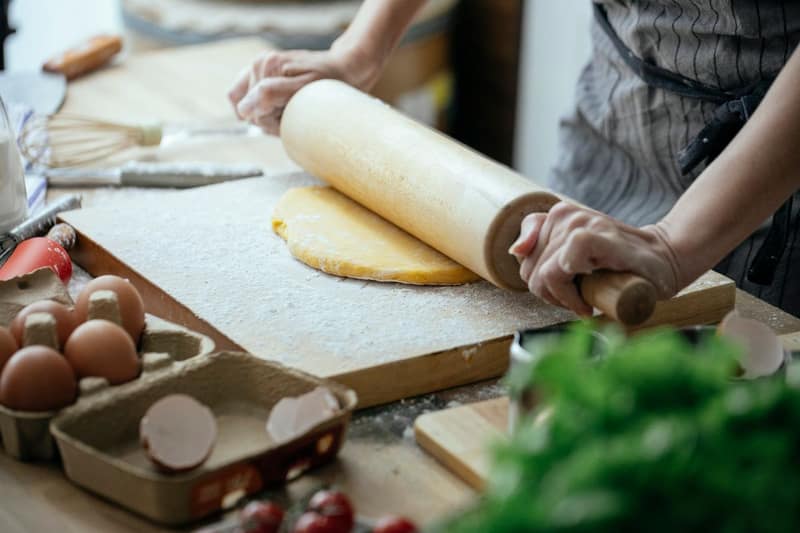
How it looks · Photo: Katerina Holmes on Pexels Step 5
Let each sheet dry for 5–10 minutes until leathery but still flexible. Dust with semolina (opens in a new tab), roll up loosely and cut across: 6–7 mm for tagliatelle, 1 cm for fettuccine, 2–3 cm for pappardelle. Shake the strands loose and coil them into nests.
Step 6
Cook in plenty of boiling salted water for 2–3 minutes, until tender with a slight bite. Lift out with tongs straight into the sauce, with a splash of the cooking water.
- 3 min
- high heat
- Stockpot / large pot (opens in a new tab)
Food safety: Drain boiling pasta water away from you and keep children clear of the stove.
Salt the pasta water at about 10 g per litre — it should taste pleasantly seasoned, not like the sea.
About this dish
- Origin
- Emilia-Romagna, Italy · Commonly attributedEgg pasta is made across northern and central Italy; rolling a thin 'sfoglia' by hand is most closely associated with Emilia-Romagna.More food from Italy
- Dish
- Lunch · Dinner · Pasta
- Cooking method
- Boiled
- Taste
- mild, rich
- Diet
- Vegetarian (lacto-ovo) · Dairy-free · No nut ingredientsWorked out from the ingredients. How labels work
All labels
Vegetarian (lacto-ovo) · Eggetarian · Ovo-vegetarian · Pescatarian · Flexitarian-friendly · Dairy-free · No nut ingredients · No added sugar · Alcohol-free · Pork-free · Beef-free · Low-sodium · DASH-style · Calorie-conscious - Good for
- Make-ahead · Freezer-friendly
- Cook more with
- All-purpose flour · Egg
Allergens
- Contains: Eggsfrom egg
- Contains: Wheatfrom all-purpose flour, semolina
- Contains: Glutenfrom all-purpose flour, semolina
Based on typical versions of these ingredients and not verified allergen-free. Brands differ and cross-contact happens, so always check labels. For severe allergies, follow your clinician’s advice.
Nutrition
436 kcal per serving
Calculated1 serving ≈ 155 g · recipe makes 4
Where the energy comes from
- Protein 16%
- Carbohydrate 72%
- Fat 12%
| Nutrient | Per serving | Per 100 g |
|---|---|---|
| Energy | 436 kcal | 281 kcal |
| Protein | 16.6 g | 10.7 g |
| Carbohydrate | 76.7 g | 49.5 g |
| Net carbohydrate | 74 g | 47.7 g |
| Sugars | 0.5 g | 0.3 g |
| Added sugars | 0 g | 0 g |
| Fibre | 2.7 g | 1.7 g |
| Fat | 5.7 g | 3.7 g |
| Saturated fat | 1.7 g | 1.1 g |
| Trans fat | — | — |
| Cholesterol | 186 mg | 120 mg |
| Sodium | 73 mg | 47 mg |
| Salt equivalent | 0.2 g | 0.1 g |
Vitamins & minerals per serving
- Potassium
- 176 mg
- Calcium
- 43 mg
- Iron
- 5.5 mg
- Magnesium
- 28 mg
- Vitamin A (RAE)
- 80 µg
- Vitamin C
- 0 mg
- Vitamin D
- 1 µg
- Vitamin B12
- 0.4 µg
- Folate (DFE)
- 315 µg
How these numbers were made
- Calculated from USDA FoodData Central (SR Legacy) per-100 g values and the listed quantities.
- Optional ingredients are not included: salt, semolina.
- “—” means the value isn’t known for enough of the ingredients; it is never zero by default.
- Values are estimates for guidance, not for medical dosing. U.S. Department of Agriculture, Agricultural Research Service. FoodData Central, 2019. fdc.nal.usda.gov.
Good to know
Tips
- Weigh your eggs: about 55–60 g of egg per 100 g of flour gives the classic texture.
- For filled pasta (ravioli, tortellini) roll a little thinner and don't let the sheets dry, so the edges seal.
Common mistakes
- Adding lots of flour while kneading — the dough becomes dry and cracks when rolled.
- Skipping the rest, which makes the dough spring back as you roll.
Serve with
- Tagliatelle with ragù alla bolognese, fettuccine al burro, or pappardelle with mushrooms.
Food safety
- Fresh egg pasta contains raw egg: keep it refrigerated and cook it thoroughly.
Storage
- Dry nests on a floured tray for an hour, then refrigerate for up to 2 days, or freeze on the tray and bag for 1 month. Cook from frozen, adding a minute.
Variations
- Pasta verde: Work 100 g of cooked, squeezed and very finely chopped spinach into the eggs and use 50 g more flour — used for lasagne verdi.
- Yolk-rich dough: Replace 2 whole eggs with 5 yolks for a deeper yellow, silkier pasta, as in Piedmont's tajarin.
Do I need a pasta machine?
No. A long, thin rolling pin is the traditional tool. A machine is quicker and makes even sheets; roll through each setting down to the second-thinnest.
Original editorial recipe · FriendsPantry editorial · Not yet independently reviewed · Added · Updated
Sauces, chutneys & dips for this dish
Recipe DNA
How this dish is built
Grouped by each ingredient’s role in the dish. Each band’s width is its share of the dish by weight. Choose a component to see what it does.
What the dish is built around
Main ingredient
- All-purpose flour400 g
- Egg4 piece · 200 g
- Semolina (optional)2 tbsp · 21 g
Reviews & corrections
Reviews come from signed-in cooks and appear after a moderator checks them. We never show made-up ratings.
You might also like
Ragù alla bolognese with tagliatelle
 Italian · 3 h · 630 kcal
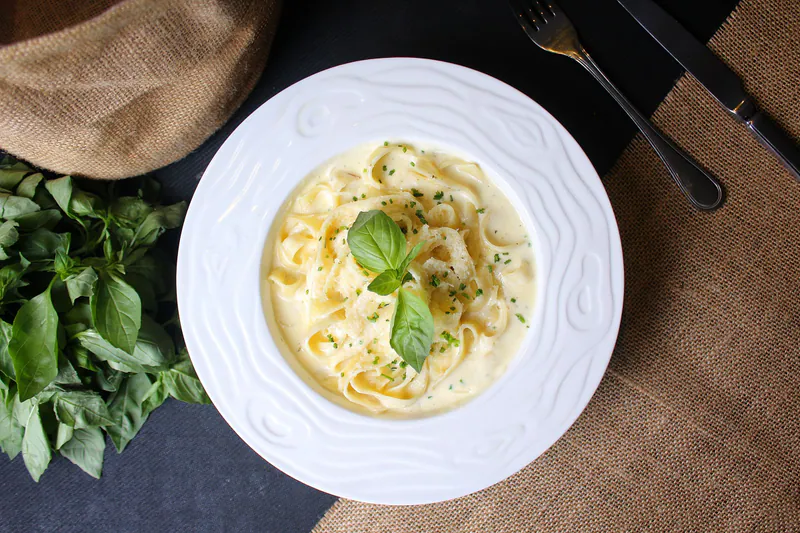
Fettuccine al burro (the original fettuccine Alfredo)
Italian · 15 min · 546 kcal · Vegetarian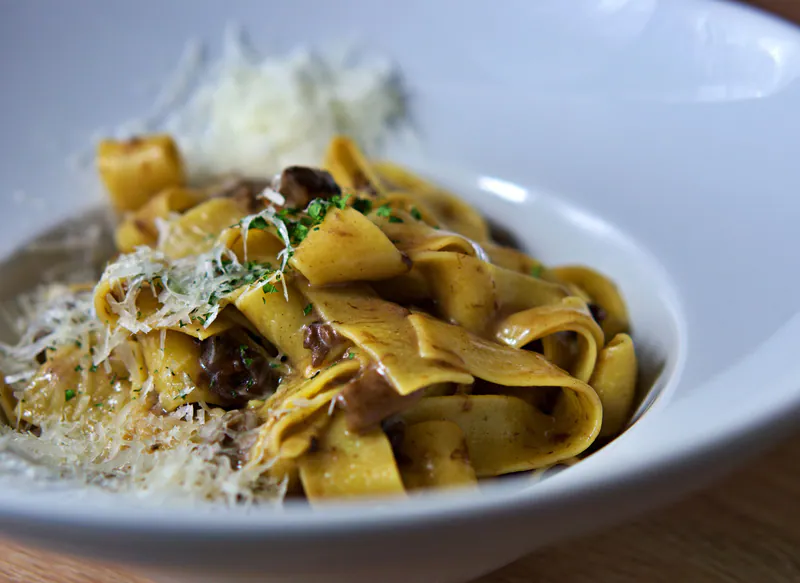
Pappardelle ai funghi (pappardelle with mushrooms)
Italian · 45 min · 600 kcal · VegetarianRicotta and spinach ravioli with butter and sage
Italian · 1 h 55 min · 677 kcal · Contains egg