
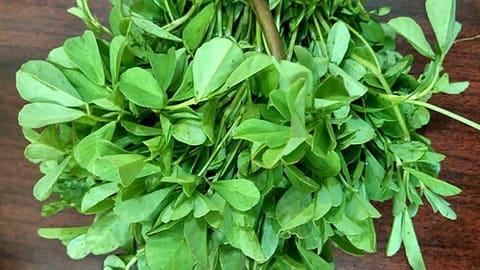
Seeds
Fenugreek
Trigonella foenum-graecum
Hard, yellow-brown, squarish seeds with a bitter, maple-like flavour, used sparingly in tempering and masalas.
Also called: methi, methi seeds, çemen, shamballeh
- Warm & sweet
- Nutty & toasty
- Earthy
- No heat
Photo: Thamizhpparithi Maari, via Wikimedia Commons (CC-BY-SA-4.0)
Flavour and aroma
bitter, maple-like, nutty when fried, celery-like. Bitter raw; nutty and maple-like when toasted.
- Heat
- No heat
- Forms
- whole, ground
How to use it
bloom in fat · Tadka (tempering) technique
Fry in hot oil for 10–20 seconds, only until reddish-brown. Dark brown seeds are unpleasantly bitter.
dry roast · Spice roasting (dry-roasting) technique
For sambar powder and pickles, roast over low heat for 2–3 minutes until golden and nutty, then grind.
soak
For idli and dosa, soak a teaspoon or so with the urad dal for 4–6 hours and grind together; it softens and makes the batter fluffier.
- Tadka for sambar, kadhi and pickles
- Panch phoron
- Soaked into idli and dosa batters
- Sambar and curry powders
- Ethiopian berbere and Yemeni hilbeh
Identifying good quality
Hard, angular, mustard-yellow to amber seeds 3–5 mm long, with a groove across one side. Very hard; good seeds are evenly coloured with no dust.
- Not to be confused with Dried fenugreek leaves: Kasuri methi is the dried leaf of the same plant; it is used differently.
Origin and history
Origin: The eastern Mediterranean and western Asia.. Grown and used: India is the world's largest producer, mainly Rajasthan; also grown in Pakistan, Nepal, Egypt, Ethiopia and Turkey..
Fenugreek is an ancient crop of the Near East and India. In South India the seeds go into idli and dosa batter, sambar powder and pickles; in Bengal they are one of the five seeds of panch phoron.
Well documented
In masalas, pastes and sauces
- Sambar powderMasala5 g per batch
- Madras curry powderMasala5 g per batch
- Malvani masalaMasala1 g per batch
- Panch phoronMasala20 g per batch
- Everyday curry powder (British-style)Masala5 g per batch
- Sri Lankan roasted curry powderMasala3 g per batch
- Berbere spice blendMasala4 g per batch
- Golbheda ko acharSauce0.9 g per batch
- Kiri hodiSauce1.8 g per batch
- Aam ki launji (sweet-sour raw mango chutney)Sauce0.9 g per batch
- Punjabi mango pickle (aam ka achaar)Sauce16.6 g per batch
- Bengali tomato-date chutney (tomato khejur chutney)Sauce0.5 g per batch
- Gongura pachadi (Andhra sorrel-leaf chutney)Sauce0.9 g per batch
- Allam pachadi (Andhra ginger chutney)Sauce0.5 g per batch
- Inji puli (Kerala ginger-tamarind relish)Sauce0.9 g per batch
- Andhra tomato pachadiSauce1 g per batch
- Beerakaya pachadi (ridge gourd chutney)Sauce0.5 g per batch
- Tomato thokkuSauce3 g per batch
- Avakaya (Andhra mango pickle)Sauce10 g per batch
- Kancha aamer chutney (Bengali green mango chutney)Sauce0.4 g per batch
- Tomato khajuri khatta (Odia tomato-date chutney)Sauce0.4 g per batch
- Dalle khursani achar (Sikkimese round chilli pickle)Sauce2 g per batch
- Amba (Iraqi mango pickle sauce)Sauce5 g per batch
- Adjika (red chilli paste)Sauce3.7 g per batch
Recipes with fenugreek
Aam ki launji (sweet-sour raw mango chutney)
 Indian · 40 min · 85 kcal · Vegan
Adjika (red chilli paste)
 Georgian · 1 h 20 min · 13 kcal · Vegan
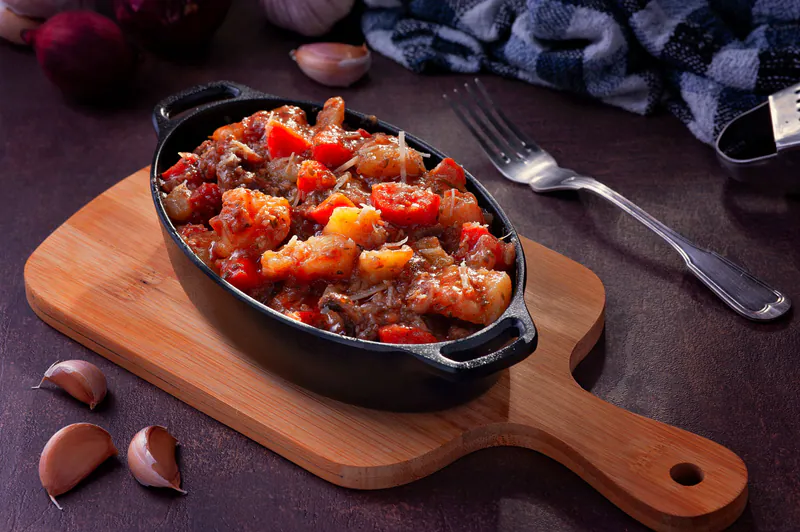
Ajapsandali
Georgian · 1 h 20 min · 325 kcal · VeganAllam pachadi (Andhra ginger chutney)
South Indian · 35 min · 56 kcal · VeganAloo sadeko
 Nepalese · 30 min · 205 kcal · Vegan
Aloo tama
Nepalese · 1 h 15 min · 223 kcal · VeganAmba (Iraqi mango pickle sauce)
 Iraqi · 72 h 45 min · 39 kcal · Vegan
Andhra tomato pachadi
South Indian · 50 min · 56 kcal · VeganAvakaya (Andhra mango pickle)
South Indian · 73 h · 49 kcal · Vegan
40 more
- Badrijani nigvzit · Georgian
- Beerakaya pachadi (ridge gourd chutney) · South Indian
- Bengali tomato-date chutney (tomato khejur chutney) · Bengali
- Chakhokhbili · Georgian
- Chicken balti · British
- Dal bhat tarkari · Nepalese
- Dalle khursani achar (Sikkimese round chilli pickle) · Indian
- Dalma · Indian
- Fahsa · Yemeni
- Georgian tomato and cucumber salad with walnuts · Georgian
- Ghormeh sabzi · Iranian
- Golbheda ko achar · Nepalese
- Gongura pachadi (Andhra sorrel-leaf chutney) · South Indian
- Gujarati dal · Gujarati
- Haryanvi kadhi · Indian
- Idli · South Indian
- Inji puli (Kerala ginger-tamarind relish) · South Indian
- Kadhi pakora · Punjabi
- Kancha aamer chutney (Bengali green mango chutney) · Bengali
- Kara kuzhambu · South Indian
- Kiri hodi · Sri Lankan
- Kori gassi · South Indian
- Kukhura ko masu · Nepalese
- Kuku sabzi · Iranian
- Lobio · Georgian
- Macher jhol · Bengali
- Machha besara · Indian
- Masala dosa · South Indian
- Masor tenga · Indian
- Mirchi ka salan · Indian
- Onion tomato uttapam · South Indian
- Pulihora (Andhra tamarind rice) · South Indian
- Punjabi mango pickle (aam ka achaar) · Punjabi
- Saltah · Yemeni
- Sambar · South Indian
- Satsivi · Georgian
- Spinach pkhali · Georgian
- Tomato khajuri khatta (Odia tomato-date chutney) · Indian
- Tomato thokku · South Indian
- Xaak bhaji (Assamese stir-fried greens) · Indian