
Preservation · beginner
Drying
Also: dehydrating, sun-drying
Removing most of the water from food so that microbes cannot grow.
What it is
Drying preserves food by removing water through sun, air, low oven heat or a dehydrator. Indian households sun-dry chillies, mango (aamchur), papads, vadis, sandige, kasuri methi and berries; elsewhere jerky, dried fruit and tomatoes.
Why cooks use it: Without available water, bacteria, yeasts and moulds cannot grow; flavours also concentrate.
The science
Microbes need available water (water activity). Drying lowers it below the level at which they can grow. Gentle heat and moving air speed evaporation; too much heat hardens the outside (case hardening) and traps moisture inside.
Enzymatic browningOxidation and rancidityMoisture and textureThe science of picklingThe science of curingThe science of dryingFood-safety temperatures
Step by step
Cut food into thin, even slices.
Pre-treat if needed: lemon water for fruit that browns; for meat jerky, heat the meat first to a safe temperature.
Spread in a single layer on racks so air reaches all sides.
Dry in a dehydrator at 50–70 °C, a low oven with the door slightly ajar, or in strong sun under a net, turning occasionally.
Test: fruit should be leathery with no moisture when squeezed; chillies brittle; leaves crumble.
Cool completely and store airtight; check for condensation in the jar after a day.
Heat and timing
- Drying 50–70 °C · Dehydrator or oven at about 50–70 °C; jerky meat should first be heated to 71 °C (beef) or 74 °C (poultry) per USDA guidance.
Time: Herbs a few hours; fruit 6–12 hours; sun-drying chillies or mango several days.
How you know it’s right
- No moisture beads when cut or squeezed
- Leaves crumble
- Chillies rattle
Common mistakes
- Uneven slices
- Overlapping pieces
- Too high heat (case hardening)
- Storing before fully cooled and dry
Troubleshooting
- Mould in the jar
- The food was not dry enough; discard it and dry the next batch longer.
- Hard outside, soft inside
- Lower the temperature and dry for longer.
Restaurant DNA
How professionals do it
Restaurants use dehydrators or very low combination ovens to make fruit crisps, powders and leathers, often grinding dried ingredients into seasoning dusts.
At home
An oven at its lowest setting with the door propped open works for small batches; a dehydrator is more efficient for regular use.
General professional practice — not any particular restaurant’s recipe.
Food safety
- Meat for jerky must be heated to a safe internal temperature before or during drying.
- Protect sun-drying food from insects, birds and dust with a fine net.
Practise it
Avakaya (Andhra mango pickle)
 South Indian · 73 h · 49 kcal · Vegan
Dalle khursani achar (Sikkimese round chilli pickle)
Indian · 72 h 25 min · 18 kcal · Vegan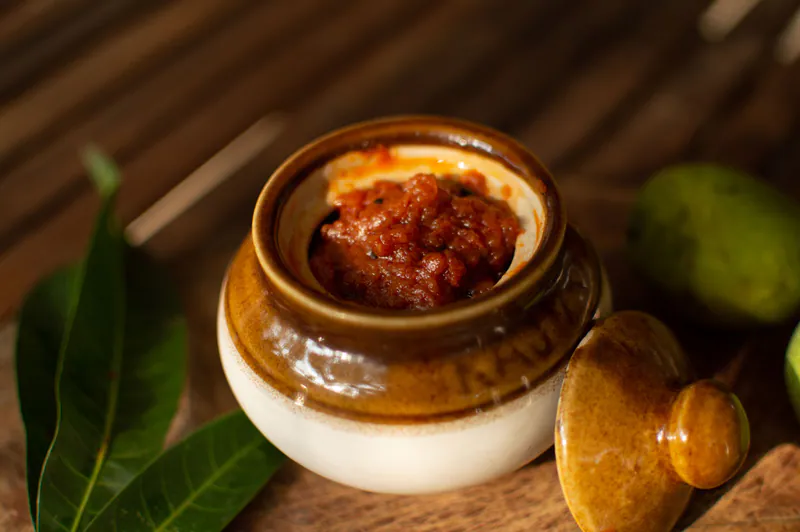
Punjabi mango pickle (aam ka achaar)
Punjabi · 45 min · 36 kcal · VeganShichimi togarashi
 Japanese · 50 min · 8 kcal · Vegan