
Cookware & bakeware · Pan
Cast-iron skillet
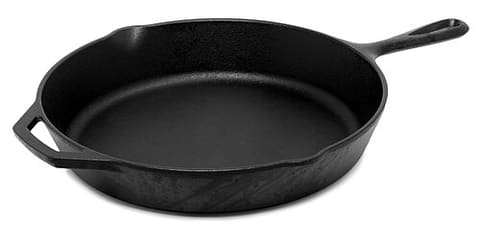
A heavy, thick frying pan of cast iron that holds intense heat and goes from hob to oven.
Useful to have · Used on the stovetop · 15 recipes
Photo: Evan-Amos, via Wikimedia Commons (public-domain)
What it is
A frying pan cast in one piece of iron, usually black, with short sides, a stubby handle and often a pouring lip. Its weight lets it store a lot of heat, so it sears well and stays hot when food goes in. Bare cast iron develops a natural non-stick 'seasoning' from polymerised oil; enamelled versions do not need seasoning.
What it’s for: Hard searing, shallow frying, baking cornbread or pan pizzas and anything that moves from hob to oven.
How to use it
- Heat gradually over medium heat for several minutes; it heats slowly but evenly.
- Add oil and food; let food sear undisturbed until it releases naturally.
- Transfer the whole pan to the oven to finish thicker cuts or bakes.
- Use a cloth or handle cover; the handle gets hot.
Good to know
- Tasks
- searing steaks and chops, shallow-frying, baking cornbread and pan pizza, roasting vegetables, charring peppers and tortillas
- Cooking methods
- Pan-fried, Shallow-fried, Sautéed, Oven-baked, Roasted, Toasted, Deep-fried
- Materials
- cast iron, enamelled cast iron
- Care and cleaning
- Wash with hot water and a brush; a little soap is fine on a well-seasoned pan. Dry thoroughly over low heat, then wipe a very thin layer of oil on. Avoid soaking and the dishwasher. Rust can be scrubbed off and the pan re-seasoned in the oven.
- Limitations
- Heavy, slow to heat and reacts with long-cooked acidic sauces (tomato, vinegar), which can taste metallic and strip seasoning.
Safety
- The handle gets as hot as the pan, including in the oven.
- Heavy; use two hands when it is full or hot.
- Do not drop a hot pan in cold water: it can crack.
If you don’t have one
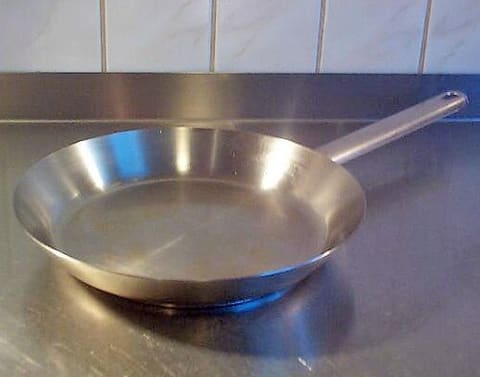
- Frying pan / skillet — A heavy stainless or carbon-steel pan sears well, though it loses heat faster.
- Baking steel — Similar heat storage for oven baking of pizza.
Equipment guide
How it works: Cast iron is a poor heat conductor but stores a lot of heat because of its mass. Once preheated, it releases heat steadily and recovers quickly when cold food is added, which gives deep, even browning. Polymerised oil (seasoning) fills the pores and forms a hard, slick layer that becomes more non-stick with use.
| Material | Good | Watch out |
|---|---|---|
| Cast iron (bare, seasoned) | Very high heat capacity, so it holds temperature when cold food goes in; excellent for searing; oven-safe; lasts generations. | Heavy and slow to heat; heats unevenly on small burners; needs seasoning and drying; long simmering of acidic sauces can strip seasoning and give a metallic taste. |
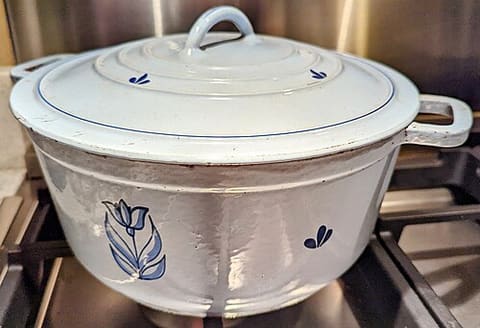
| Enamelled cast iron | Heat retention of cast iron with a non-reactive glass surface that needs no seasoning; good for acidic braises. | Very heavy; enamel can chip or craze with thermal shock or metal utensils; light interiors stain. |
| Machined (smooth) vs as-cast (rough) surface | Smooth surfaces release food sooner; rough surfaces hold seasoning well. | Smooth finishes cost more; rough surfaces take longer to become slick. |
- Standard skillet
- 20–30 cm; searing, frying, cornbread, oven roasting.
- Deep skillet or chicken fryer
- Higher sides for shallow-frying and braising.
- Pre-seasoned vs unseasoned
- Pre-seasoned is ready to use; seasoning still improves with use.
Buying guidance
Starting out: A pre-seasoned 26 cm skillet.
Keen cook: Add a 30 cm skillet or a deep skillet for frying and bigger batches.
- Size: 25–30 cm
- Helper handle opposite the main handle (they are heavy)
- Pour spouts
- Even wall thickness with no cracks or pits
No brands or prices — check current reviews before buying.
Techniques:RoastingBakingToastingSearingCharcoal grillingPan-fryingShallow-fryingSpice roasting (dry-roasting)DeglazingSous vide
Related tools
Recipes that use it
Batbout (Moroccan pan pocket bread)
 Moroccan · 2 h 5 min · 112 kcal · Vegan
Bazlama (Turkish stovetop flatbread)
 Turkish · 2 h 15 min · 365 kcal · Vegetarian
Chettinad masala
 South Indian · 25 min · 7 kcal · Vegan
Corn tortillas (masa harina)
 Mexican · 1 h · 76 kcal · Vegan
Goda masala
Indian · 38 min · 14 kcal · VeganMalvani masala
Indian · 40 min · 10 kcal · VeganPunjabi garam masala
Punjabi · 27 min · 7 kcal · VeganSalsa roja asada
Mexican · 20 min · 14 kcal · VeganSambar powder
South Indian · 38 min · 23 kcal · VeganTaboon bread
 Palestinian · 2 h 40 min · 344 kcal · Vegan
Tandoori roti
Punjabi · 1 h 25 min · 206 kcal · VegetarianTirokafteri (spicy whipped feta)
 Greek · 48 min · 173 kcal · Vegetarian
3 more
- Chole masala · Punjabi
- Welsh cakes · British
- Xacuti masala · Goan