
Advanced & modernist · advanced
Sous vide
Also: precision cooking, low-temperature water-bath cooking
Cooking sealed food in a water bath held at an exact temperature.
What it is
Sous vide ('under vacuum') places food in a sealed bag in a water bath controlled by an immersion circulator to a precise temperature, often the exact final temperature wanted at the centre. Food is usually seared afterwards for colour.
Why cooks use it: Because the water never exceeds the target, meat and fish cook evenly edge to edge to the exact doneness, and it is hard to overcook.
The science
Water transfers heat much more efficiently than air at the same temperature, and holding food at a set temperature lets the centre reach it without the outside overshooting. Food safety depends on both temperature and time: pathogens are killed more slowly at lower temperatures, so a lower temperature needs a longer hold.
How heat moves into foodHow proteins set when cookedFood-safety temperaturesMolecular gastronomySous-vide science
Step by step
Season the food and seal it in a food-safe bag, removing as much air as possible (vacuum sealer or water displacement).
Heat the water bath to the target temperature.
Submerge the bag fully; clip it so it does not float.
Cook for the time given in a tested time-temperature table for the food and its thickness.
Remove, pat dry and sear briefly in a very hot pan or with a torch.
Serve at once, or chill rapidly in iced water and refrigerate if not serving.
Heat and timing
- Sous vide 52–85 °C · Steak about 52–57 °C; chicken breast about 60–65 °C held long enough to pasteurise; vegetables about 83–85 °C.
Time: 45 minutes to 3 hours for most portions; 24–72 hours for tough cuts.
How you know it’s right
- Bag fully submerged with no air pockets
- Even colour from edge to centre when sliced
Common mistakes
- Air pockets that make the bag float and cook unevenly
- Holding food below about 54 °C for many hours
- Skipping the sear
- Searing too long and overcooking the outer layer
Troubleshooting
- Bag floating
- Remove more air, add a weight or clip it to the side.
- Pale, soft surface
- Dry the food thoroughly and sear in a smoking-hot pan for under a minute per side.
Restaurant DNA
How professionals do it
Restaurants cook proteins sous vide in batches, chill them, and reheat and sear to order, which makes service fast and consistent; they follow HACCP plans for time and temperature.
At home
A home immersion circulator and zip-top bags (water displacement) work well; keep a reliable chart for chicken and pork.
General professional practice — not any particular restaurant’s recipe.
Food safety
- Use published time-temperature tables. For poultry, 74 °C is instantly safe; at lower temperatures the centre must be held for a set time (for example, about 35 minutes at 60 °C, about 3 minutes at 65 °C, according to commonly cited USDA-derived tables).
- Do not cook below about 54 °C for more than roughly 4 hours.
- Chill cooked bags rapidly in iced water if not serving immediately.
- Use bags rated for cooking temperatures.
Practise it
Leche flan
 Filipino · 5 h 5 min · 335 kcal · Contains egg
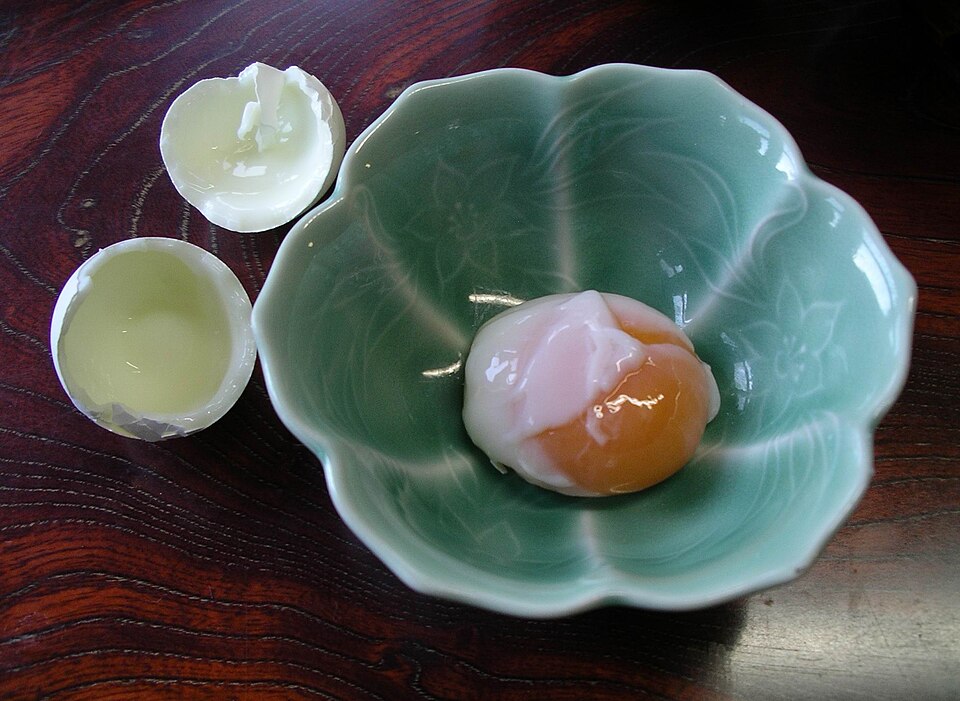
Onsen tamago (hot-spring eggs)
 Japanese · 50 min · 81 kcal