
 Korean · Appetizers & starters
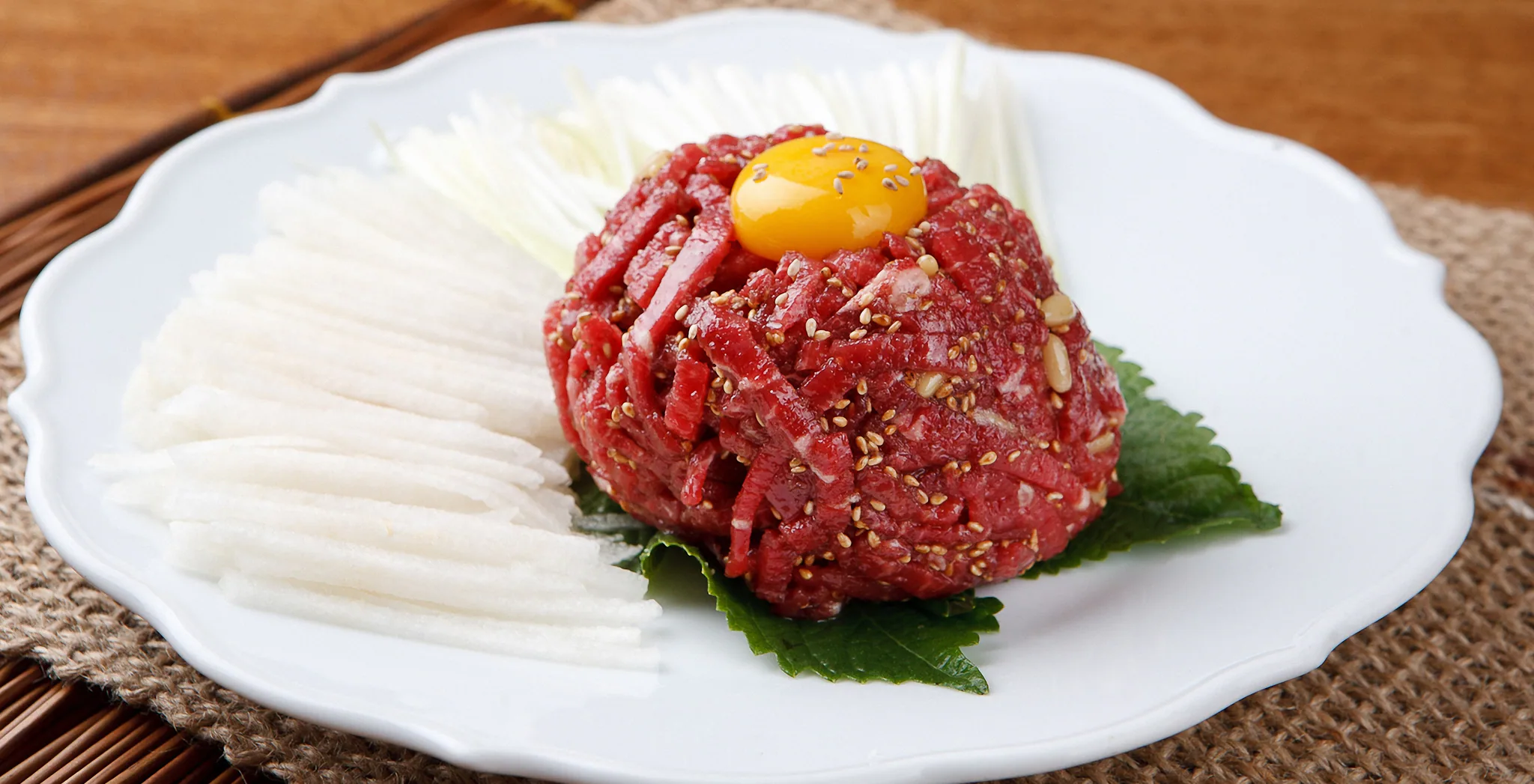
Yukhoe (Korean beef tartare)
Non-vegetarian
육회 · yukhoe
Very fresh, lean raw beef cut into fine strips and dressed with soy sauce, sesame oil, garlic, sugar and pepper, then crowned with a raw egg yolk and served with matchsticks of crisp pear. The name joins yuk (meat) and hoe (raw dish).
Yukhoe (Korean beef tartare) is a Korean starter from South Korea, ready in about 40 minutes and made with beef tenderloin, soy sauce and toasted sesame oil. It serves 2 and is rated easy to cook.
- Prep
- 20 min
- Cook
- 0 min
- Rest
- 20 min
- Total
- 40 min
- Serves
- 2
- Level
- Easy
- Calories
- 451
Main ingredients
Ingredients
For the seasoning
To serve
Method
To serve
14 minStep 1
Wrap the beef in cling film and freeze for 20 minutes so it firms up and is easier to slice.
- 1 min
Food safety: Wash hands, boards and knives after handling raw meat, and keep it apart from salad and other ready-to-eat food.
Step 2
Toss the pear (opens in a new tab) matchsticks with the lemon juice (opens in a new tab) and arrange them in a ring or nest on a chilled plate.
- 5 min
Step 3
With a very sharp knife, slice the beef against the grain into thin slices, then into fine strips about 3 mm wide. Pat dry with kitchen paper.
Seasoning
5 minStep 4
Just before serving, mix the soy sauce (opens in a new tab), sesame oil (opens in a new tab), sugar (opens in a new tab), garlic (opens in a new tab), spring onion (opens in a new tab), salt and pepper (opens in a new tab) in a bowl. Add the beef and toss gently with chopsticks until evenly coated, then mix in the sesame seeds (opens in a new tab).
Dress the beef at the last moment; the salt and sugar draw out moisture if it sits.
Step 5
Pile the beef on top of the pear (opens in a new tab), make a hollow in the centre and slip in an egg yolk (opens in a new tab). Scatter over the pine nuts (opens in a new tab) and serve at once, mixing the yolk through at the table.
- 2 min
Food safety: Raw or lightly cooked egg carries a small risk of Salmonella; use very fresh eggs from a trusted source (pasteurised eggs where available) and avoid serving to pregnant people, young children, the elderly or anyone with a weakened immune system.
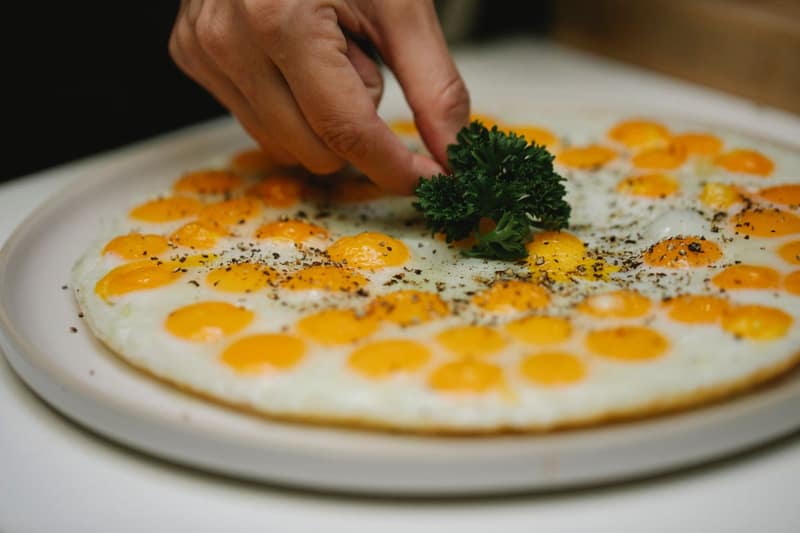
How it looks · Photo: Klaus Nielsen on Pexels
At a glance
1 · To serve in a bowl
 Pear
 Lemon juice
 Egg yolk
 Pine nuts
then just
2 · Seasoning in a bowl
 Soy sauce
 Toasted sesame oil
 Sugar
 Garlic
 Spring onion
 Salt
 Black pepper
 Sesame seeds
About this dish
- Origin
- Korea, South Korea · Commonly attributedIts origin is unclear: some trace it to China, others to the Korean royal court. Gwangju and Jeonju are known for their yukhoe.More food from South Korea
South Korea - Dish
- Dinner · Appetizers & starters
- Cooking method
- Raw, No-cook
- Taste
- umami, nutty, sweet & savoury, fresh
- Diet
- Dairy-free · Low-carb · High-proteinWithout the optional extras: No nut ingredientsWorked out from the ingredients. How labels work
All labels
Non-vegetarian · Dairy-free · Alcohol-free · Pork-free · Low-carb · High-protein · Calorie-conscious - Good for
- Festive & celebration
- Cook more with
- Beef tenderloin · Soy sauce · Toasted sesame oil · Sugar · Garlic · Spring onion
Allergens
- Contains: Eggsfrom egg yolk
- Contains, can be adapted: Tree nutsfrom pine nuts
- Contains: Wheatfrom soy sauce
- Contains: Glutenfrom soy sauce
- Contains: Soyfrom soy sauce
- Contains: Sesamefrom toasted sesame oil, sesame seeds
Based on typical versions of these ingredients and not verified allergen-free. Brands differ and cross-contact happens, so always check labels. For severe allergies, follow your clinician’s advice.
Nutrition
451 kcal per serving
Estimated1 serving ≈ 304 g · recipe makes 2
Where the energy comes from
- Protein 34%
- Carbohydrate 20%
- Fat 46%
| Nutrient | Per serving | Per 100 g* |
|---|---|---|
| Energy | 451 kcal | 149 kcal |
| Protein | 38.4 g | 12.7 g |
| Carbohydrate | 22.4 g | 7.4 g |
| Net carbohydrate | 18.6 g | 6.1 g |
| Sugars | 13.4 g | 4.4 g |
| Added sugars | 4.2 g | 1.4 g |
| Fibre | 3.8 g | 1.2 g |
| Fat | 23.3 g | 7.7 g |
| Saturated fat | 5.7 g | 1.9 g |
| Trans fat | — | — |
| Cholesterol | 274 mg | 90 mg |
| Sodium | 1087 mg | 358 mg |
| Salt equivalent | 2.7 g | 0.9 g |
Vitamins & minerals per serving
- Potassium
- 767 mg
- Calcium
- 130 mg
- Iron
- 4.1 mg
- Magnesium
- 70 mg
- Vitamin A (RAE)
- 70 µg
- Vitamin C
- 8 mg
- Vitamin D
- 1.1 µg
- Vitamin B12
- 2 µg
- Folate (DFE)
- 62 µg
How these numbers were made
- Calculated from USDA FoodData Central (SR Legacy) per-100 g values and the listed quantities.
- *Per 100 g of combined raw ingredients; the cooked dish may weigh more or less.
- Optional ingredients are not included: pine nuts.
- Beef tenderloin: Top sirloin steak, lean only (FDC 174055) used as a stand-in; centre-cut beef tenderloin (fillet) is a similarly lean muscle.
- “—” means the value isn’t known for enough of the ingredients; it is never zero by default.
- Values are estimates for guidance, not for medical dosing. U.S. Department of Agriculture, Agricultural Research Service. FoodData Central, 2019. fdc.nal.usda.gov.
Good to know
Tips
- Keep everything cold, including the plate and bowl.
- Hand-cutting gives a far better texture than mincing.
Common mistakes
- Using a fatty or sinewy cut, which is chewy raw.
- Leaving the dressed beef to stand, so it turns grey and watery.
Serve with
- Serve with soju, or as part of a Korean barbecue spread.
- Offer a little chogochujang (gochujang with vinegar, sugar and honey) for dipping.
Food safety
- Raw beef carries a risk of foodborne illness (including E. coli and Salmonella). Use only very fresh, whole-muscle beef from a trusted butcher, keep it refrigerated until the last minute and eat it straight away. Not recommended for pregnant people, young children, the elderly or anyone with a weakened immune system.
- Raw or lightly cooked egg carries a small risk of Salmonella; use very fresh eggs from a trusted source (pasteurised eggs where available) and avoid serving to pregnant people, young children, the elderly or anyone with a weakened immune system.
Storage
- Do not store; make and eat immediately.
Variations
- Yukhoe bibimbap: The dressed raw beef is served on rice with vegetables and gochujang, a speciality of Jinju.
- Yukhoe with chogochujang: The beef is dressed with sweet-sour chilli paste instead of soy sauce, a southern style.
Original editorial recipe · FriendsPantry editorial · source: TasteAtlas (dish facts) · Not yet independently reviewed · Added
Recipe DNA
How this dish is built
Built from the recipe’s own sections. Each band’s width is its share of the dish by weight. Choose a component to see what it does.
What the dish is built around
Main ingredient
- Beef tenderloin, very fresh, trimmed of all fat and sinew300 g
Reviews & corrections
Reviews come from signed-in cooks and appear after a moderator checks them. We never show made-up ratings.
You might also like
Bibimbap
Korean · 1 h · 657 kcal
Beef bulgogi
Korean · 55 min · 288 kcal
Jeon (assorted Korean pan-fried morsels)
Korean · 1 h · 509 kcal
Japchae
Korean · 45 min · 464 kcal