
Sweet and sour pork
Non-vegetarian
咕嚕肉 · gū lū ròu
Crisp fried nuggets of pork tossed with pineapple, peppers and onion in a glossy, tangy sauce of vinegar, sugar and ketchup.
Sweet and sour pork is a Cantonese main course from China, ready in about 55 minutes and made with pork shoulder, pineapple and rice vinegar. It serves 4 and is rated intermediate to cook.
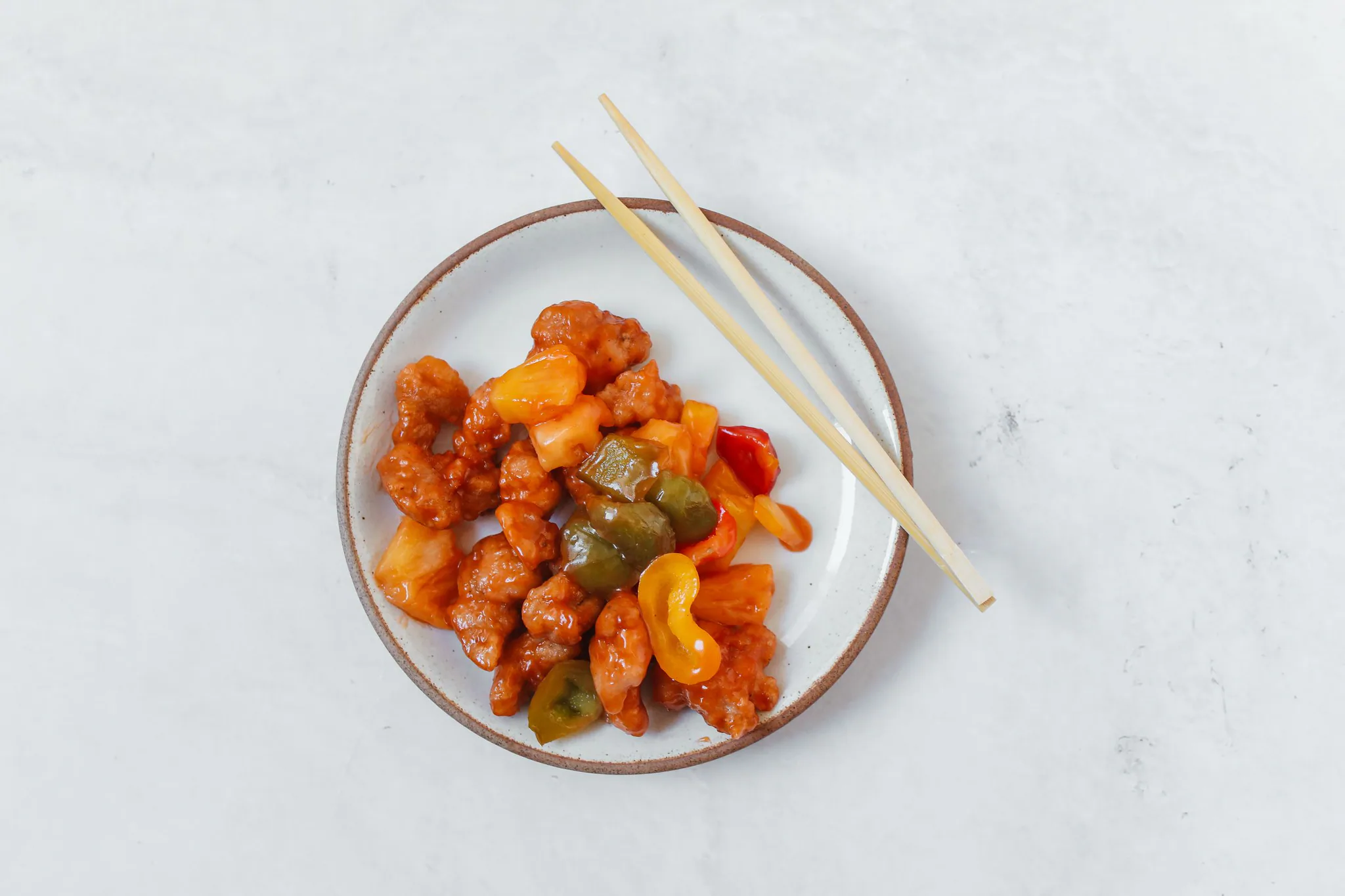
- Prep
- 30 min
- Cook
- 25 min
- Total
- 55 min
- Serves
- 4
- Level
- Intermediate
- Calories
- 576
Ingredients
Marinade
Coating
For frying
Stir-fry
Sauce
Method
Step 1
Toss the pork with the soy sauce (opens in a new tab), wine and salt and leave for 15 minutes. Stir in the beaten egg (opens in a new tab), then toss the pieces in the cornstarch (opens in a new tab) until thickly coated.
- 18 min
Food safety: Wash hands and boards after handling raw pork.
Step 2
Heat the oil in a wok (opens in a new tab) to 170 °C. Fry the pork in two batches for 4–5 minutes until golden and cooked through, then lift out onto a rack.
Food safety: Never fill the wok more than a third full of oil, keep children away and don't leave hot oil unattended.
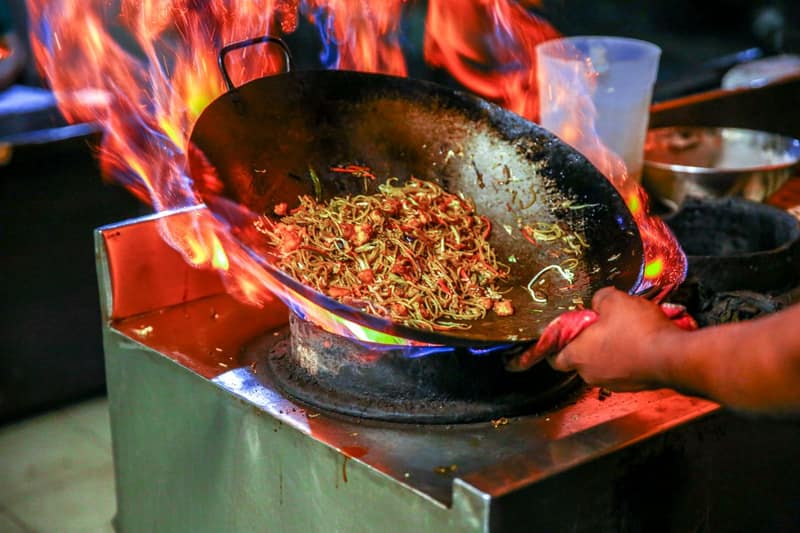
How it looks · Photo: Aesthos AR. Photography on Pexels Step 3
Raise the oil to 190 °C and fry all the pork again for 1–2 minutes until very crisp. Drain well.
- 3 min
- 190°C
The second fry is what keeps the coating crunchy once sauced.
Step 4
Pour off all but 1 tbsp oil. Stir-fry the onion (opens in a new tab) and peppers over high heat for 2 minutes, then add the pineapple (opens in a new tab).
- 3 min
- high heat
Step 5
Add the ketchup (opens in a new tab), vinegar, sugar (opens in a new tab) and water, bring to a boil and thicken with the cornstarch (opens in a new tab) slurry. Tip in the pork, toss quickly to coat and serve at once.
- 2 min
- high heat

How it looks · Photo: Willians Huerta on Pexels
About this dish
- Origin
- Guangdong, China · Commonly attributedA Cantonese dish; the ketchup-based sauce is a later adaptation that is now standard in Cantonese restaurants worldwide.Also popular in United Kingdom, United States, Australia, CanadaMore food from China
- Dish
- Dinner · Lunch · Main courses
- Cooking method
- Deep-fried, Stir-fried
- Taste
- sweet & sour, fruity, savoury
- Diet
- Dairy-free · No nut ingredients · High-proteinWith the listed swaps: Pork-freeWorked out from the ingredients. How labels work
All labels
Non-vegetarian · Dairy-free · No nut ingredients · Beef-free · High-protein - Good for
- Child-friendly
- Cook more with
- Pork shoulder · Pineapple · Rice vinegar · Soy sauce · Shaoxing wine · Egg
- Techniques
- Deep-frying · Stir-frying · Boiling
Allergens
- Contains: Eggsfrom egg
- Contains, can be adapted: Wheatfrom soy sauce, shaoxing wine
- Contains, can be adapted: Glutenfrom soy sauce, shaoxing wine
- Contains: Soyfrom soy sauce
- May contain: Mustardfrom tomato ketchup
- May contain: Celeryfrom tomato ketchup
Based on typical versions of these ingredients and not verified allergen-free. Brands differ and cross-contact happens, so always check labels. For severe allergies, follow your clinician’s advice.
Nutrition
576 kcal per serving
Estimated1 serving ≈ 359 g · recipe makes 4
Where the energy comes from
- Protein 16%
- Carbohydrate 30%
- Fat 54%
| Nutrient | Per serving | Per 100 g* |
|---|---|---|
| Energy | 576 kcal | 161 kcal |
| Protein | 22.6 g | 6.3 g |
| Carbohydrate | 43.4 g | 12.1 g |
| Net carbohydrate | 40.9 g | 11.4 g |
| Sugars | 20.7 g | 5.8 g |
| Added sugars | — | — |
| Fibre | 2.5 g | 0.7 g |
| Fat | 34.2 g | 9.5 g |
| Saturated fat | 8.4 g | 2.3 g |
| Trans fat | — | — |
| Cholesterol | 126 mg | 35 mg |
| Sodium | 776 mg | 216 mg |
| Salt equivalent | 1.9 g | 0.5 g |
Vitamins & minerals per serving
- Potassium
- 630 mg
- Calcium
- 49 mg
- Iron
- 2 mg
- Magnesium
- 43 mg
- Vitamin A (RAE)
- 81 µg
- Vitamin C
- 87 mg
- Vitamin D
- 2.2 µg
- Vitamin B12
- 0.9 µg
- Folate (DFE)
- 44 µg
How these numbers were made
- Calculated from USDA FoodData Central (SR Legacy) per-100 g values and the listed quantities.
- *Per 100 g of combined raw ingredients; the cooked dish may weigh more or less.
- Shaoxing wine: Sake (FDC 167723) used as a stand-in for Chinese rice cooking wine.
- Rice vinegar: Distilled vinegar (FDC 172237) used as a stand-in for unseasoned rice vinegar.
- “—” means the value isn’t known for enough of the ingredients; it is never zero by default.
- Values are estimates for guidance, not for medical dosing. U.S. Department of Agriculture, Agricultural Research Service. FoodData Central, 2019. fdc.nal.usda.gov.
Good to know
Tips
- Taste the sauce before adding the pork and balance the vinegar and sugar to your liking.
Common mistakes
- Letting the pork sit in the sauce — toss and serve immediately or the coating goes soft.
Serve with
- Serve with steamed jasmine rice and a plain green vegetable.
Storage
- Refrigerate for up to 2 days; the coating will soften.
Reheating
- Reheat in a hot oven or air fryer rather than the microwave to regain some crispness.
Variations
- Sweet and sour chicken: Use chicken thigh chunks and fry for slightly less time.
Original editorial recipe · FriendsPantry editorial · Not yet independently reviewed · Added · Updated
Sauces, chutneys & dips for this dish
Recipe DNA
How this dish is built
Built from the recipe’s own sections. Each band’s width is its share of the dish by weight. Choose a component to see what it does.
What the dish is built around
Main ingredient
- Pork shoulder, cut into 2.5 cm chunks450 g
Reviews & corrections
Reviews come from signed-in cooks and appear after a moderator checks them. We never show made-up ratings.
You might also like
Char siu (Cantonese barbecue pork)
 Cantonese · 1 h 10 min · 392 kcal
Beef and broccoli stir-fry
Cantonese · 30 min · 309 kcal
Beef chow fun
Cantonese · 30 min · 772 kcal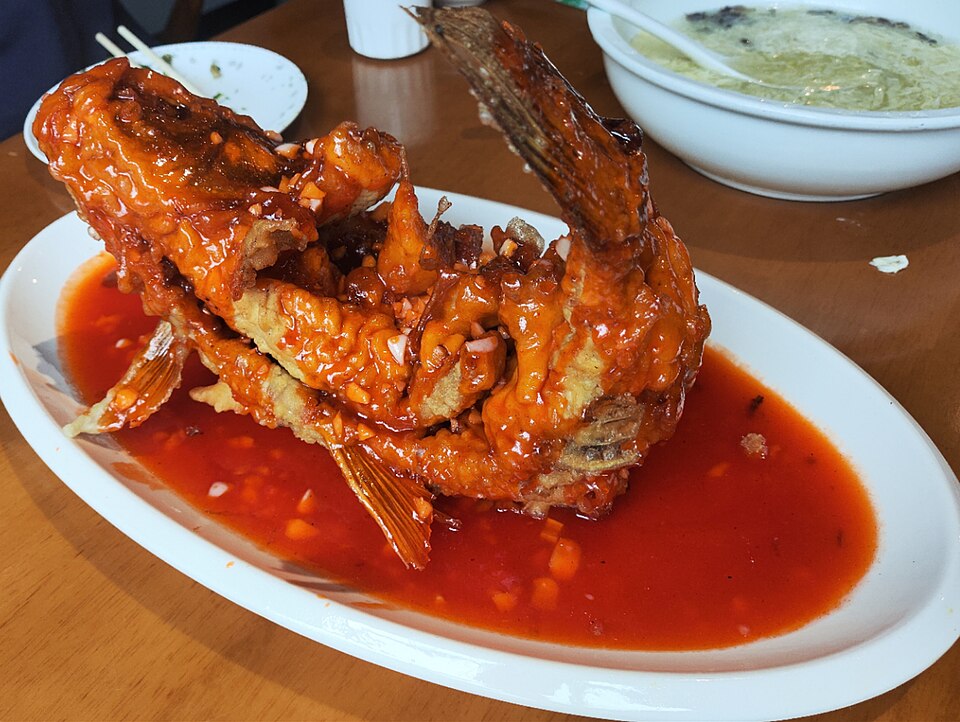
Shandong sweet and sour carp
Chinese · 45 min · 672 kcal