
Kongguksu (Korean cold soy milk noodles)
Vegetarian
콩국수 · kongguksu
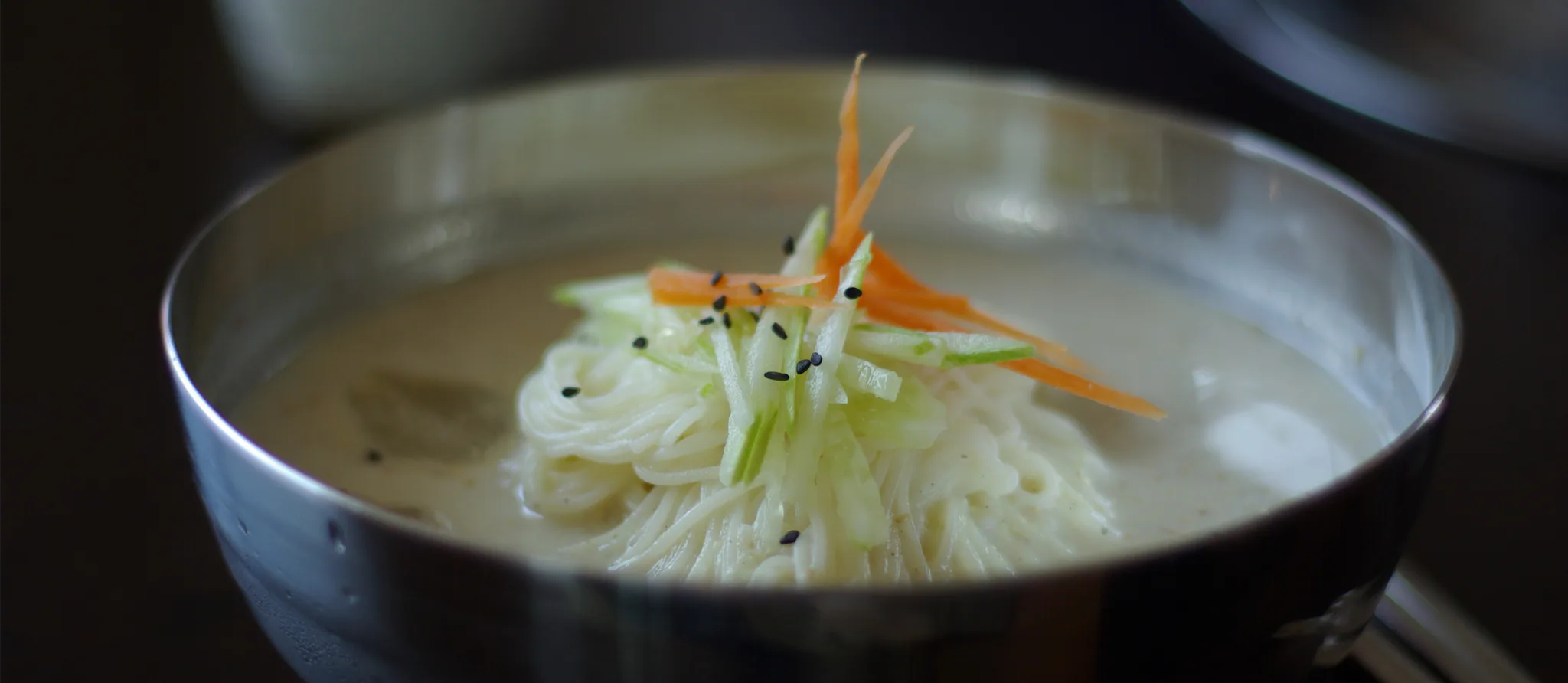
Thin wheat noodles served in an ice-cold, creamy broth of soybeans blended with toasted sesame, topped with cucumber and tomato. A simple, nourishing Korean summer dish.
Kongguksu (Korean cold soy milk noodles) is a Korean noodle dish from South Korea, ready in about 1 hour 40 minutes and made with dried soybeans (mature yellow soybeans) and udon noodles. It serves 4 and is rated easy to cook.
- Prep
- 20 min
- Cook
- 20 min
- Rest
- 1 h
- Total
- 1 h 40 min
- Serves
- 4
- Level
- Easy
- Calories
- 570
Plus 8–12 hours soaking the soybeans.
Main ingredients
Ingredients
For the soy milk broth
For the noodles
To serve
Method
Soy milk broth
27 minStep 1
Drain the soaked soybeans (opens in a new tab) and rub them between your hands under water to loosen the skins; skim off and discard as many skins as you can for a smoother, whiter broth.
- 10 min
Step 2
Boil the beans in the water for 10–12 minutes, uncovered, until they no longer taste raw or beany but are still slightly firm. Drain and rinse in cold water.
- 12 min
- medium-high heat
- Saucepan (opens in a new tab)
Under-cooked beans taste grassy; over-cooked beans taste like soft tofu. Taste one at 10 minutes.
Step 3
Blend the beans with the sesame seeds (opens in a new tab), pine nuts (opens in a new tab) and cold water until completely smooth. For a silkier broth, pass it through a sieve. Stir in the salt and chill for at least 1 hour.
Noodles
8 minStep 4
Cook the noodles in plenty of boiling water according to the packet (usually 3–4 minutes). Drain and rinse thoroughly under cold running water, rubbing them to remove the starch.
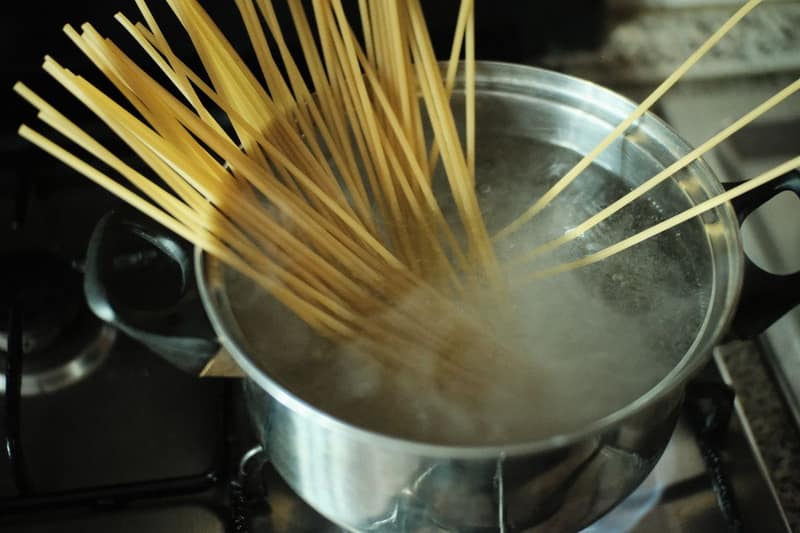
How it looks · Photo: Gianpiero Ferraro on Pexels
To serve
3 minStep 5
Divide the noodles between bowls, pour over the cold soy milk broth and top with cucumber (opens in a new tab), tomato (opens in a new tab) and a few ice cubes. Season at the table with salt, or sugar (opens in a new tab) if you like.
- 3 min
At a glance
1 · Soy milk broth in a pot
- Dried soybeans (mature yellow soybeans)
 Sesame seeds
 Pine nuts
 Salt
then cook
2 · Noodles in a pot
 Udon noodles
then divide
3 · To serve in a bowl
 Cucumber
 Tomato
 Sugar
About this dish
- Origin
- South Korea · Well documentedA summer staple across Korea; in the Jeolla provinces it is often sweetened with sugar, elsewhere only salted.Also popular in North KoreaMore food from South Korea
South Korea - Dish
- Lunch · Dinner · Noodles · Cold soups
- Cooking method
- Boiled, Blended
- Taste
- nutty, creamy, mild, refreshing
- Diet
- Vegan · Dairy-free · High-proteinWithout the optional extras: No nut ingredients, No added sugarWith the listed swaps: Whole-food focusedWorked out from the ingredients. How labels work
All labels
Vegan · Plant-based · Vegetarian (lacto-ovo) · Eggetarian · Lacto-vegetarian · Ovo-vegetarian · Pescatarian · Flexitarian-friendly · Dairy-free · Egg-free · Alcohol-free · Pork-free · Beef-free · High-protein · Low-fat - Good for
- Make-ahead · Budget-friendly
- Cook more with
- Udon noodles · Sesame seeds · Cucumber · Tomato
- Techniques
- Boiling · Wet grinding · Emulsification
Allergens
- Contains, can be adapted: Tree nutsfrom pine nuts
- Contains: Wheatfrom udon noodles
- Contains: Glutenfrom udon noodles
- Contains: Soyfrom dried soybeans (mature yellow soybeans)
- Contains: Sesamefrom sesame seeds
Based on typical versions of these ingredients and not verified allergen-free. Brands differ and cross-contact happens, so always check labels. For severe allergies, follow your clinician’s advice.
Nutrition
570 kcal per serving
Estimated1 serving ≈ 486 g · recipe makes 4
Where the energy comes from
- Protein 21%
- Carbohydrate 60%
- Fat 19%
| Nutrient | Per serving | Per 100 g* |
|---|---|---|
| Energy | 570 kcal | 117 kcal |
| Protein | 31.1 g | 6.4 g |
| Carbohydrate | 87.4 g | 18 g |
| Net carbohydrate | 75.8 g | 15.6 g |
| Sugars | — | — |
| Added sugars | 0 g | 0 g |
| Fibre | 11.6 g | 2.4 g |
| Fat | 12.2 g | 2.5 g |
| Saturated fat | 1.8 g | 0.4 g |
| Trans fat | — | — |
| Cholesterol | 0 mg | 0 mg |
| Sodium | 2668 mg | 549 mg |
| Salt equivalent | 6.7 g | 1.4 g |
Vitamins & minerals per serving
- Potassium
- 882 mg
- Calcium
- 207 mg
- Iron
- 7.4 mg
- Magnesium
- 147 mg
- Vitamin A (RAE)
- 16 µg
- Vitamin C
- 8 mg
- Vitamin D
- 0 µg
- Vitamin B12
- 0 µg
- Folate (DFE)
- 82 µg
How these numbers were made
- Calculated from USDA FoodData Central (SR Legacy) per-100 g values and the listed quantities.
- *Per 100 g of combined raw ingredients; the cooked dish may weigh more or less.
- Optional ingredients are not included: pine nuts, ice, sugar.
- Dried soybeans (mature yellow soybeans): Boiled mature soybeans (FDC 174299) scaled by 2 as a stand-in for dry beans: soybeans roughly double to two-and-a-half times their weight when soaked and cooked.
- Udon noodles: Dry somen (FDC 168908) used as a stand-in; both are plain Japanese wheat noodles.
- “—” means the value isn’t known for enough of the ingredients; it is never zero by default.
- Values are estimates for guidance, not for medical dosing. U.S. Department of Agriculture, Agricultural Research Service. FoodData Central, 2019. fdc.nal.usda.gov.
Good to know
Tips
- Unsweetened store-bought soy milk blended with a spoon of tahini or sesame makes a quick weekday version.
- The broth keeps well, so make a double batch and chill it.
Common mistakes
- Not rinsing the noodles well, which makes the broth gluey.
Serve with
- Serve with baechu kimchi or radish kimchi to cut the richness.
Storage
- The broth keeps 2 days refrigerated; cook the noodles just before serving.
Variations
- Jeolla-style kongguksu: Seasoned with sugar instead of, or as well as, salt.
- Black bean kongguksu: Made with black soybeans (seoritae) for a grey, nuttier broth.
Original editorial recipe · FriendsPantry editorial · source: TasteAtlas (dish facts) · Not yet independently reviewed · Added
Recipe DNA
How this dish is built
Built from the recipe’s own sections. Each band’s width is its share of the dish by weight. Choose a component to see what it does.
The liquid foundation
For the soy milk broth
- Dried soybeans (mature yellow soybeans), soaked in cold water for 8–12 hours200 g
- Water1.5 l · 0 g
- Sesame seeds, toasted2 tbsp · 18 g
- Pine nuts (optional)20 g
- Water900 ml · 900 g
- Salt1 tsp · 6 g
Reviews & corrections
Reviews come from signed-in cooks and appear after a moderator checks them. We never show made-up ratings.
You might also like
Baechu kimchi (napa cabbage kimchi)
 Korean · 7 h 5 min · 44 kcal
Kongnamul-guk
Korean · 30 min · 102 kcal · Vegan
Bibim guksu
Korean · 15 min · 527 kcal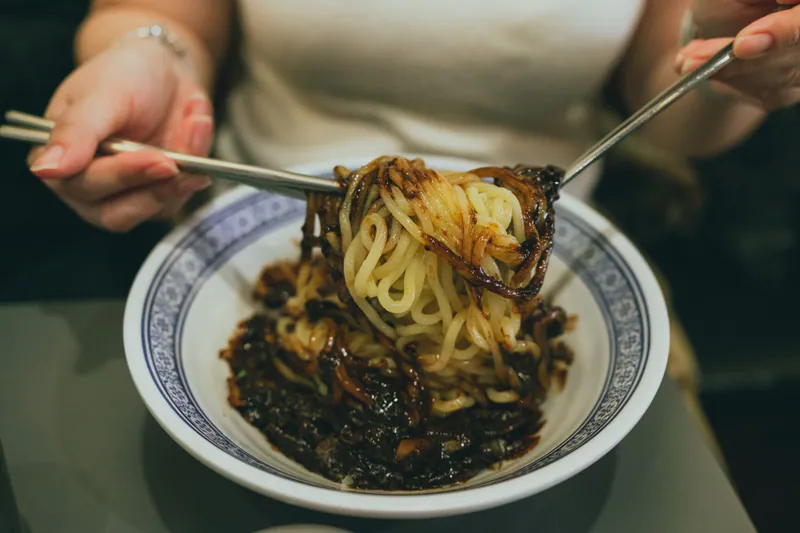
Jjajangmyeon (Korean black bean noodles)
Korean · 40 min · 807 kcal