
Galatopita (Greek milk pie)
Contains egg (no meat or fish)
Γαλατόπιτα · galatópita
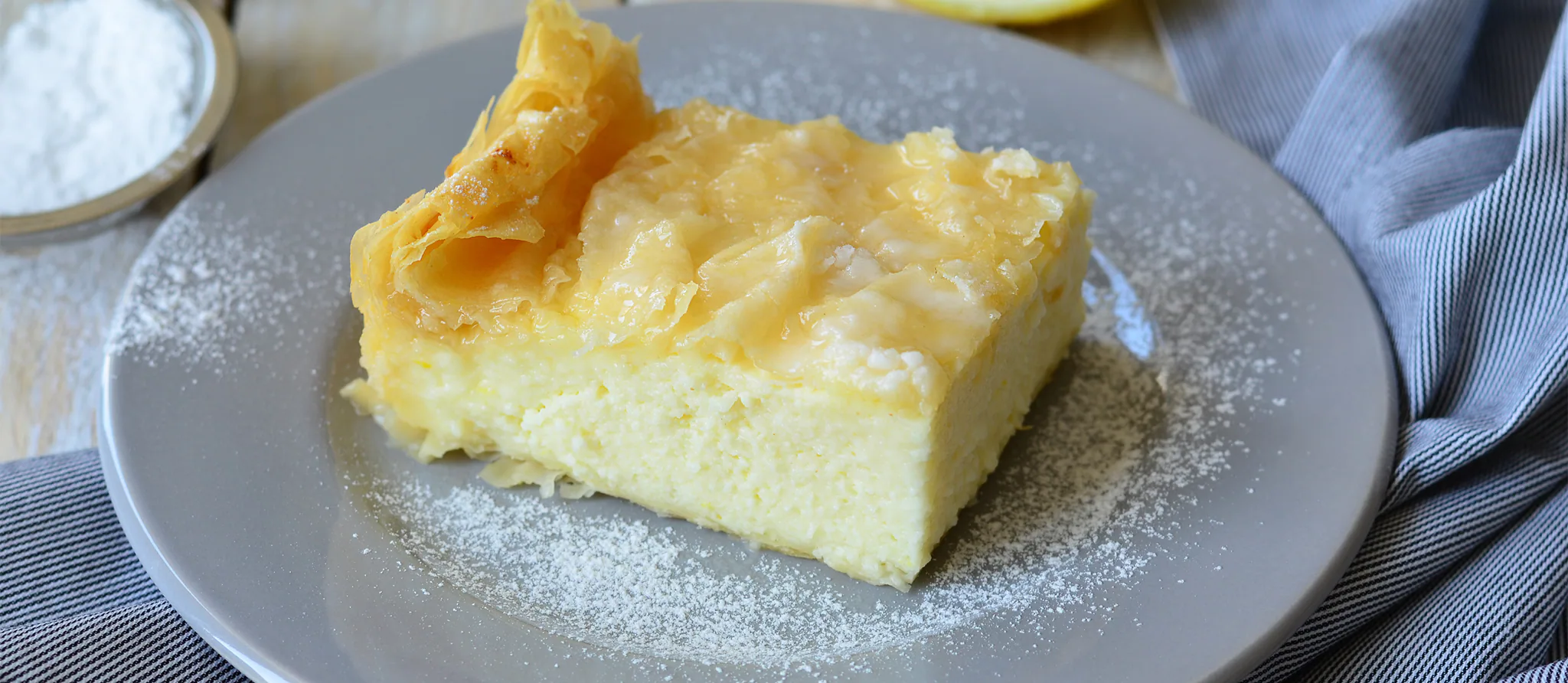
A simple, comforting Greek pie of semolina custard flavoured with vanilla and citrus zest, baked until set with a caramelised top. Often made without pastry — the custard forms its own golden skin.
Galatopita (Greek milk pie) is a Greek dessert from Greece, ready in about 2 hours 15 minutes and made with milk, semolina and egg. It serves 8 and is rated easy to cook.
- Prep
- 15 min
- Cook
- 1 h
- Rest
- 1 h
- Total
- 2 h 15 min
- Serves
- 8
- Level
- Easy
- Calories
- 325
Main ingredients
Ingredients
To finish
Method
Step 1
Heat the oven (opens in a new tab) to 180 °C and butter (opens in a new tab) a 25 cm round or 20 × 30 cm baking dish (opens in a new tab).
Step 2
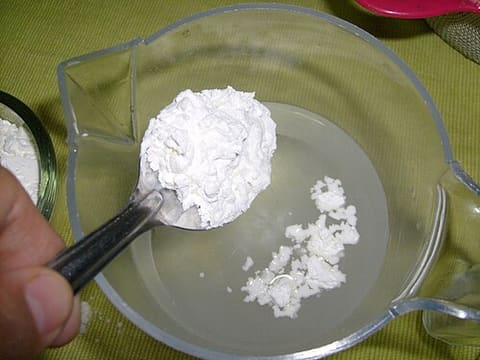
Heat the milk (opens in a new tab) with half the sugar (opens in a new tab), the citrus zests and salt until steaming. Whisk (opens in a new tab) the semolina (opens in a new tab) and cornstarch (opens in a new tab) together and rain them in, whisking constantly, then cook gently, stirring, until thick like a loose porridge, 5–6 minutes. Take off the heat and stir in the butter (opens in a new tab) and vanilla (opens in a new tab).
- 10 min
- medium-low heat
- Saucepan (opens in a new tab)
- Whisk (opens in a new tab)
How it looks · Photo: Kampus Production on Pexels Step 3
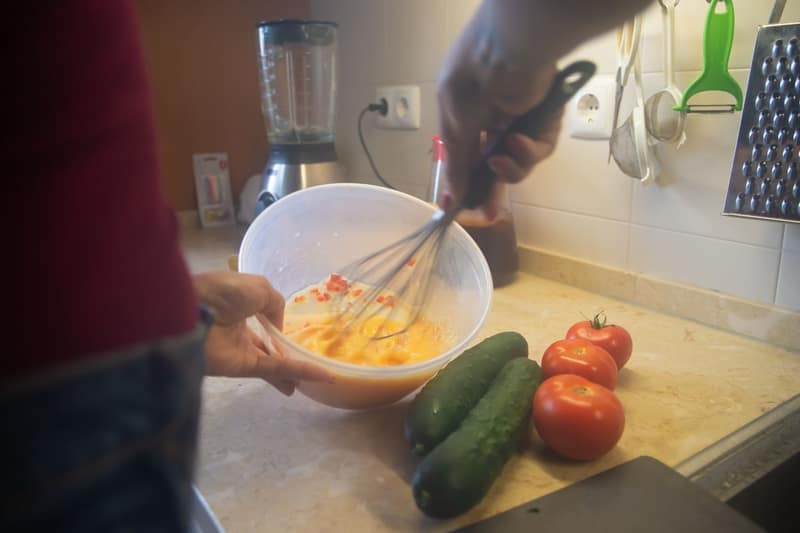
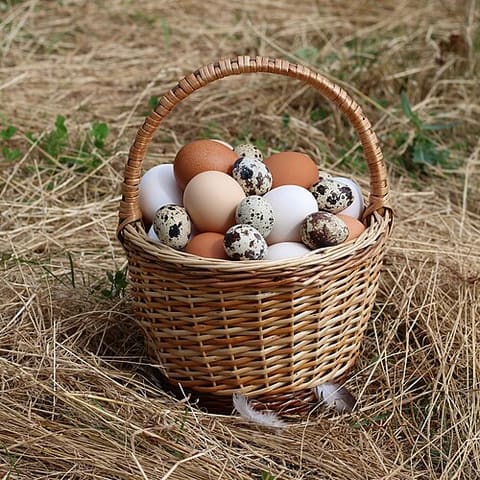
Whisk (opens in a new tab) the eggs (opens in a new tab) with the remaining sugar (opens in a new tab) until pale and foamy. Let the semolina (opens in a new tab) cream cool for 5 minutes, then whisk in the eggs a little at a time.
Step 4
Pour into the dish and bake for 45–50 minutes until puffed, set with only a slight wobble in the middle, and golden brown on top.
- 50 min
- 180°C
- Oven (opens in a new tab)
Step 5
Cool for at least 1 hour (it sinks a little as it cools). Dust with cinnamon (opens in a new tab) and icing sugar (opens in a new tab) before cutting into squares or wedges.
- 2 min
At a glance
 Milk
 Semolina
 Cornstarch
 Sugar
 Egg
 Butter
 Vanilla extract
 Lemon zest
 Orange zest
 Salt
 Cinnamon
 Icing sugar
About this dish
- Origin
- Thessaly, Epirus and the islands, Greece · Commonly attributedA village dessert made with plenty of fresh milk; versions with a phyllo base are common in Epirus and Thessaly.More food from Greece
Greece - Dish
- Dessert · Snack · Breakfast · Desserts · Pastries
- Cooking method
- Oven-baked, Simmered
- Taste
- sweet, creamy, citrusy, buttery
- Diet
- Vegetarian (lacto-ovo) · No nut ingredientsWorked out from the ingredients. How labels work
All labels
Vegetarian (lacto-ovo) · Eggetarian · Pescatarian · Flexitarian-friendly · No nut ingredients · Pork-free · Beef-free · Low-sodium - Good for
- Make-ahead · Budget-friendly · Child-friendly
Allergens
- Contains: Milkfrom milk, butter
- Contains: Eggsfrom egg
- Contains: Wheatfrom semolina
- Contains: Glutenfrom semolina
Based on typical versions of these ingredients and not verified allergen-free. Brands differ and cross-contact happens, so always check labels. For severe allergies, follow your clinician’s advice.
Nutrition
325 kcal per serving
Calculated1 serving ≈ 204 g · recipe makes 8
Where the energy comes from
- Protein 11%
- Carbohydrate 53%
- Fat 35%
| Nutrient | Per serving | Per 100 g* |
|---|---|---|
| Energy | 325 kcal | 160 kcal |
| Protein | 9.3 g | 4.6 g |
| Carbohydrate | 43.1 g | 21.2 g |
| Net carbohydrate | 42.4 g | 20.8 g |
| Sugars | — | — |
| Added sugars | 22.5 g | 11.1 g |
| Fibre | 0.7 g | 0.3 g |
| Fat | 12.8 g | 6.3 g |
| Saturated fat | 7.1 g | 3.5 g |
| Trans fat | — | — |
| Cholesterol | 122 mg | 60 mg |
| Sodium | 159 mg | 78 mg |
| Salt equivalent | 0.4 g | 0.2 g |
Vitamins & minerals per serving
- Potassium
- 239 mg
- Calcium
- 165 mg
- Iron
- 1.2 mg
- Magnesium
- 24 mg
- Vitamin A (RAE)
- 151 µg
- Vitamin C
- 1 mg
- Vitamin D
- 2.2 µg
- Vitamin B12
- 0.8 µg
- Folate (DFE)
- 61 µg
How these numbers were made
- Calculated from USDA FoodData Central (SR Legacy) per-100 g values and the listed quantities.
- *Per 100 g of combined raw ingredients; the cooked dish may weigh more or less.
- Optional ingredients are not included: cinnamon, icing sugar.
- “—” means the value isn’t known for enough of the ingredients; it is never zero by default.
- Values are estimates for guidance, not for medical dosing. U.S. Department of Agriculture, Agricultural Research Service. FoodData Central, 2019. fdc.nal.usda.gov.
Good to know
Tips
- Galatopita slices most neatly when fully cold, but many Greeks prefer it just warm.
Common mistakes
- Adding the eggs to boiling-hot semolina, which scrambles them.
Serve with
- Serve at room temperature with Greek coffee, or chilled on a hot afternoon.
Food safety
- Milk-and-egg desserts should be refrigerated within 2 hours of baking.
Storage
- Keeps 3–4 days covered in the fridge.
Variations
- Galatopita with phyllo: The custard is baked on a base of buttered phyllo sheets, with a few crumpled sheets on top.
- Galaktoboureko: Its syrup-soaked cousin: a similar semolina custard sealed in phyllo and drenched in lemon syrup after baking.
Original editorial recipe · FriendsPantry editorial · source: TasteAtlas (dish facts) · Not yet independently reviewed · Added
Recipe DNA
How this dish is built
Built from the recipe’s own sections. Each band’s width is its share of the dish by weight. Choose a component to see what it does.
What the dish is built around
Main ingredient
- Milk1 l · 1030 g
- Semolina, fine semolina130 g
- Egg4 piece · 200 g
- Butter60 g
- Lemon zest1 tsp · 2 g
- Orange zest1 tsp · 2 g
Reviews & corrections
Reviews come from signed-in cooks and appear after a moderator checks them. We never show made-up ratings.
You might also like
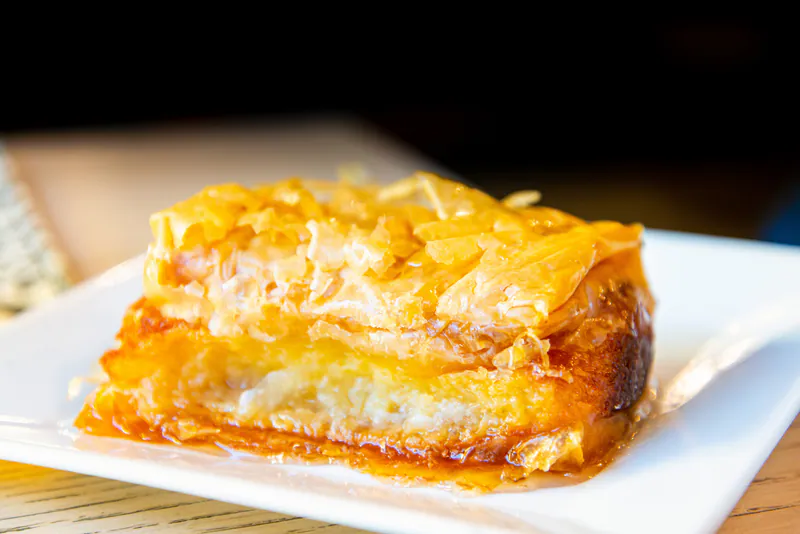
Galaktoboureko
 Greek · 3 h 30 min · 421 kcal · Contains egg
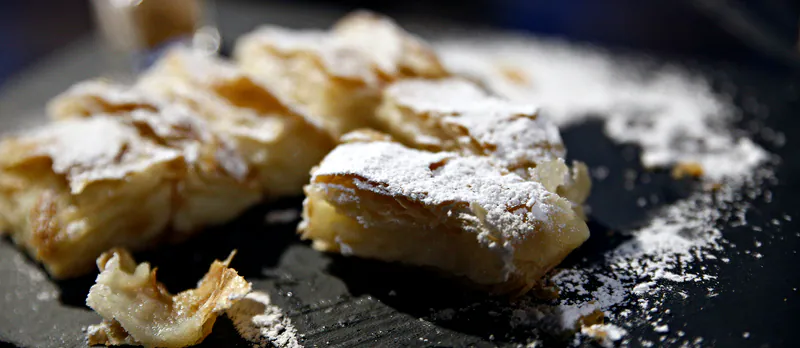
Bougatsa (semolina custard filo pie)
Greek · 1 h 45 min · 334 kcal · Contains egg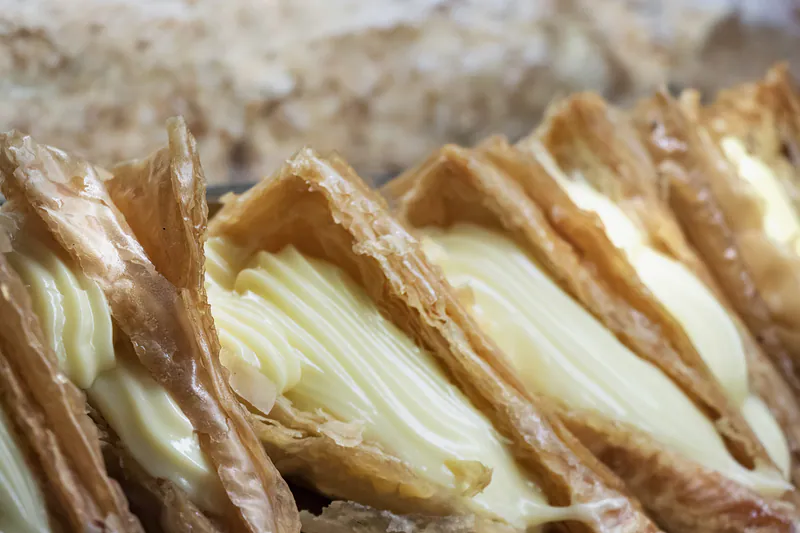
Trigona Panoramatos (custard-filled phyllo cones)
Greek · 4 h 25 min · 388 kcal · Contains egg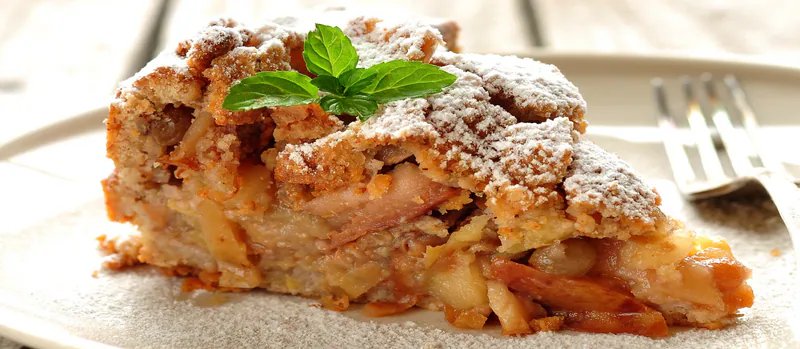
Milopita (Greek apple cake)
Greek · 1 h 35 min · 311 kcal · Contains egg