
Confit de canard (duck confit)
Non-vegetarian
Confit de canard
Duck legs cured overnight with salt, garlic, thyme and bay, then cooked very slowly submerged in duck fat until meltingly tender and finished in a hot pan for crackling-crisp skin. Once a way to preserve meat through winter, it is now one of the great dishes of south-west France.
Confit de canard (duck confit) is a French main course from France, ready in about 15 hours 50 minutes and made with duck (pieces), thyme (fresh) and duck fat. It serves 4 and is rated intermediate to cook.
- Prep
- 20 min
- Cook
- 3 h 30 min
- Rest
- 12 h
- Total
- 15 h 50 min
- Serves
- 4
- Level
- Intermediate
- Calories
- 349
Main ingredients
Method
Cure
15 minStep 1
Mix the salt, crushed peppercorns (opens in a new tab), sliced garlic (opens in a new tab), thyme (opens in a new tab) leaves and bay. Rub all over the duck legs (opens in a new tab), put them skin-side down in a dish, cover and refrigerate for 12–24 hours.
Do not cure longer than 24 hours or the meat becomes too salty.
Step 2
Heat the oven (opens in a new tab) to 120 °C. Rinse the cure off the legs under cold water and pat them completely dry.
- 5 min
- 120°C
Cooking
3 h 30 minStep 3
Melt the duck fat (opens in a new tab) in a heavy casserole just large enough to hold the legs snugly. Add the legs, unpeeled garlic (opens in a new tab) and thyme (opens in a new tab) sprigs; the legs should be fully submerged. Bring to a bare simmer on the hob, then cover and transfer to the oven (opens in a new tab).
- 10 min
- low heat
- Dutch oven / casserole pot (opens in a new tab)
Step 4
Cook for 2½–3 hours, until the meat is very tender and a skewer slides into the thigh with no resistance. The fat should barely bubble.
- 180 min
- 120°C
- Oven (opens in a new tab)
Food safety: Cook chicken and duck until the thickest part reaches 74 °C (165 °F).
Step 5
To store, put the legs in a clean jar or dish, strain the fat over them so they are completely covered and refrigerate once cool. Otherwise, lift them out to crisp straight away.

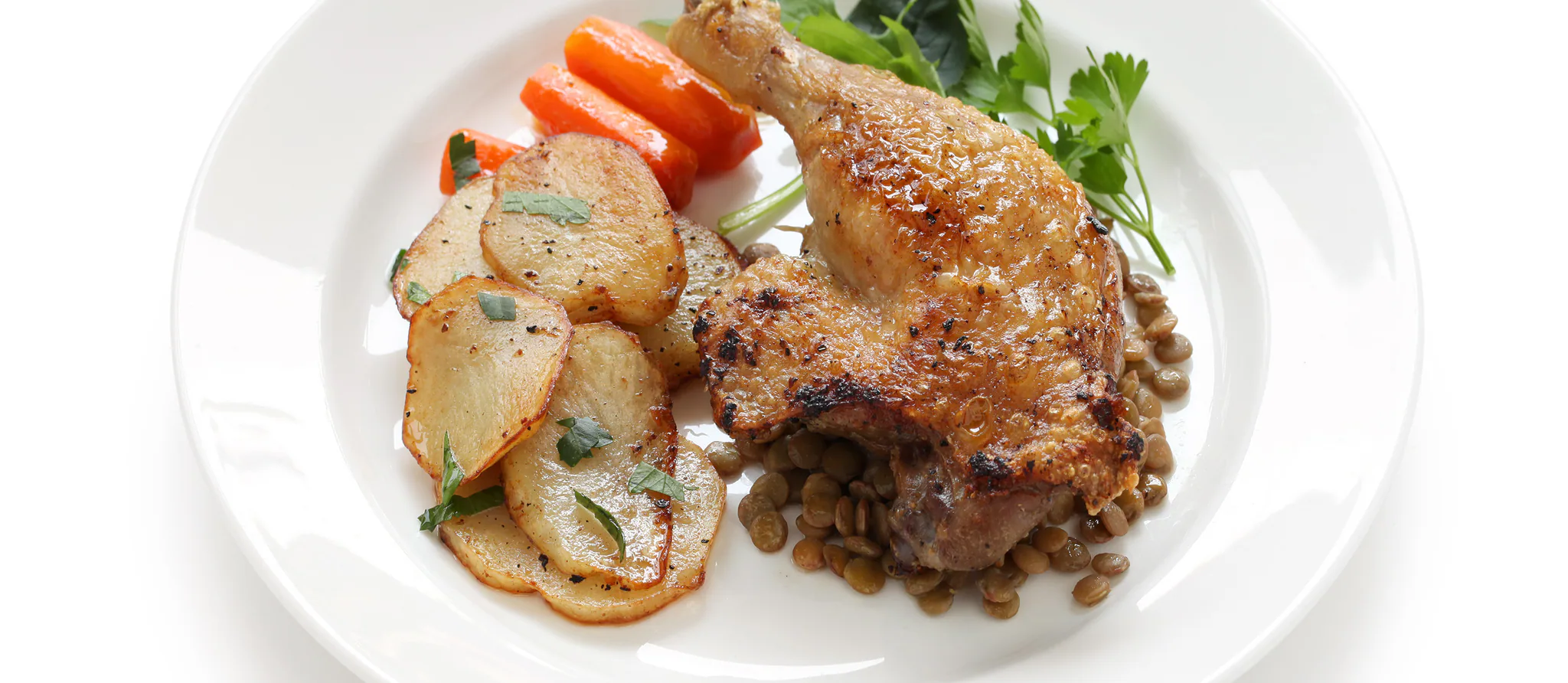
How it looks · Photo: Katerina Holmes on Pexels Step 6
To serve, scrape off most of the fat and put the legs skin-side down in a cold heavy pan. Heat gently to medium and cook for 10–12 minutes, without moving them, until the skin is deep golden and crisp, then turn and warm the other side for 3 minutes.
- 15 min
- medium heat
- Cast-iron skillet (opens in a new tab)
- Tongs (opens in a new tab)
Alternatively roast skin-side up at 220 °C for 15–20 minutes.
At a glance
1 · Cure in a bowl
 Duck (pieces)
 Salt
 Black peppercorns
 Garlic
 Thyme (fresh)
 Bay leaves
then melt
2 · Cooking in a pan
- Duck fat
- Garlic
- Thyme (fresh)
About this dish
- Origin
- Gascony and the South-West (Occitanie, formerly Midi-Pyrénées), France · Well documentedA traditional preserving method in the duck- and goose-rearing farms of Gascony, the Landes and the Périgord, where legs were cooked in their own fat and stored under it in crocks for months.More food from France
France - Dish
- Lunch · Dinner · Main courses
- Cooking method
- Marinated / cured, Slow-cooked, Pan-fried
- Taste
- rich, savoury, herby, salty
- Diet
- No gluten ingredients · Dairy-free · No nut ingredients · Low-carb · High-proteinWorked out from the ingredients. How labels work
All labels
Non-vegetarian · Whole-food focused · Paleo-style · No gluten ingredients · Dairy-free · Egg-free · No nut ingredients · No added sugar · Alcohol-free · Pork-free · Beef-free · Low-carb · High-protein · Calorie-conscious - Good for
- Make-ahead · Festive & celebration
- Cook more with
- Duck (pieces) · Thyme (fresh) · Duck fat · Black peppercorns · Garlic · Bay leaves
- Techniques
- Pan-frying · Simmering · Marinating · Curing
Allergens
None of the 14 major allergens appear in the listed ingredients.
Based on typical versions of these ingredients and not verified allergen-free. Brands differ and cross-contact happens, so always check labels. For severe allergies, follow your clinician’s advice.
Nutrition
349 kcal per serving
Estimated1 serving ≈ 201 g · recipe makes 4
Where the energy comes from
- Protein 39%
- Carbohydrate 6%
- Fat 55%
| Nutrient | Per serving | Per 100 g* |
|---|---|---|
| Energy | 349 kcal | 173 kcal |
| Protein | 33.6 g | 16.7 g |
| Carbohydrate | 5.2 g | 2.6 g |
| Net carbohydrate | 4.7 g | 2.3 g |
| Sugars | 0.1 g | 0 g |
| Added sugars | 0 g | 0 g |
| Fibre | 0.5 g | 0.3 g |
| Fat | 20.8 g | 10.3 g |
| Saturated fat | 8.1 g | 4 g |
| Trans fat | — | — |
| Cholesterol | 148 mg | 74 mg |
| Sodium | 716 mg | 356 mg |
| Salt equivalent | 1.8 g | 0.9 g |
Vitamins & minerals per serving
- Potassium
- 537 mg
- Calcium
- 44 mg
- Iron
- 4.8 mg
- Magnesium
- 39 mg
- Vitamin A (RAE)
- 46 µg
- Vitamin C
- 15 mg
- Vitamin D
- 0.4 µg
- Vitamin B12
- 0.7 µg
- Folate (DFE)
- 46 µg
How these numbers were made
- Calculated from USDA FoodData Central (SR Legacy) per-100 g values and the listed quantities.
- *Per 100 g of combined raw ingredients; the cooked dish may weigh more or less.
- Duck fat: Lard used as a stand-in; rendered duck fat is likewise almost pure fat, with somewhat more monounsaturated and less saturated fat.
- “—” means the value isn’t known for enough of the ingredients; it is never zero by default.
- Values are estimates for guidance, not for medical dosing. U.S. Department of Agriculture, Agricultural Research Service. FoodData Central, 2019. fdc.nal.usda.gov.
Good to know
Tips
- Strain the leftover fat and keep it refrigerated; it is excellent for roasting potatoes and can be used for the next batch.
- Confit improves after a week or more in the fridge under its fat.
Common mistakes
- Cooking the fat at a rolling boil, which fries the duck and makes it stringy.
- Moving the legs while crisping the skin, which tears it.
Serve with
- Serve with pommes sarladaises (potatoes sautéed in duck fat with garlic and parsley) and a green salad dressed with walnut oil.
- Shred into cassoulet or onto a salade landaise with gizzards and pine nuts.
Food safety
- Cook chicken and duck until the thickest part reaches 74 °C (165 °F).
- Home-made confit is not shelf-stable: always keep it refrigerated and make sure the meat is completely covered by fat with no air pockets.
Storage
- Fully submerged in fat in a sealed container, confit keeps up to 1 month refrigerated; once removed from the fat, eat within 3 days.
Reheating
- Crisp in a pan or hot oven as in the last step until piping hot.
Variations
- Confit d'oie: Goose legs and wings confited the same way; traditional in the Landes and Périgord.
- Gésiers confits: Duck gizzards cooked slowly in fat and served warm in salads.
- Quick oven confit: Legs are roasted slowly in a snug dish in their own rendered fat with a little added duck fat.
Original editorial recipe · FriendsPantry editorial · source: TasteAtlas (dish facts) · Not yet independently reviewed · Added
Recipe DNA
How this dish is built
Built from the recipe’s own sections. Each band’s width is its share of the dish by weight. Choose a component to see what it does.
For cooking
- Duck fat1000 g
- Garlic, unpeeled, lightly crushed4 clove · 16 g
- Thyme (fresh)2 sprig · 1 g
Reviews & corrections
Reviews come from signed-in cooks and appear after a moderator checks them. We never show made-up ratings.
You might also like
Cassoulet
 French · 2 h 55 min · 975 kcal
Simple Green Salad with Mustard Vinaigrette
International · 10 min · 110 kcal · Vegetarian
Salade lyonnaise
French · 35 min · 377 kcal
Ratatouille
French · 1 h 20 min · 276 kcal · Vegan