Heat and cooking · beginner
How heat moves into food
Heat reaches food by conduction, convection and radiation, and how fast it arrives decides whether the outside overcooks before the inside is done.
What happens
Conduction is heat passing by direct contact: from burner to pan, pan to food, and from the hot surface of a food towards its cooler centre. Convection is heat carried by a moving fluid such as boiling water, frying oil, steam or oven air. Radiation is energy that travels as infrared light from glowing coals, a grill element or the walls of a hot oven or tandoor, and it browns the surface it hits. Every cooking method is a mix of the three. Inside food, heat can only travel by slow conduction, which is why a thick piece takes much longer than a thin one: doubling the thickness roughly quadruples the time for the centre to come up to temperature. Water-based liquids can't get hotter than their boiling point (100 °C at sea level), while oil and dry air can go far higher.
Why it matters in the kitchen
Choosing the method, the pan and the heat level is really choosing how fast heat arrives at the surface compared with how fast it can travel to the centre. That balance decides between a browned crust with a juicy middle and a burnt outside with a raw inside.
Temperatures and conditions
- Water boils (sea level) 100–100 °C · Lower at altitude, roughly 1 °C less per 300 m of height.
- Steam in a pressure cooker 115–121 °C · About 1 bar above atmospheric pressure raises the boiling point to around 120 °C.
- Deep-frying oil 160–190 °C
- Water droplets skate on a dry pan (Leidenfrost effect) 180–220 °C · A steam cushion forms under the drop; the exact onset depends on the metal and its surface.
- Home oven range 120–260 °C
- Tandoor wall and air 300–480 °C · Figures vary widely with fuel and how long the tandoor has been fired.
In practice
- Boiling potatoes: convection from the water, then slow conduction into the centre.
- Searing a steak: conduction from the pan dominates, so full contact and a hot, heavy pan matter.
- Naan in a tandoor: conduction from the clay wall underneath and intense radiation and hot air on top.
- Steaming idli: condensing steam releases a lot of energy as it turns back into water on the batter's surface.
Myths and facts
Myth: A 200 °C oven is far more dangerous to touch than a pot of boiling water.
Fact: Air carries heat poorly, so you can reach into a 200 °C oven briefly without harm, but a second in 100 °C water scalds. The medium matters as much as the temperature.
Myth: Cast iron heats evenly.
Fact: Cast iron conducts heat poorly and develops hot spots over a burner. Its strength is that it holds a lot of heat once it is fully preheated, so it doesn't cool sharply when food goes in.
Myth: Turning the flame higher makes the water boil hotter, so food cooks faster.
Fact: Once water is boiling it stays at its boiling point; more flame only makes it evaporate faster. A pressure cooker is the way to cook food in water above 100 °C.
Myth: Steam is gentler than boiling water.
Fact: Steam at 100 °C releases a large amount of extra energy (latent heat) as it condenses on food or skin, so it cooks fast and burns badly.
Use it to cook better
- Preheat heavy pans (cast iron, tawa) thoroughly, for several minutes, so they hold enough stored heat to sear.
- Cut ingredients to an even size so they finish at the same time.
- For thick cuts, start hot to brown and then lower the heat or move to the oven so the centre catches up without the outside burning.
- Don't crowd a pan or a fryer: cold food drops the temperature and moisture turns frying into steaming.
- At altitude, allow longer for boiled foods like rice, dal and pasta, or use a pressure cooker.
Try it at home
Water versus air
You need: 2 small potatoes of the same size, A pot of boiling water, An oven heated to 200 °C, A knife or skewer
- Put one potato in the boiling water and the other, whole, in the oven at the same moment.
- After 20 minutes, test both with a skewer.
- Keep testing every 10 minutes and note when each is tender to the centre.
What you’ll see: The boiled potato is cooked long before the baked one, even though the oven is twice as hot, because water transfers heat far better than air.
Use a slotted spoon and oven gloves; lift the lid away from your face to avoid steam.
Going deeper
Copper and aluminium conduct heat many times better than stainless steel or cast iron, which is why good stainless pans have an aluminium or copper core or base. Heat capacity is a separate property: a thick cast-iron or steel pan stores more energy and recovers its temperature better when cold food is added. Inside food, the time for heat to reach the centre scales roughly with the square of the thickness, which is why a 4 cm steak needs far more than twice the time of a 2 cm one. Carry-over cooking happens because the hotter outer layers keep conducting heat inward after the food leaves the heat.
Ingredients it affects most
Techniques that rely on it
Worth double-checking
- Tandoor temperatures are reported anywhere from about 300 °C to over 450 °C; treat the marker as approximate.
- The Leidenfrost onset for water on steel is commonly quoted around 190–200 °C but varies with the surface.
 Punjabi · 40 min · 167 kcal ·
 Cantonese · 1 h 10 min · 392 kcal
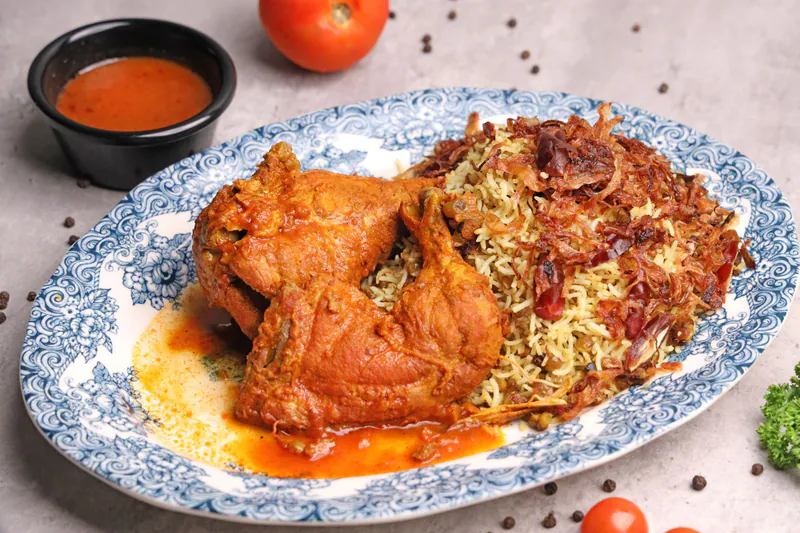
 Saudi Arabian · 1 h 45 min · 667 kcal
 Nepalese · 22 min · 59 kcal ·
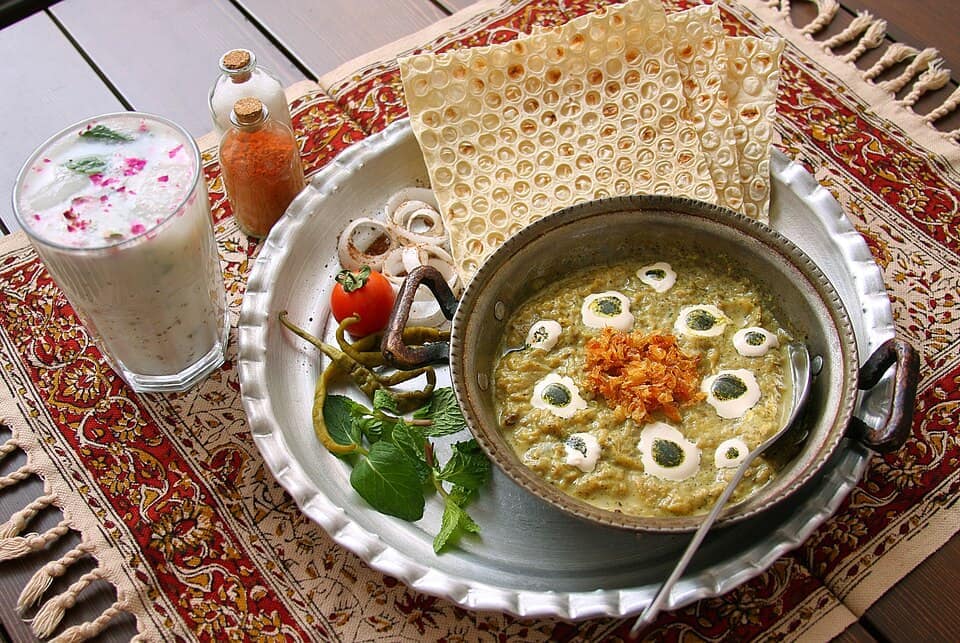
 Iranian · 1 h · 224 kcal ·