
Magret de canard (seared duck breast with cherry sauce)
Non-vegetarian
Magret de canard
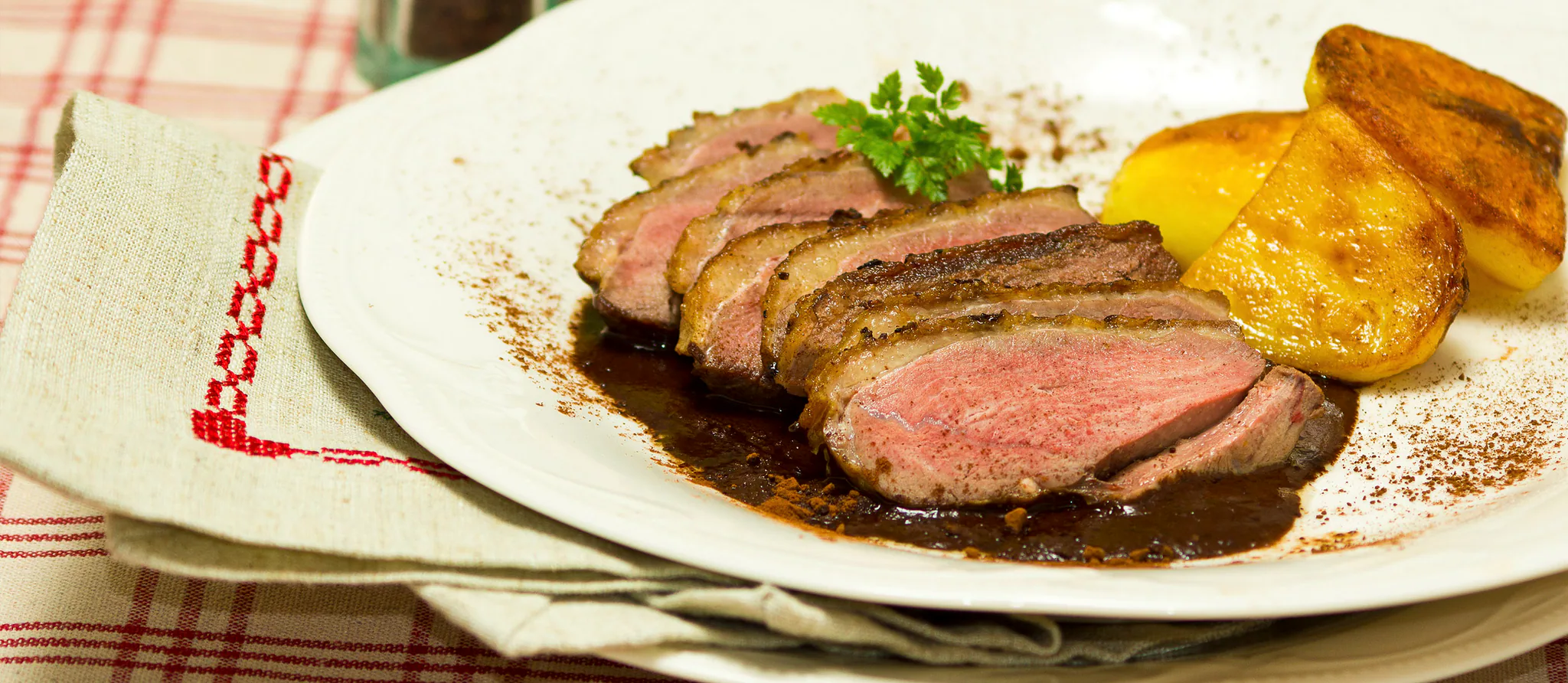
A fattened-duck breast seared skin-side down until the fat renders into a crisp, golden crust, then rested and sliced pink like a steak. Served here with a quick pan sauce of shallots, cherries, brandy and red wine.
Magret de canard (seared duck breast with cherry sauce) is a French main course from France, ready in about 1 hour 15 minutes and made with duck breast (magret) and cherries. It serves 4 and is rated intermediate to cook.
- Prep
- 15 min
- Cook
- 30 min
- Rest
- 30 min
- Total
- 1 h 15 min
- Serves
- 4
- Level
- Intermediate
- Calories
- 356
Main ingredients
Ingredients
For the cherry sauce
Method
Step 1
Pat the duck breasts (opens in a new tab) dry. Trim any overhanging skin, then score the fat in a fine crisscross pattern about 1 cm apart, cutting through the fat but not into the meat. Season both sides with salt and pepper (opens in a new tab) and leave at room temperature for 20 minutes.
Step 2
Lay the breasts skin-side down in a cold, heavy frying pan with no oil. Set it over medium heat and let the fat render slowly for 10–14 minutes, pouring the melted fat into a heatproof bowl every few minutes, until the skin is deep golden, thin and crisp.
- 12 min
- medium heat
- Cast-iron skillet (opens in a new tab)
Starting in a cold pan renders the fat gently instead of burning the skin before the fat has melted. Keep the duck fat for roasting potatoes.
Step 3
Turn the breasts over and cook the flesh side for 3–5 minutes, until a thermometer in the thickest part reads 54–57 °C for pink (medium-rare). Transfer skin-side up to a board and rest for 8–10 minutes.
- 5 min
- medium-high heat
- Food thermometer (opens in a new tab)
Food safety: Magret is traditionally served pink. Food-safety agencies advise cooking poultry to 74 °C (165 °F); cook it through if serving young children, pregnant or elderly guests, or anyone with a weakened immune system.
Step 4
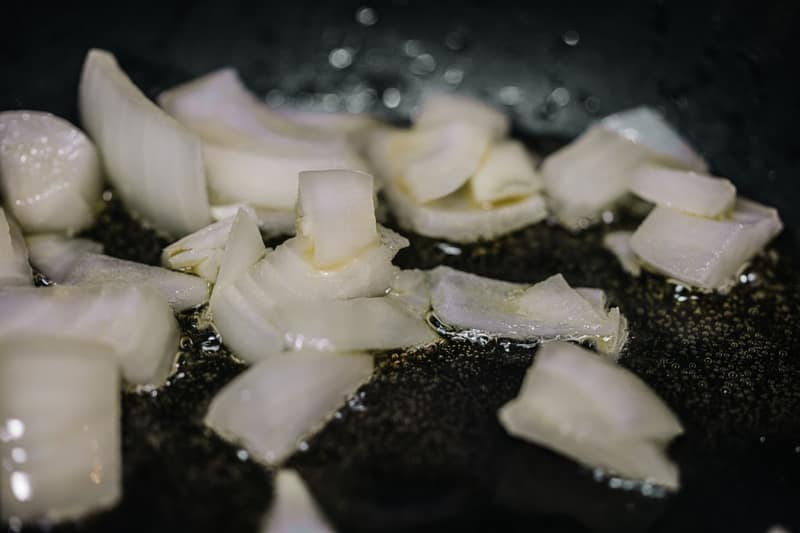
Pour off all but 1 tbsp fat from the pan. Add the shallots (opens in a new tab) and cook over medium heat for 2 minutes until soft. Add the cherries (opens in a new tab) and toss for 1 minute.
- 3 min
- medium heat
How it looks · Photo: Magda Ehlers on Pexels Step 5
Take the pan off the heat, add the brandy (opens in a new tab), then return it to the heat and let it bubble away (or carefully flame it). Add the red wine (opens in a new tab) and vinegar and boil until reduced by half, then add the stock and sugar (opens in a new tab) and simmer until syrupy, 4–5 minutes.
- 8 min
- medium-high heat
Food safety: If you flame the brandy, turn off the extractor fan and keep your face and sleeves back from the pan.
Step 6
Off the heat, swirl in the cold butter (opens in a new tab) until glossy. Add any juices from the resting duck and season.
- 1 min
Step 7
Slice the breasts across the grain into 1 cm slices, fan them on warm plates and spoon the cherry (opens in a new tab) sauce alongside.
At a glance
 Duck breast (magret)
 Salt
 Black pepper
 Shallot
 Cherries
- Brandy
 Dry red wine
 Wine vinegar
 Chicken stock
 Sugar
 Butter
About this dish
- Origin
- Gascony (Gers, South-West France), France · Well documentedMagret comes from ducks raised for foie gras in South-West France. Gascon chef André Daguin is credited with first cooking it like a steak, rare to medium-rare, at his restaurant in Auch in 1959; before that the breast was usually confited.Also popular in BelgiumMore food from France
France - Dish
- Dinner · Main courses
- Cooking method
- Pan-fried
- Taste
- rich, savoury, fruity, sweet & sour
- Diet
- No gluten ingredients · No nut ingredients · Low-carb · High-proteinWorked out from the ingredients. How labels work
All labels
Non-vegetarian · No gluten ingredients · Egg-free · No nut ingredients · Pork-free · Beef-free · Low-carb · High-protein · Calorie-conscious - Good for
- Festive & celebration
- Cook more with
- Duck breast (magret) · Cherries · Shallot · Dry red wine · Wine vinegar · Chicken stock
- Techniques
- Pan-frying · Boiling · Simmering · Reduction · Plating
Allergens
- Contains: Milkfrom butter
- May contain: Celeryfrom chicken stock
- Contains: Sulphitesfrom dry red wine, wine vinegar
Based on typical versions of these ingredients and not verified allergen-free. Brands differ and cross-contact happens, so always check labels. For severe allergies, follow your clinician’s advice.
Nutrition
356 kcal per serving
Estimated1 serving ≈ 311 g · recipe makes 4
Where the energy comes from
- Protein 41%
- Carbohydrate 18%
- Fat 41%
| Nutrient | Per serving | Per 100 g* |
|---|---|---|
| Energy | 356 kcal | 114 kcal |
| Protein | 33.7 g | 10.8 g |
| Carbohydrate | 15.3 g | 4.9 g |
| Net carbohydrate | 13.7 g | 4.4 g |
| Sugars | 9.3 g | 3 g |
| Added sugars | 1 g | 0.3 g |
| Fibre | 1.6 g | 0.5 g |
| Fat | 15 g | 4.8 g |
| Saturated fat | 6.8 g | 2.2 g |
| Trans fat | — | — |
| Cholesterol | 146 mg | 47 mg |
| Sodium | 791 mg | 254 mg |
| Salt equivalent | 2 g | 0.6 g |
Vitamins & minerals per serving
- Potassium
- 711 mg
- Calcium
- 38 mg
- Iron
- 4.8 mg
- Magnesium
- 47 mg
- Vitamin A (RAE)
- 78 µg
- Vitamin C
- 15 mg
- Vitamin D
- 0.2 µg
- Vitamin B12
- 0.7 µg
- Folate (DFE)
- 53 µg
How these numbers were made
- Calculated from USDA FoodData Central (SR Legacy) per-100 g values and the listed quantities.
- *Per 100 g of combined raw ingredients; the cooked dish may weigh more or less.
- Optional ingredients are not included: brandy.
- Duck breast (magret): Domesticated duck meat without skin (FDC 172410) used as a stand-in; a magret is sold with a thick fat cap, much of which renders out in the pan, so fat is underestimated if the skin is eaten.
- “—” means the value isn’t known for enough of the ingredients; it is never zero by default.
- Values are estimates for guidance, not for medical dosing. U.S. Department of Agriculture, Agricultural Research Service. FoodData Central, 2019. fdc.nal.usda.gov.
Good to know
Tips
- Score finely and evenly: it lets the fat render out and stops the breast curling in the pan.
- If the skin is crisp before the fat has thinned, lower the heat rather than turning the breast early.
Common mistakes
- Cooking over high heat from the start, which burns the skin while leaving a thick layer of unrendered fat beneath it.
- Slicing straight from the pan; without resting, the juices run out onto the board.
Serve with
- With potatoes sautéed in the reserved duck fat with garlic and parsley (pommes sarladaises).
- With green beans or a frisée salad and a South-West red wine.
Food safety
- Rendered duck fat keeps for months in a clean, covered jar in the fridge.
Storage
- Keeps 2 days refrigerated; slice cold for salads or sandwiches.
Reheating
- Warm slices briefly in a hot pan, skin-side down, so they do not overcook.
Variations
- Magret au miel: The pan is deglazed with honey and vinegar (or balsamic) for a sweet-sour glaze.
- Magret aux pêches: Peaches or figs replace the cherries in late summer.
- Magret séché: Duck breast cured in salt and pepper and air-dried for a few weeks, then sliced thin like ham.
What is the difference between magret and ordinary duck breast?
Strictly, magret is the breast of a duck fattened for foie gras (usually a moulard). It is larger, thicker and has a deeper fat cap than a standard Pekin duck breast, so it is cooked more like a beef steak.
Original editorial recipe · FriendsPantry editorial · source: TasteAtlas (dish facts) · Not yet independently reviewed · Added
Recipe DNA
How this dish is built
Built from the recipe’s own sections. Each band’s width is its share of the dish by weight. Choose a component to see what it does.
Reviews & corrections
Reviews come from signed-in cooks and appear after a moderator checks them. We never show made-up ratings.
You might also like
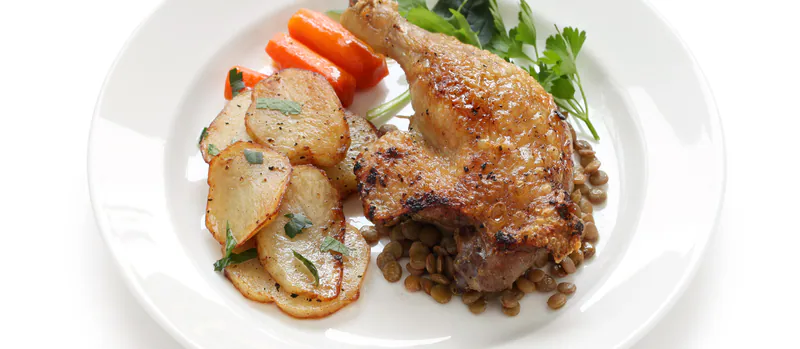
Confit de canard (duck confit)
 French · 15 h 50 min · 349 kcal
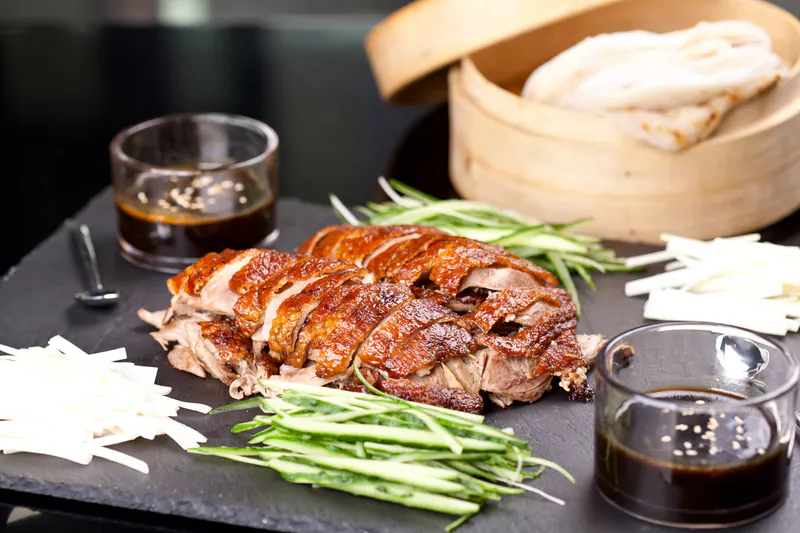
Peking duck (Beijing kao ya)
 Chinese · 26 h 50 min · 1141 kcal
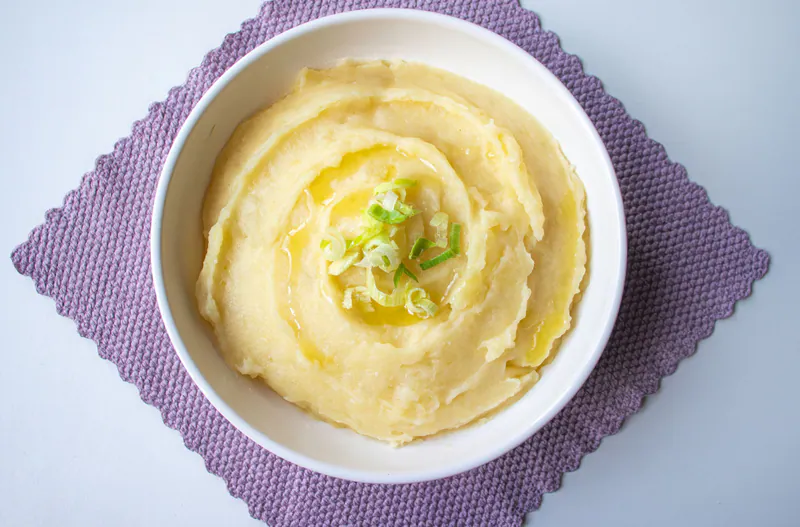
Creamy Mashed Potatoes
International · 32 min · 306 kcal · Vegetarian
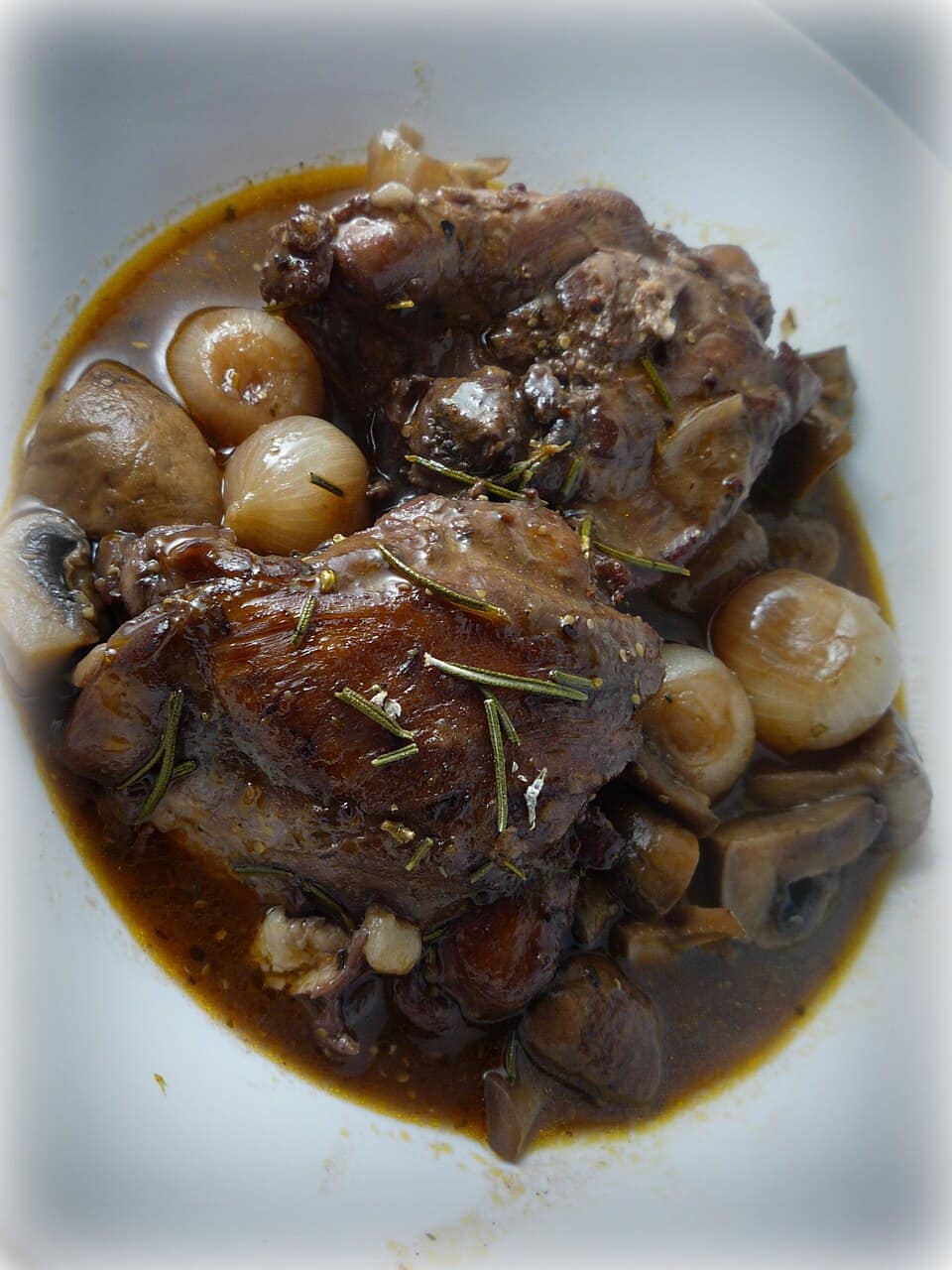
Coq au vin
French · 1 h 35 min · 773 kcal