
Kitsune udon
Non-vegetarian
きつねうどん · kitsune udon
Thick udon noodles in a light, savoury dashi broth, topped with pouches of fried tofu simmered until sweet and juicy, and a handful of spring onion.
Kitsune udon is a Japanese noodle dish, ready in about 25 minutes and made with fried tofu pouches (aburaage), dashi and udon noodles. It serves 2 and is rated easy to cook.
No licensed photograph of this dish yet.
- Prep
- 5 min
- Cook
- 20 min
- Total
- 25 min
- Serves
- 2
- Level
- Easy
- Calories
- 548
Method
Step 1
Pour boiling water over the fried tofu to remove excess oil, then squeeze gently.
- 2 min
Step 2
Simmer the tofu in 100 ml dashi (opens in a new tab) with 1 tbsp each of soy sauce (opens in a new tab) and mirin (opens in a new tab) and the sugar (opens in a new tab) until the liquid is almost gone.
- 10 min
- medium-low heat
- Saucepan (opens in a new tab)
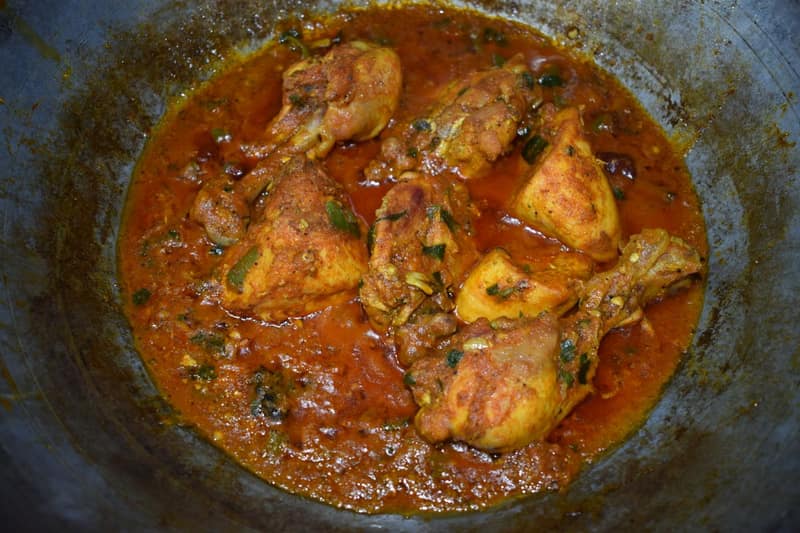
How it looks · Photo: Bachir Mamud on Pexels Step 3
Heat the remaining dashi (opens in a new tab) with the remaining soy sauce (opens in a new tab) and mirin (opens in a new tab) to make the broth; taste and add a pinch of salt only if needed. Keep hot.
- 4 min
- medium heat
Step 4
Cook the udon (opens in a new tab) in plenty of boiling water according to the packet, then drain.
- 8 min
- high heat
- Stockpot / large pot (opens in a new tab)
Step 5
Divide the noodles between bowls, ladle over the hot broth and top with the tofu, spring onion (opens in a new tab) and shichimi.
- 1 min
About this dish
- Origin
- Commonly associated with Osaka, Japan · Commonly attributedMore food from Japan
- Dish
- Lunch · Dinner · Noodles · Soups · Main courses
- Cooking method
- Simmered, Boiled
- Taste
- umami, sweet & savoury, mild
- Diet
- Pescatarian · Dairy-free · No nut ingredients · High-proteinWith the listed swaps: Vegan, Plant-based, Vegetarian (lacto-ovo), Eggetarian, Lacto-vegetarian, Ovo-vegetarianWorked out from the ingredients. How labels work
All labels
Pescatarian · Non-vegetarian · Flexitarian-friendly · Dairy-free · Egg-free · No nut ingredients · Pork-free · Beef-free · High-protein · Low-fat - Good for
- Everyday
- Cook more with
- Fried tofu pouches (aburaage) · Dashi · Udon noodles · Soy sauce · Sugar · Mirin
- Techniques
- Boiling · Simmering · Stock making
Allergens
- Contains, can be adapted: Fishfrom dashi
- Contains: Wheatfrom soy sauce, udon noodles
- Contains: Glutenfrom soy sauce, udon noodles
- Contains: Soyfrom fried tofu pouches (aburaage), soy sauce
Based on typical versions of these ingredients and not verified allergen-free. Brands differ and cross-contact happens, so always check labels. For severe allergies, follow your clinician’s advice.
Nutrition
548 kcal per serving
Estimated1 serving ≈ 590 g · recipe makes 2
Where the energy comes from
- Protein 20%
- Carbohydrate 65%
- Fat 14%
| Nutrient | Per serving | Per 100 g* |
|---|---|---|
| Energy | 548 kcal | 93 kcal |
| Protein | 26.6 g | 4.5 g |
| Carbohydrate | 85.7 g | 14.5 g |
| Net carbohydrate | 80 g | 13.6 g |
| Sugars | — | — |
| Added sugars | — | — |
| Fibre | 5.7 g | 1 g |
| Fat | 8.3 g | 1.4 g |
| Saturated fat | 1.5 g | 0.3 g |
| Trans fat | — | — |
| Cholesterol | 4 mg | 1 mg |
| Sodium | 3871 mg | 656 mg |
| Salt equivalent | 9.7 g | 1.6 g |
Vitamins & minerals per serving
- Potassium
- 928 mg
- Calcium
- 130 mg
- Iron
- 3 mg
- Magnesium
- 91 mg
- Vitamin A (RAE)
- 16 µg
- Vitamin C
- 3 mg
- Vitamin D
- 0 µg
- Vitamin B12
- 2.8 µg
- Folate (DFE)
- 41 µg
How these numbers were made
- Calculated from USDA FoodData Central (SR Legacy) per-100 g values and the listed quantities.
- *Per 100 g of combined raw ingredients; the cooked dish may weigh more or less.
- Optional ingredients are not included: red chilli flakes.
- Dashi: Home-prepared fish stock (FDC 172885) used as a stand-in for katsuobushi-kombu dashi; both are very low in energy.
- Mirin: Sake (FDC 167723) used as a stand-in; true mirin is sweeter, so sugar is underestimated.
- Udon noodles: Dry somen (FDC 168908) used as a stand-in; both are plain Japanese wheat noodles.
- “—” means the value isn’t known for enough of the ingredients; it is never zero by default.
- Values are estimates for guidance, not for medical dosing. U.S. Department of Agriculture, Agricultural Research Service. FoodData Central, 2019. fdc.nal.usda.gov.
Good to know
Tips
- The sweet tofu can be made a day ahead and kept in its juices.
Common mistakes
- Skipping the boiling-water rinse leaves the tofu greasy and stops it absorbing the sweet simmering liquid.
Serve with
- Pair with onigiri for a fuller meal.
Storage
- Store broth, noodles and tofu separately in the fridge for up to 2 days.
Reheating
- Reheat the broth to boiling and briefly dip the noodles in it.
Variations
- Kitsune soba: The same topping and broth with buckwheat soba.
Original editorial recipe · FriendsPantry editorial · Not yet independently reviewed · Added · Updated
Sauces, chutneys & dips for this dish
Recipe DNA
How this dish is built
Grouped by each ingredient’s role in the dish. Each band’s width is its share of the dish by weight. Choose a component to see what it does.
What the dish is built around
Main ingredient
- Fried tofu pouches (aburaage), halved2 sheet · 40 g
- Udon noodles200 g
Reviews & corrections
Reviews come from signed-in cooks and appear after a moderator checks them. We never show made-up ratings.
You might also like
Zaru soba
 Japanese · 45 min · 374 kcal
Shoyu ramen (home-style)
Japanese · 40 min · 751 kcal
Oyakodon
Japanese · 25 min · 598 kcal
Katsudon
Japanese · 40 min · 1003 kcal