
Ka'ak al-Quds
Contains egg (no meat or fish)
كعك القدس · ka'ak al-quds
Long oval rings of soft, slightly sweet bread thickly coated in sesame seeds, sold from street carts across Jerusalem's Old City. Eaten with za'atar, eggs and falafel for breakfast.
Ka'ak al-Quds is a Palestinian bread from Palestine, ready in about 2 hours 18 minutes and made with all-purpose flour and sesame seeds. It serves 6 and is rated intermediate to cook.
No licensed photograph of this dish yet.
- Prep
- 30 min
- Cook
- 18 min
- Rest
- 1 h 30 min
- Total
- 2 h 18 min
- Serves
- 6
- Level
- Intermediate
- Calories
- 502
Ingredients
For the coating
Method
Step 1
Mix the flour, yeast, sugar (opens in a new tab) and salt. Add the milk (opens in a new tab), water and oil and knead into a soft, smooth dough. Cover and leave until doubled.
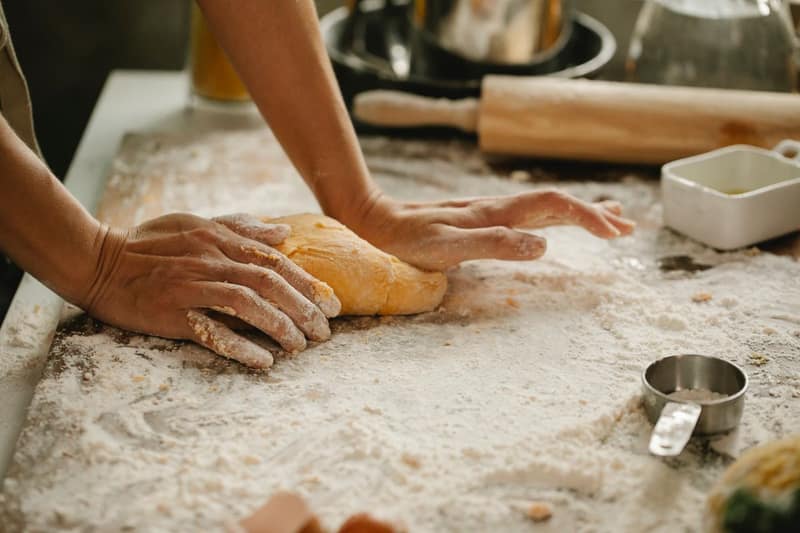
How it looks · Photo: Klaus Nielsen on Pexels Step 2
Divide into 6. Roll each into a 45 cm rope, join the ends and stretch into a long oval ring.
- 10 min
Step 3
Dissolve the sugar (opens in a new tab) in the water. Dip each ring in the sugar water, then press into the sesame seeds (opens in a new tab) to coat thickly. Lay on lined trays and rise for 30 minutes.
Step 4
Bake until deep golden and the sesame (opens in a new tab) is toasted.
- 18 min
- 230°C
- Oven (opens in a new tab)
Step 5
Cool for a few minutes, then serve warm with a little dish of za'atar (opens in a new tab) for dipping and hard-boiled eggs (opens in a new tab) on the side.
- 2 min

How it looks · Photo: Willians Huerta on Pexels
About this dish
- Origin
- Jerusalem, Palestine · Commonly attributedStrongly associated with Jerusalem's Palestinian bakeries; similar sesame rings are sold in Lebanon and Jordan.Also popular in Israel, JordanMore food from Palestine
- Dish
- Breakfast · Snack · Breads & flatbreads
- Cooking method
- Oven-baked
- Taste
- nutty, mild, sweet
- Diet
- Vegetarian (lacto-ovo) · No nut ingredientsWithout the optional extras: Lacto-vegetarian, Egg-freeWorked out from the ingredients. How labels work
All labels
Vegetarian (lacto-ovo) · Eggetarian · Pescatarian · Flexitarian-friendly · No nut ingredients · Alcohol-free · Pork-free · Beef-free · DASH-style - Good for
- Portable / lunchbox · Street food
- Cook more with
- All-purpose flour · Sesame seeds · Dried yeast · Sugar · Milk
- Techniques
- Baking · Kneading · Fermentation
Allergens
- Contains: Milkfrom milk
- Contains, can be adapted: Eggsfrom egg
- Contains: Wheatfrom all-purpose flour
- Contains: Glutenfrom all-purpose flour
- Contains: Sesamefrom sesame seeds, za'atar
Based on typical versions of these ingredients and not verified allergen-free. Brands differ and cross-contact happens, so always check labels. For severe allergies, follow your clinician’s advice.
Nutrition
502 kcal per serving
Calculated1 serving ≈ 185 g · recipe makes 6
Where the energy comes from
- Protein 10%
- Carbohydrate 60%
- Fat 30%
| Nutrient | Per serving | Per 100 g* |
|---|---|---|
| Energy | 502 kcal | 272 kcal |
| Protein | 12.8 g | 7 g |
| Carbohydrate | 75.5 g | 40.9 g |
| Net carbohydrate | 71 g | 38.4 g |
| Sugars | 7.8 g | 4.2 g |
| Added sugars | 6.3 g | 3.4 g |
| Fibre | 4.5 g | 2.5 g |
| Fat | 16.7 g | 9.1 g |
| Saturated fat | 2.7 g | 1.5 g |
| Trans fat | — | — |
| Cholesterol | 3 mg | 1 mg |
| Sodium | 599 mg | 324 mg |
| Salt equivalent | 1.5 g | 0.8 g |
Vitamins & minerals per serving
- Potassium
- 213 mg
- Calcium
- 209 mg
- Iron
- 6.4 mg
- Magnesium
- 81 mg
- Vitamin A (RAE)
- 12 µg
- Vitamin C
- 0 mg
- Vitamin D
- 0.3 µg
- Vitamin B12
- 0.1 µg
- Folate (DFE)
- 287 µg
How these numbers were made
- Calculated from USDA FoodData Central (SR Legacy) per-100 g values and the listed quantities.
- *Per 100 g of combined raw ingredients; the cooked dish may weigh more or less.
- Optional ingredients are not included: za'atar, egg.
- “—” means the value isn’t known for enough of the ingredients; it is never zero by default.
- Values are estimates for guidance, not for medical dosing. U.S. Department of Agriculture, Agricultural Research Service. FoodData Central, 2019. fdc.nal.usda.gov.
Good to know
Tips
- A tray of hot water on the oven floor in the first minutes of baking keeps the crust soft and shiny.
Common mistakes
- Coating too thinly — ka'ak should be thickly crusted with sesame on all sides.
Serve with
- Tear and dip in za'atar and olive oil, with hard-boiled eggs and falafel.
Storage
- Best on the day; freeze for up to 1 month.
Reheating
- Warm in a hot oven for 3–4 minutes.
Original editorial recipe · FriendsPantry editorial · Not yet independently reviewed · Added · Updated
Recipe DNA
How this dish is built
Built from the recipe’s own sections. Each band’s width is its share of the dish by weight. Choose a component to see what it does.
What the dish is built around
Main ingredient
- All-purpose flour500 g
- Milk, lukewarm150 ml · 155 g
- Egg, hard-boiled, for serving (optional)4 piece · 200 g
Masalas in this recipe
Make the masala first, then come back to finish the dish.
Dry spice blend
Za'atar
This recipe uses 4 tbsp (21 g for 6 rings).
Baker’s notes
Customise in Bread & BakeryTimeline and readiness cues
Mix and knead · about 30 min
Weigh everything. Knead until smooth and elastic: a small piece stretches thin enough to see light through (the windowpane test).
First rise (bulk) · about 1 h
About doubled, domed, jiggly, with bubbles on the sides. A floured finger poked in leaves a dent that fills slowly.
Final proof · about 30 min
Poke test: the dent springs back slowly and only partly. Springs back fast = needs longer; doesn't spring back = over-proofed, bake now.
Bake · about 18 min at 230 °C
Deep golden; bread sounds hollow when tapped underneath, or reads 93–96 °C inside (enriched breads 88–90 °C).
- Start to finish: about 2 h 18 min. Times are a guide — warmth changes everything; follow the cues.
The dough
| Ingredient | Role | Weight | Baker’s % |
|---|---|---|---|
| All-purpose flour | Flour | 500 g | 100% |
| Water | Water | 260 g | 52% |
| Milk | Other liquid | 155 g | 30.9% |
| Olive oil | Fat | 40 g | 8.1% |
| Sugar | Sugar | 38 g | 7.5% |
| Salt | Salt | 9 g | 1.8% |
| Dried yeast | Yeast | 7 g | 1.4% |
- Total flour
- 500 g
- Hydration
- 52%
- With milk, eggs…
- 78.9%
- Wholegrain
- 0%
Hydration = water ÷ flour × 100. Milk is about 87% water and eggs about 75%, so they’re shown separately as “with milk, eggs…”.
- Wet dough (over 75%) — sticky; use wet hands and folds instead of kneading. Ciabatta, focaccia and open sourdough.
- Milk, eggs and other liquids add about 27 points of extra water, so it handles like a 79% dough.
- Salt 1.8% — normal for bread.
If something goes wrong
Dense, heavy loaf
Likely causes
- Under-kneaded (weak gluten)
- Under-proofed
- Old or dead yeast/starter
- Too much wholegrain flour without extra water
What to do
- Knead to the windowpane stage
- Proof by the poke test, not the clock
- Test yeast in warm water with sugar; feed the starter and use it at its peak
- Add 5–10% more water for wholegrain flours and give them a rest
Gummy or wet crumb
Likely causes
- Under-baked
- Sliced while hot
- Hydration too high for the flour
What to do
- Bake to 93–96 °C inside (cakes: clean skewer)
- Cool completely on a rack before slicing
- Reduce water by 3–5% or use a stronger flour
Spreads flat / no oven spring
Likely causes
- Over-proofed
- Weak shaping (no surface tension)
- Oven not hot enough
- Too much water for the flour
What to do
- Shorten the proof; bake when the poke springs back slowly
- Shape tightly so the skin is taut
- Preheat fully (30+ minutes; with a stone or Dutch oven, 45)
- Lower hydration or use bread flour
Collapsed or sunken middle
Likely causes
- Oven door opened too early
- Too much leavening or sugar
- Under-baked centre
- Over-proofed yeast dough
What to do
- Don't open the oven for the first two-thirds of baking
- Measure leaveners exactly with spoons, levelled
- Test the centre before removing
- Proof less
Pale crust
Likely causes
- Oven too cool
- Too little sugar or no milk/egg for browning
- Over-fermented (yeast ate the sugars)
What to do
- Check the oven with a thermometer
- Brush with egg wash or milk
- Shorten the fermentation
Burnt bottom
Likely causes
- Tray too close to the heat
- Dark tray absorbs more heat
- Too much sugar in the dough
What to do
- Bake on the middle shelf
- Double up trays or use a light-coloured one
- Lower the temperature 10–15 °C and bake a little longer
Crust too hard or thick
Likely causes
- Baked too long at too low a temperature
- No steam at the start
What to do
- Bake hotter for a shorter time
- Add steam for the first 15 minutes (tray of boiling water, or a covered Dutch oven)
- Cool under a tea towel for a softer crust
Big holes or tunnels
Likely causes
- Overmixed batter (cakes, muffins)
- Air trapped while shaping bread
- Uneven proof
What to do
- Mix quick breads only until no dry flour shows
- Degas gently and shape tightly
- Proof covered in an even, warm place
Dough didn't rise
Likely causes
- Dead yeast (expired or killed by hot liquid)
- Kitchen too cold
- Salt in direct contact with fresh yeast
- Starter not active
What to do
- Liquid should be lukewarm (no hotter than 40 °C)
- Proof somewhere warm (an oven with just the light on)
- Mix the salt into the flour, not onto the yeast
- Feed the starter until it doubles in 4–8 hours
Over-proofed (sour smell, collapses when scored)
Likely causes
- Too warm
- Too much yeast
- Left too long
What to do
- Knock back, reshape and proof again briefly (yeast doughs)
- Use less yeast or a cooler proof
- Set a timer and check early with the poke test
Dry or crumbly
Likely causes
- Too much flour (scooped, not weighed)
- Over-baked
- Too little fat or sugar
What to do
- Weigh flour, or spoon it into the cup and level
- Check 5 minutes early
- Don't cut fat or sugar by more than a quarter without another moisture source
Reviews & corrections
Reviews come from signed-in cooks and appear after a moderator checks them. We never show made-up ratings.
You might also like
Musakhan
 Palestinian · 1 h 35 min · 1198 kcal
Taboon bread
Palestinian · 2 h 40 min · 344 kcal · Vegan
Manakish za'atar
 Lebanese · 1 h 41 min · 424 kcal · Vegetarian
Lahmacun
 Turkish · 1 h 55 min · 692 kcal