
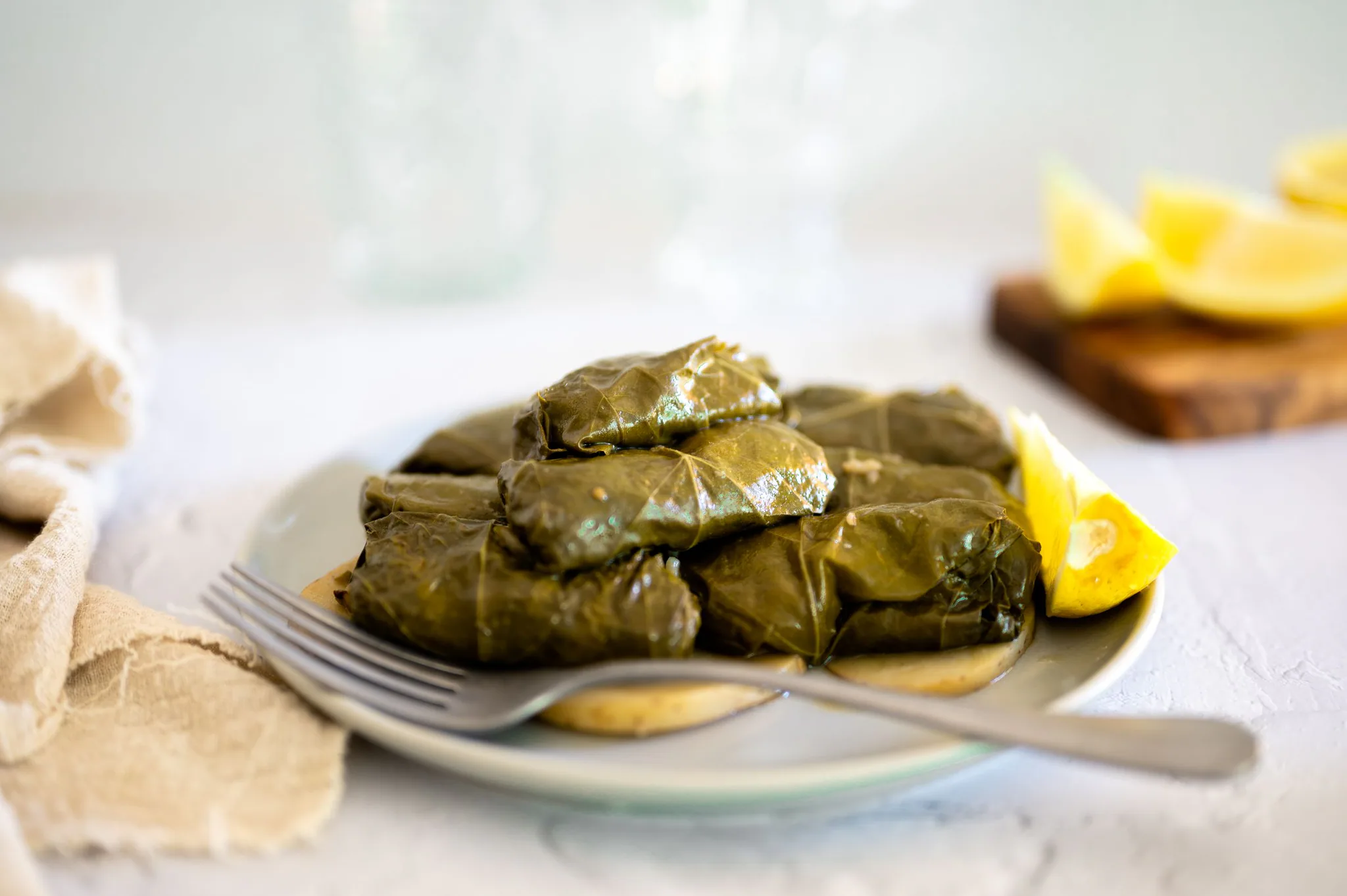
Dolmadakia (rice-stuffed vine leaves)
Vegetarian
Ντολμαδάκια γιαλαντζί · Dolmadakia yalantzi
Small vine-leaf parcels of rice, herbs and spring onion, gently simmered in olive oil and lemon and served cool as a meze. Naturally meat-free.
Dolmadakia (rice-stuffed vine leaves) is a Greek starter, ready in about 2 hours 45 minutes and made with grape (vine) leaves in brine and short-grain rice. It serves 6 and is rated intermediate to cook.
- Prep
- 50 min
- Cook
- 55 min
- Rest
- 1 h
- Total
- 2 h 45 min
- Serves
- 6
- Level
- Intermediate
- Calories
- 382
Method
Step 1
Rinse the vine leaves (opens in a new tab) and blanch them in boiling water for 2 minutes until pliable; drain and snip off any stems.
- 5 min
- high heat
Step 2
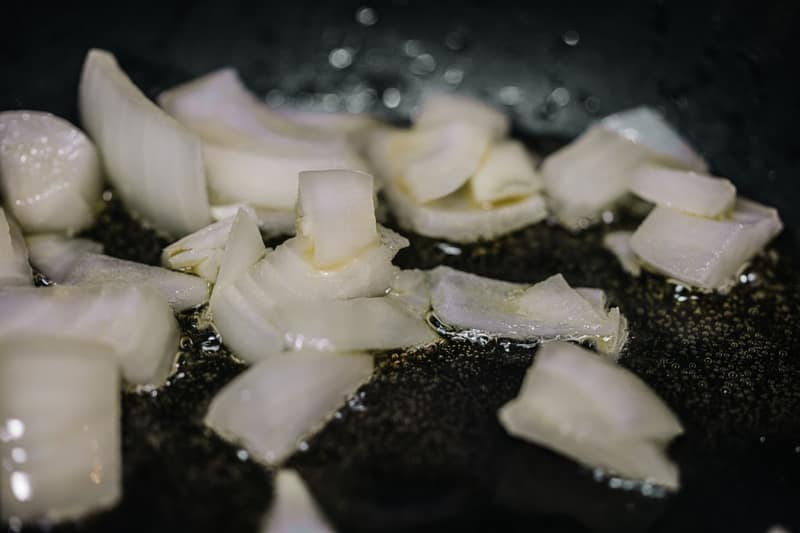
Soften the onion (opens in a new tab) and spring onion (opens in a new tab) in 4 tbsp of the oil for 5 minutes. Stir in the rice, herbs, pine nuts (opens in a new tab), half the lemon juice (opens in a new tab), salt and pepper (opens in a new tab) and cook 2 minutes more.
- 8 min
- medium heat
- Frying pan / skillet (opens in a new tab)
How it looks · Photo: Magda Ehlers on Pexels Step 3
Lay a leaf shiny side down, place a teaspoon of filling near the stem end, fold in the sides and roll up firmly — the rice swells, so don't overfill.
- 35 min
Step 4
Line a wide pot with spare leaves and pack in the rolls seam-side down in tight layers. Pour over the remaining oil, lemon juice (opens in a new tab) and the hot water, weigh down with a plate and simmer gently for 45–50 minutes until the rice is tender and the liquid absorbed.
- 50 min
- low heat
- Saucepan (opens in a new tab)
Step 5
Cool in the pot for at least 1 hour. Serve at room temperature with yogurt.
- 1 min
About this dish
- Origin
- Not attributed to one place · Origin disputedStuffed vine leaves are shared by Greek, Turkish, Levantine, Armenian and Balkan cuisines; this lemony herb-and-rice version is a Greek meze staple.Also popular in Greece, Türkiye, Cyprus
- Dish
- Lunch · Snack · Appetizers & starters · Finger food
- Cooking method
- Simmered, Steamed
- Taste
- herby, citrusy, fresh, mild
- Diet
- Vegetarian (lacto-ovo) · No gluten ingredientsWithout the optional extras: Vegan, Plant-based, Ovo-vegetarian, Dairy-free, No nut ingredientsWorked out from the ingredients. How labels work
All labels
Vegetarian (lacto-ovo) · Eggetarian · Lacto-vegetarian · Pescatarian · Flexitarian-friendly · No gluten ingredients · Egg-free · No added sugar · Alcohol-free · Pork-free · Beef-free - Good for
- Make-ahead · Portable / lunchbox
- Cook more with
- Grape (vine) leaves in brine · Short-grain rice · Onion · Spring onion · Dill · Mint
Allergens
- Contains, can be adapted: Milkfrom greek yogurt
- Contains, can be adapted: Tree nutsfrom pine nuts
- May contain: Sulphitesfrom grape (vine) leaves in brine
Based on typical versions of these ingredients and not verified allergen-free. Brands differ and cross-contact happens, so always check labels. For severe allergies, follow your clinician’s advice.
Nutrition
382 kcal per serving
Calculated1 serving ≈ 215 g · recipe makes 6
Where the energy comes from
- Protein 4%
- Carbohydrate 41%
- Fat 55%
| Nutrient | Per serving | Per 100 g* |
|---|---|---|
| Energy | 382 kcal | 178 kcal |
| Protein | 4.3 g | 2 g |
| Carbohydrate | 39.5 g | 18.3 g |
| Net carbohydrate | — | — |
| Sugars | — | — |
| Added sugars | 0 g | 0 g |
| Fibre | — | — |
| Fat | 23.6 g | 11 g |
| Saturated fat | 3.3 g | 1.5 g |
| Trans fat | — | — |
| Cholesterol | 0 mg | 0 mg |
| Sodium | 1155 mg | 536 mg |
| Salt equivalent | 2.9 g | 1.3 g |
Vitamins & minerals per serving
- Potassium
- 114 mg
- Calcium
- 102 mg
- Iron
- 1.6 mg
- Magnesium
- 20 mg
- Vitamin A (RAE)
- —
- Vitamin C
- 11 mg
- Vitamin D
- 0 µg
- Vitamin B12
- 0 µg
- Folate (DFE)
- 37 µg
How these numbers were made
- Calculated from USDA FoodData Central (SR Legacy) per-100 g values and the listed quantities.
- *Per 100 g of combined raw ingredients; the cooked dish may weigh more or less.
- Optional ingredients are not included: pine nuts, greek yogurt.
- “—” means the value isn’t known for enough of the ingredients; it is never zero by default.
- Values are estimates for guidance, not for medical dosing. U.S. Department of Agriculture, Agricultural Research Service. FoodData Central, 2019. fdc.nal.usda.gov.
Good to know
Tips
- A heatproof plate on top keeps the rolls from unravelling as the rice swells.
Common mistakes
- Overfilling or rolling too tightly: the rice swells and splits the leaves.
Food safety
- Cooked rice dishes served cool should be cooled within 1 hour and refrigerated; don't leave them out for more than 2 hours.
Storage
- Refrigerate in their juices up to 5 days.
Variations
- Dolmades with meat (Greece): Minced beef or lamb in the filling, served hot with avgolemono sauce.
- Zeytinyağlı yaprak sarma (Türkiye): The Turkish olive-oil version, often with currants, allspice and cinnamon.
Original editorial recipe · FriendsPantry editorial · Not yet independently reviewed · Added · Updated
Sauces, chutneys & dips for this dish
Recipe DNA
How this dish is built
Grouped by each ingredient’s role in the dish. Each band’s width is its share of the dish by weight. Choose a component to see what it does.
What the dish is built around
Main ingredient
- Grape (vine) leaves in brine40 leaf · 160 g
- Short-grain rice, rinsed250 g
- Lemon juice4 tbsp · 61 g
- Greek yogurt (optional)200 g
Reviews & corrections
Reviews come from signed-in cooks and appear after a moderator checks them. We never show made-up ratings.
You might also like
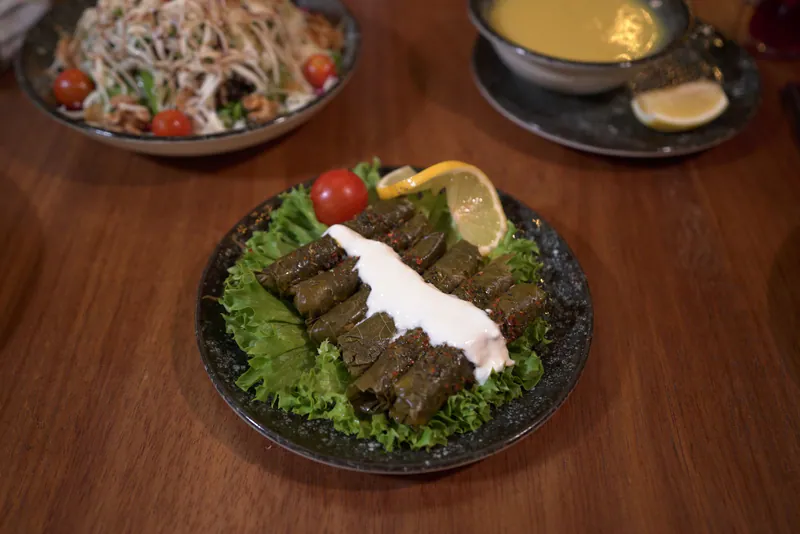
Koupepia
 Cypriot · 1 h 55 min · 494 kcal
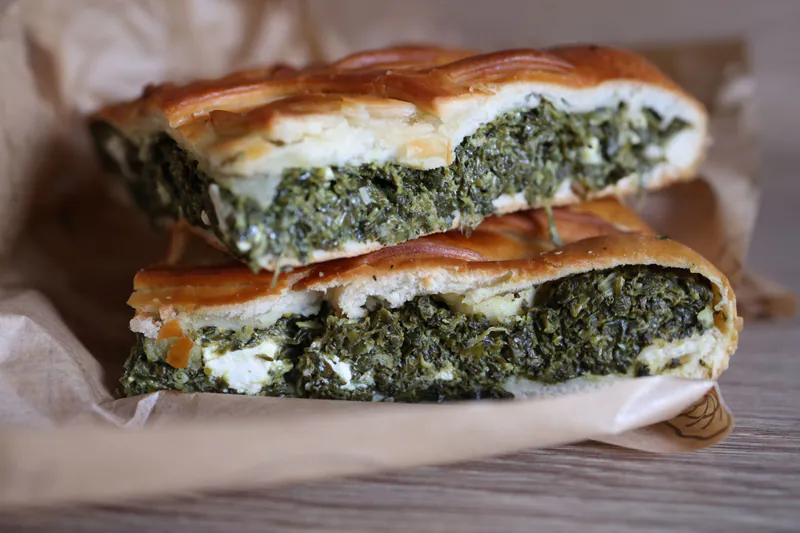
Spanakopita
 Greek · 1 h 40 min · 307 kcal · Contains egg
Kleftiko
Cypriot · 4 h · 610 kcalKeftedes (Greek meatballs)
Greek · 1 h 5 min · 453 kcal