
Ulli chammanthi (Kerala shallot chutney)
Vegetarian
ഉള്ളി ചമ്മന്തി · uḷḷi cammanti
Small shallots crushed with flame-roasted dried red chillies, tamarind, curry leaves and salt, then glossed with raw coconut oil. A fierce, coconut-free chammanthi traditionally ground on a grinding stone and eaten with rice gruel (kanji), tapioca and rice.
Ulli chammanthi (Kerala shallot chutney) is a South Indian condiment, ready in about 15 minutes and made with shallot, dried whole chillies and coconut oil. It serves 4 and is rated beginner to cook.
No licensed photograph of this dish yet.
- Prep
- 12 min
- Cook
- 3 min
- Total
- 15 min
- Serves
- 4
- Level
- Beginner
- Calories
- 55
Method
Step 1
Peel the shallots (opens in a new tab) (soak them in warm water for 10 minutes first to loosen the skins) and pick the seeds out of the tamarind (opens in a new tab).
- 10 min
Step 2
Hold the dried chillies with tongs (opens in a new tab) over a low gas flame, or toast them in a dry pan over medium heat, turning, for 1–2 minutes until crisp, puffed and lightly blackened in spots. Toast the curry leaves (opens in a new tab) for a few seconds until crisp.
- 2 min
- medium heat
- Tongs (opens in a new tab)
Food safety: Roasting chillies over a flame produces pungent smoke; work under a hood or by an open window.
Step 3
Crush the roasted chillies with the salt in a mortar (or the small jar of a blender (opens in a new tab)) to coarse flakes. Add the tamarind (opens in a new tab) and curry leaves (opens in a new tab) and pound, then add the shallots (opens in a new tab) and pound or pulse (no water) to a coarse, juicy paste. The texture should be rough, not smooth.
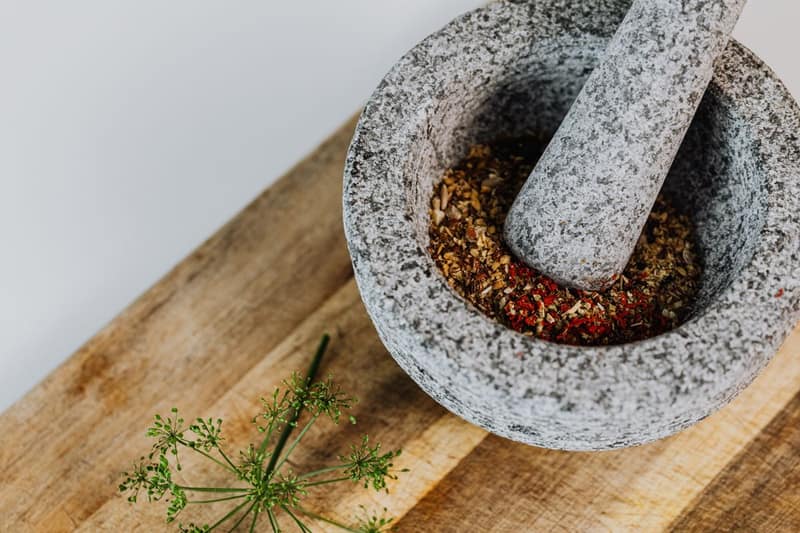
How it looks · Photo: https://kaboompics.com/ on Pexels Step 4
Pour over the raw coconut oil (opens in a new tab) and mix it in with a spoon (or, as in Kerala homes, with your fingers). Taste and add salt.
- 1 min
About this dish
- Origin
- Kerala, India · Commonly attributedA traditional Kerala home chammanthi; recipes agree on shallot, chilli, tamarind and raw coconut oil.More food from India
- Dish
- Lunch · Dinner · Breakfast · Condiments, chutneys & relishes
- Cooking method
- Grilled, Raw
- Taste
- spicy (chilli heat), smoky, tangy, savoury
- Diet
- Vegan · No gluten ingredients · Dairy-free · No nut ingredients · Low-carbWorked out from the ingredients. How labels work
All labels
Vegan · Plant-based · Vegetarian (lacto-ovo) · Eggetarian · Lacto-vegetarian · Ovo-vegetarian · Pescatarian · Flexitarian-friendly · Whole-food focused · Paleo-style · No gluten ingredients · Dairy-free · Egg-free · No nut ingredients · No added sugar · Alcohol-free · Pork-free · Beef-free · Low-carb - Good for
- Everyday · Budget-friendly
- Cook more with
- Shallot · Dried whole chillies · Coconut oil · Tamarind · Curry leaves
- Techniques
- Grilling · Charcoal grilling
Allergens
None of the 14 major allergens appear in the listed ingredients.
Based on typical versions of these ingredients and not verified allergen-free. Brands differ and cross-contact happens, so always check labels. For severe allergies, follow your clinician’s advice.
Nutrition
55 kcal per serving
Estimated1 serving ≈ 31 g · recipe makes 4
Where the energy comes from
- Protein 6%
- Carbohydrate 39%
- Fat 56%
| Nutrient | Per serving | Per 100 g |
|---|---|---|
| Energy | 55 kcal | 177 kcal |
| Protein | 0.8 g | 2.7 g |
| Carbohydrate | 5.6 g | 17.9 g |
| Net carbohydrate | 4.4 g | 14.1 g |
| Sugars | 2.4 g | 7.5 g |
| Added sugars | 0 g | 0 g |
| Fibre | 1.2 g | 3.8 g |
| Fat | 3.6 g | 11.4 g |
| Saturated fat | 2.9 g | 9.2 g |
| Trans fat | 0 g | 0 g |
| Cholesterol | 0 mg | 0 mg |
| Sodium | 295 mg | 943 mg |
| Salt equivalent | 0.7 g | 2.4 g |
Vitamins & minerals per serving
- Potassium
- 126 mg
- Calcium
- 11 mg
- Iron
- 0.5 mg
- Magnesium
- 8 mg
- Vitamin A (RAE)
- 15 µg
- Vitamin C
- 2 mg
- Vitamin D
- 0 µg
- Vitamin B12
- 0 µg
- Folate (DFE)
- 10 µg
How these numbers were made
- Calculated from USDA FoodData Central (SR Legacy) per-100 g values and the listed quantities.
- Not counted (tiny amounts or “to taste”): curry leaves.
- “—” means the value isn’t known for enough of the ingredients; it is never zero by default.
- Values are estimates for guidance, not for medical dosing. U.S. Department of Agriculture, Agricultural Research Service. FoodData Central, 2019. fdc.nal.usda.gov.
Good to know
Tips
- Shallots are essential; large onions turn watery and harsh.
- The raw coconut oil is not a garnish — it rounds off the heat and gives the chammanthi its Kerala flavour.
Common mistakes
- Adding water to help the grinder, which makes it thin and sharp.
- Burning the chillies to ash rather than just spotting them black.
Serve with
- Serve with kanji (rice gruel) and cherupayar (moong) curry, or with boiled kappa (tapioca).
- Good with puttu, dosa, appam or plain Kerala matta rice.
Food safety
- Raw ground shallots spoil quickly at room temperature; refrigerate leftovers.
Storage
- Best the same day; keeps 2 days in the fridge.
Variations
- Kanthari chammanthi: Uses fresh kanthari (bird's-eye) chillies instead of dried, for a very hot green chammanthi.
- Ulli thenga chammanthi: Adds 50 g grated coconut — this becomes close to thenga chammanthi.
Original editorial recipe · FriendsPantry editorial · Not yet independently reviewed · Added · Updated
Goes with
Recipe DNA
How this dish is built
Grouped by each ingredient’s role in the dish. Each band’s width is its share of the dish by weight. Choose a component to see what it does.
Make it milder, swap ingredients for your diet, change the batch size or thickness — the original stays as it is.
Customise in Sauce & DrizzleReviews & corrections
Reviews come from signed-in cooks and appear after a moderator checks them. We never show made-up ratings.
You might also like
Thenga chammanthi (Kerala pounded coconut chutney)
 South Indian · 13 min · 138 kcal · Vegan
Chammanthi podi (Kerala roasted coconut chutney powder)
South Indian · 1 h · 65 kcal · VeganInji puli (Kerala ginger-tamarind relish)
South Indian · 50 min · 60 kcal · VeganRed coconut chutney
South Indian · 20 min · 92 kcal · Vegan