
Thai red curry paste
Non-vegetarian
พริกแกงแดง · phrik kaeng daeng
Soaked dried red chillies pounded with lemongrass, galangal, makrut lime zest, coriander root, shallots, garlic, toasted seeds and shrimp paste into a dense, brick-red paste. The base of red curries, jungle curries and countless stir-fries.
Thai red curry paste is a Thai condiment from Thailand, ready in about 45 minutes and made with dried whole chillies, galangal and lemongrass. It serves 8 and is rated intermediate to cook.
No licensed photograph of this dish yet.
- Prep
- 25 min
- Cook
- 5 min
- Rest
- 15 min
- Total
- 45 min
- Serves
- 8
- Level
- Intermediate
- Calories
- 17
Method
Step 1
Snap the stems off the chillies, shake out the seeds and soak in just-boiled water for 15 minutes until soft and pliable. Squeeze out as much water as you can and chop finely.
- 15 min
Food safety: Wear gloves or wash your hands well after handling chillies, and keep them away from your eyes.
Step 2
Meanwhile dry-roast the coriander seeds (opens in a new tab), cumin and white peppercorns in a small pan over medium-low heat for 1–2 minutes until fragrant and a shade darker. Toast the foil-wrapped shrimp paste (opens in a new tab) in the same pan for about 1 minute per side. Cool the seeds on a plate, then pound them to a fine powder in the mortar and set aside.
- 5 min
- medium-low heat
- Frying pan / skillet (opens in a new tab)
- Mortar and pestle (opens in a new tab)
Food safety: Toast shrimp paste wrapped in foil with the fan on — it is pungent — and note that it makes the paste unsuitable for anyone with a shellfish allergy.
Step 3
Pound the chillies with the salt until they break down to a rough mush. Add the hardest aromatics first — galangal (opens in a new tab), then lemongrass (opens in a new tab), lime (opens in a new tab) zest and coriander root — pounding each to a paste before adding the next.
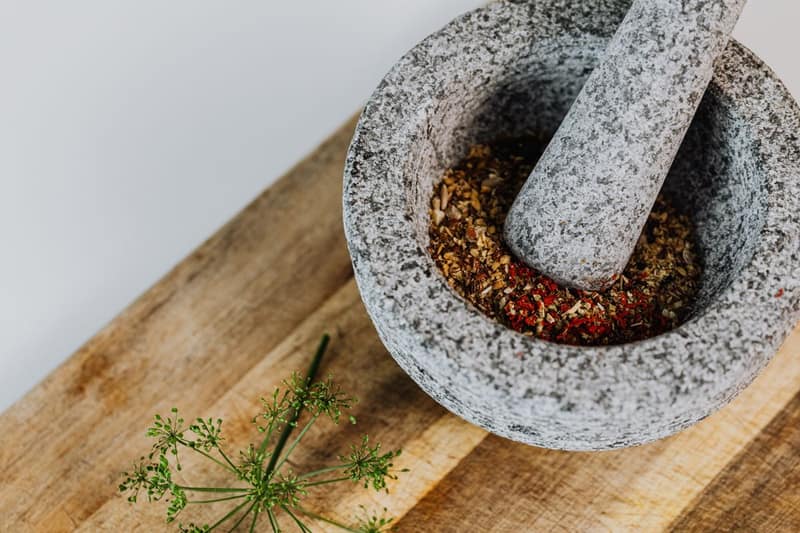
How it looks · Photo: https://kaboompics.com/ on Pexels Step 4
Add the shallots (opens in a new tab) and garlic (opens in a new tab) a little at a time and keep pounding until the paste is fine and no fibres of lemongrass (opens in a new tab) remain, 5–10 minutes. Finally work in the shrimp paste (opens in a new tab) and ground spices. (In a food processor (opens in a new tab), blend everything with no more than 1–2 tbsp water and scrape down often; the paste will be a little looser.)
Step 5
Use straight away or pack into a jar. To use, fry 2–4 tbsp in cracked coconut cream or oil over medium heat for 3–5 minutes, until it smells cooked and the oil turns red, before adding meat and coconut milk.
About this dish
- Origin
- Central Thailand, Thailand · Well documentedProportions follow the widely published central Thai pattern (as set out by cooks such as David Thompson); every household and market stall varies the chilli and aromatics.Also popular in United Kingdom, United States, AustraliaMore food from Thailand
- Dish
- Condiments, chutneys & relishes
- Cooking method
- Raw, Toasted
- Taste
- spicy (chilli heat), aromatic / warmly spiced, umami, citrusy
- Diet
- Pescatarian · No gluten ingredients · Dairy-free · No nut ingredientsWorked out from the ingredients. How labels work
All labels
Pescatarian · Non-vegetarian · Flexitarian-friendly · No gluten ingredients · Dairy-free · Egg-free · No nut ingredients · No added sugar · Alcohol-free · Pork-free · Beef-free · Low-fat · DASH-style - Good for
- Make-ahead · Freezer-friendly
- Cook more with
- Dried whole chillies · Galangal · Lemongrass · Lime · Coriander leaves · Shallot
- Techniques
- Toasting · Spice roasting (dry-roasting)
Allergens
- Contains: Crustaceansfrom shrimp paste
Based on typical versions of these ingredients and not verified allergen-free. Brands differ and cross-contact happens, so always check labels. For severe allergies, follow your clinician’s advice.
Nutrition
17 kcal per serving
Estimated1 serving ≈ 15 g · recipe makes 8
Where the energy comes from
- Protein 14%
- Carbohydrate 72%
- Fat 14%
| Nutrient | Per serving | Per 100 g |
|---|---|---|
| Energy | 17 kcal | 113 kcal |
| Protein | 0.7 g | 4.5 g |
| Carbohydrate | 3.5 g | 23.5 g |
| Net carbohydrate | — | — |
| Sugars | — | — |
| Added sugars | 0 g | 0 g |
| Fibre | — | — |
| Fat | 0.3 g | 1.8 g |
| Saturated fat | 0 g | 0.2 g |
| Trans fat | — | — |
| Cholesterol | 0 mg | 0 mg |
| Sodium | 221 mg | 1476 mg |
| Salt equivalent | 0.6 g | 3.7 g |
Vitamins & minerals per serving
- Potassium
- 97 mg
- Calcium
- 14 mg
- Iron
- 0.6 mg
- Magnesium
- 8 mg
- Vitamin A (RAE)
- 21 µg
- Vitamin C
- 2 mg
- Vitamin D
- 0 µg
- Vitamin B12
- 0 µg
- Folate (DFE)
- 5 µg
How these numbers were made
- Calculated from USDA FoodData Central (SR Legacy) per-100 g values and the listed quantities.
- Galangal: Fresh ginger used as a stand-in: no galangal entry in FDC SR Legacy, and galangal is a closely related rhizome used in similar small amounts.
- Shrimp paste: Fish sauce (FDC 174531) at 1.5× as a stand-in salted fermented seafood condiment; protein is understated.
- “—” means the value isn’t known for enough of the ingredients; it is never zero by default.
- Values are estimates for guidance, not for medical dosing. U.S. Department of Agriculture, Agricultural Research Service. FoodData Central, 2019. fdc.nal.usda.gov.
Good to know
Tips
- Pounding gives a better, more aromatic paste than blending because it crushes the fibres rather than chopping them.
- For a hotter paste, replace a third of the long chillies with small dried bird's eye chillies.
Common mistakes
- Leaving the chilli seeds in, which makes the paste harsh rather than deep and fruity.
- Adding lots of water to the blender — the paste will steam, not fry, and the curry will taste raw.
- Not frying the paste long enough before the liquid goes in.
Serve with
- Thai red curry with chicken and bamboo shoots, jungle curry, red duck curry, tod mun pla (fish cakes), and as the base of panang paste.
Food safety
- Toast shrimp paste wrapped in foil with the fan on — it is pungent — and note that it makes the paste unsuitable for anyone with a shellfish allergy.
- Fresh garlic and aromatics in oil must stay refrigerated; never keep the paste at room temperature.
Storage
- Pack into a clean jar, press cling film onto the surface or cover with a thin layer of oil, and refrigerate; or freeze in tablespoon portions in an ice-cube tray and bag them. Keeps about 10 days in the fridge and 3 months frozen.
Variations
- Jungle curry paste (kaeng pa): Use fresh and dried bird's eye chillies, add krachai (fingerroot) and leave out the dry spices for a fierce, coconut-free curry.
- Panang paste: Pound in roasted peanuts and a little extra coriander and cumin; see the separate panang paste recipe.
Original editorial recipe · FriendsPantry editorial · Not yet independently reviewed · Added · Updated
About this masala
- Type
- Curry paste
- Texture
- Smooth paste
- One batch makes
- about 120 g
- Keeps
- 10 days
- Store
- Covered, in the fridge
- Recipe
- Traditional
Central Thailand. Makes Thai curry paste, the ingredient our dish recipes list. All masalas
Regional variations: Panang curry paste
Used in
Amounts are each dish’s own quantity, for the servings it is written for. “Make enough” opens this recipe scaled for that dish.
- Thai red curry with chicken and bamboo shootsMade fresh in the recipe (pounded in the mortar in step 1) · 147 g for 4 servingsMake enough
- Thai satay peanut sauce30 g · 30 g for 10 servings (about 55 g)Make enough
Recipe DNA
How this dish is built
Grouped by each ingredient’s role in the dish. Each band’s width is its share of the dish by weight. Choose a component to see what it does.
What the dish is built around
Main ingredient
- Galangal, raw, peeled and finely chopped8 g
- Lemongrass, raw, tender lower part of 2 stalks, finely sliced15 g
- Lime, raw zest only, finely grated — makrut lime zest if you can find it2 g
Reviews & corrections
Reviews come from signed-in cooks and appear after a moderator checks them. We never show made-up ratings.
You might also like
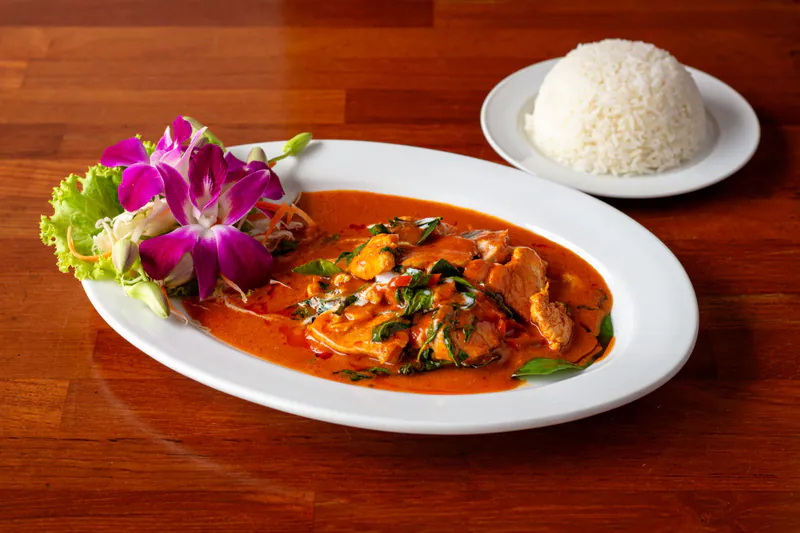
Thai red curry with chicken and bamboo shoots
 Thai · 55 min · 682 kcal
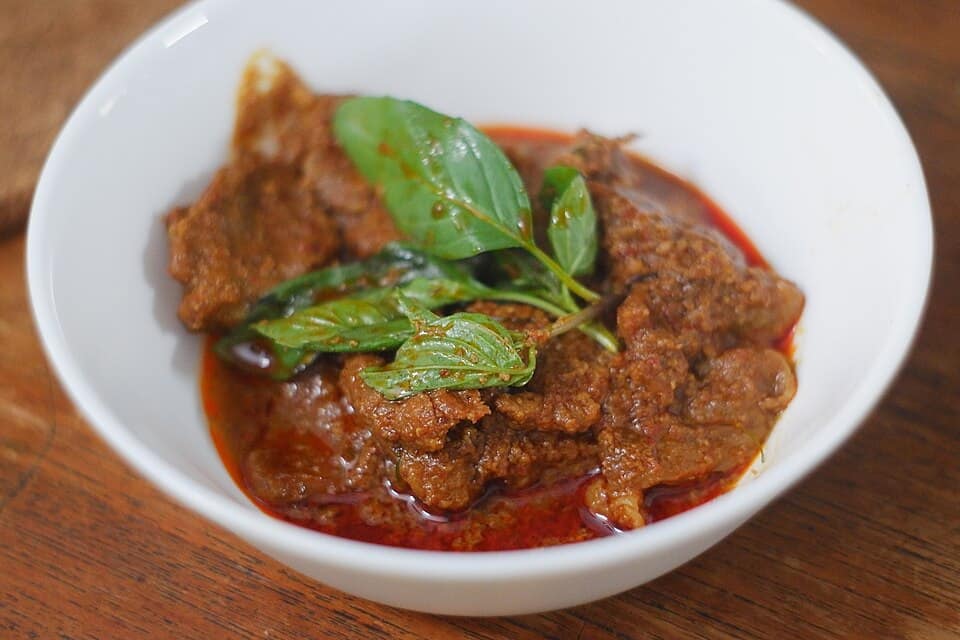
Panang curry with beef
Thai · 50 min · 569 kcal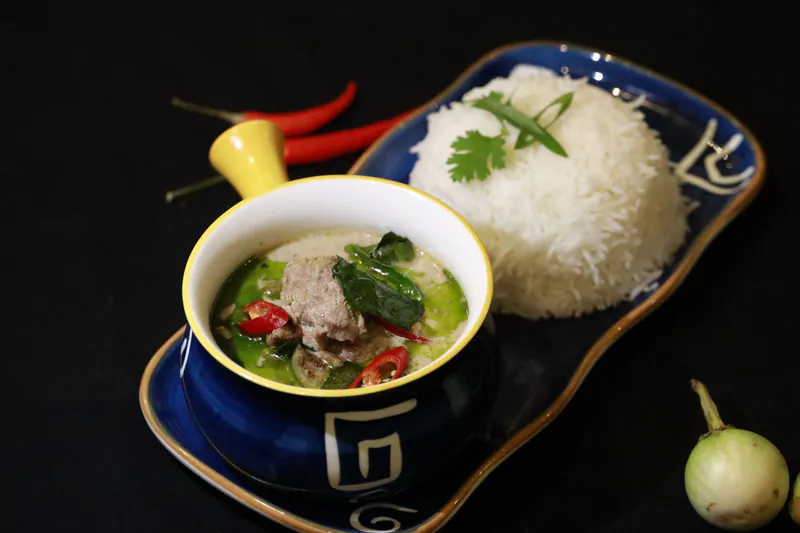
Thai green curry with chicken
Thai · 55 min · 679 kcalMassaman curry with beef
Thai · 2 h 55 min · 741 kcal