
Taiwanese beef noodle soup
Non-vegetarian
紅燒牛肉麵 · hóng shāo niú ròu miàn
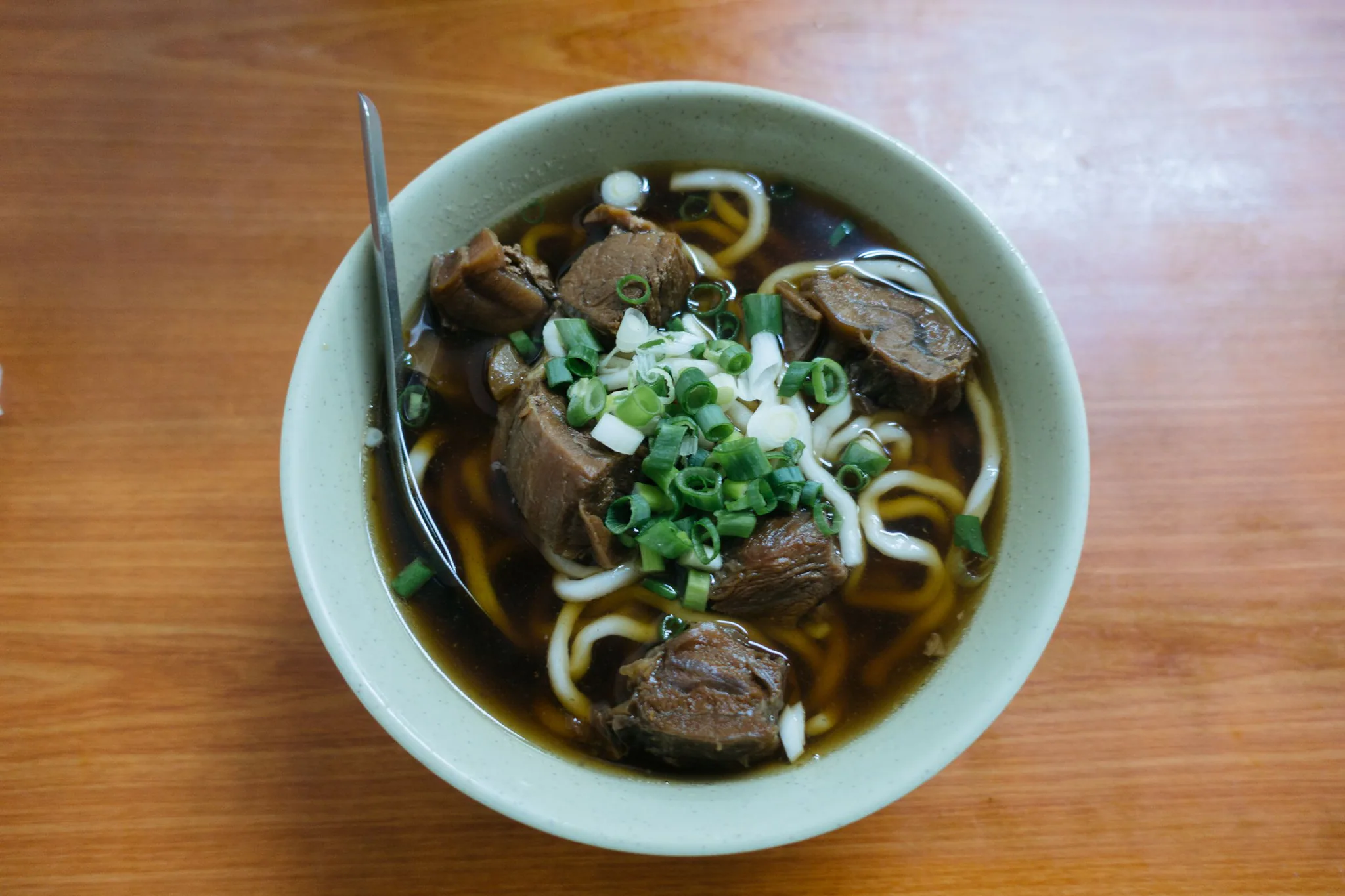
Chunks of beef shank braised for hours in a deep, spiced broth of chilli bean paste, soy sauce, star anise and tomato, served over thick wheat noodles with greens.
Taiwanese beef noodle soup is a Taiwanese noodle dish, ready in about 3 hours and made with beef chuck, chilli bean paste (doubanjiang) and soy sauce. It serves 6 and is rated intermediate to cook.
- Prep
- 20 min
- Cook
- 2 h 40 min
- Total
- 3 h
- Serves
- 6
- Level
- Intermediate
- Calories
- 551
Method
Step 1
Put the beef in a pot of cold water, bring to a boil and blanch for 5 minutes. Drain and rinse.
- 12 min
- high heat
Food safety: Wash hands and boards after handling raw beef.
Step 2
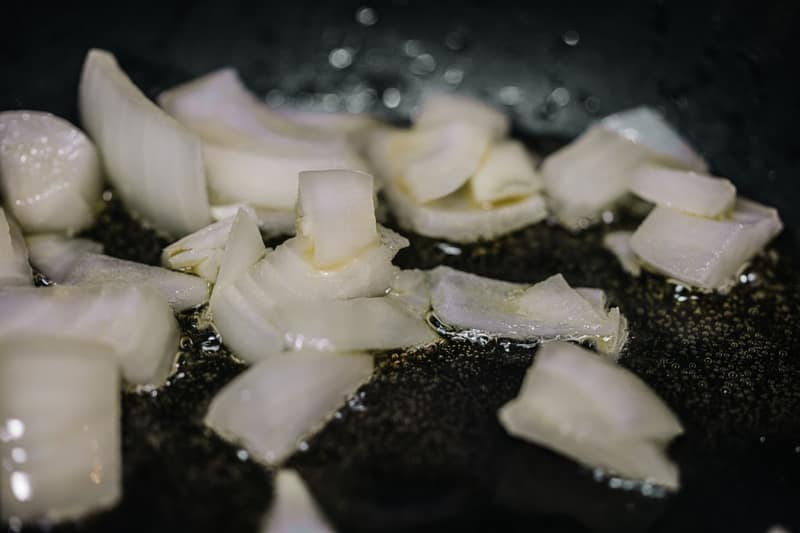
Heat the oil in a heavy pot and fry the ginger, garlic (opens in a new tab), spring onion (opens in a new tab) whites and onion (opens in a new tab) until browned at the edges. Add the chilli bean paste (opens in a new tab) and fry until the oil turns red.
- 6 min
- medium heat
- Dutch oven / casserole pot (opens in a new tab)
How it looks · Photo: Magda Ehlers on Pexels Step 3
Add the beef, tomato (opens in a new tab), spices, wine, soy sauce (opens in a new tab) and sugar (opens in a new tab) and stir for 2 minutes, then pour in the water.
- 4 min
- medium-high heat
Step 4
Bring to a boil, cover and simmer gently for 2–2½ hours until the beef is very tender. Skim, fish out the whole spices and season with salt.
- 135 min
- low heat
Step 5
Cook the noodles, adding the bok choy (opens in a new tab) for the last minute. Divide between deep bowls, top with beef and plenty of hot broth and the spring onion (opens in a new tab) greens.
- 8 min
- high heat
- Saucepan (opens in a new tab)
About this dish
- Origin
- Taiwan · Commonly attributedThe red-braised style is widely credited to cooks in Taiwan after 1949, drawing on Sichuan flavours; details of its invention are debated.Also popular in ChinaMore food from Taiwan
- Dish
- Lunch · Dinner · Noodles · Soups · Main courses
- Cooking method
- Braised, Simmered, Boiled
- Taste
- savoury, spicy (chilli heat), aromatic / warmly spiced, rich
- Diet
- Dairy-free · No nut ingredients · High-proteinWorked out from the ingredients. How labels work
All labels
Non-vegetarian · Dairy-free · Egg-free · No nut ingredients · Pork-free · High-protein · Low-fat - Good for
- Make-ahead · Freezer-friendly · Batch cooking
- Cook more with
- Beef chuck · Chilli bean paste (doubanjiang) · Soy sauce · Udon noodles · Fresh ginger · Garlic
Allergens
- Contains: Wheatfrom chilli bean paste (doubanjiang), shaoxing wine, soy sauce, udon noodles
- Contains: Glutenfrom chilli bean paste (doubanjiang), shaoxing wine, soy sauce, udon noodles
- Contains: Soyfrom chilli bean paste (doubanjiang), soy sauce
Based on typical versions of these ingredients and not verified allergen-free. Brands differ and cross-contact happens, so always check labels. For severe allergies, follow your clinician’s advice.
Nutrition
551 kcal per serving
Estimated1 serving ≈ 747 g · recipe makes 6
Where the energy comes from
- Protein 33%
- Carbohydrate 46%
- Fat 21%
| Nutrient | Per serving | Per 100 g* |
|---|---|---|
| Energy | 551 kcal | 74 kcal |
| Protein | 44.6 g | 6 g |
| Carbohydrate | 63 g | 8.4 g |
| Net carbohydrate | 57.4 g | 7.7 g |
| Sugars | — | — |
| Added sugars | 2.1 g | 0.3 g |
| Fibre | 5.7 g | 0.8 g |
| Fat | 12.6 g | 1.7 g |
| Saturated fat | 3.3 g | 0.4 g |
| Trans fat | — | — |
| Cholesterol | 96 mg | 13 mg |
| Sodium | 2668 mg | 357 mg |
| Salt equivalent | 6.7 g | 0.9 g |
Vitamins & minerals per serving
- Potassium
- 1135 mg
- Calcium
- 192 mg
- Iron
- 5.6 mg
- Magnesium
- 99 mg
- Vitamin A (RAE)
- 204 µg
- Vitamin C
- 46 mg
- Vitamin D
- 0.2 µg
- Vitamin B12
- 3.5 µg
- Folate (DFE)
- 87 µg
How these numbers were made
- Calculated from USDA FoodData Central (SR Legacy) per-100 g values and the listed quantities.
- *Per 100 g of combined raw ingredients; the cooked dish may weigh more or less.
- Not counted (tiny amounts or “to taste”): sichuan peppercorns.
- Chilli bean paste (doubanjiang): Miso (FDC 172442) as a stand-in: both are salted fermented soybean pastes; doubanjiang adds chilli and broad beans.
- Star anise / anise: Anise seed (FDC 171316) used as a stand-in for star anise.
- Shaoxing wine: Sake (FDC 167723) used as a stand-in for Chinese rice cooking wine.
- Udon noodles: Dry somen (FDC 168908) used as a stand-in; both are plain Japanese wheat noodles.
- “—” means the value isn’t known for enough of the ingredients; it is never zero by default.
- Values are estimates for guidance, not for medical dosing. U.S. Department of Agriculture, Agricultural Research Service. FoodData Central, 2019. fdc.nal.usda.gov.
Good to know
Tips
- Make the broth a day ahead: the flavour deepens and you can lift off the set fat.
Common mistakes
- Boiling the broth hard, which makes the beef tough and the soup cloudy.
Serve with
- Serve with pickled mustard greens (suan cai) and chilli oil at the table.
Storage
- Refrigerate the beef and broth for up to 4 days or freeze for 3 months.
Reheating
- Bring the broth back to a full simmer; cook the noodles fresh.
Variations
- Clear-braised beef noodle soup (Taiwan): Qing dun: a lighter broth without chilli bean paste or dark soy, seasoned mainly with salt and aromatics.
Original editorial recipe · FriendsPantry editorial · Not yet independently reviewed · Added · Updated
Recipe DNA
How this dish is built
Grouped by each ingredient’s role in the dish. Each band’s width is its share of the dish by weight. Choose a component to see what it does.
What the dish is built around
Main ingredient
- Beef chuck, shank or chuck, in 4 cm chunks900 g
- Tomato, quartered2 piece · 240 g
- Udon noodles, dried weight; thick wheat noodles400 g
- Bok choy, halved4 piece · 480 g
Reviews & corrections
Reviews come from signed-in cooks and appear after a moderator checks them. We never show made-up ratings.
You might also like
Tomato beef noodle soup
 Chinese · 2 h · 585 kcal
Lu rou fan (Taiwanese braised pork rice)
 Taiwanese · 2 h · 779 kcal
Mapo tofu
Sichuan · 25 min · 253 kcal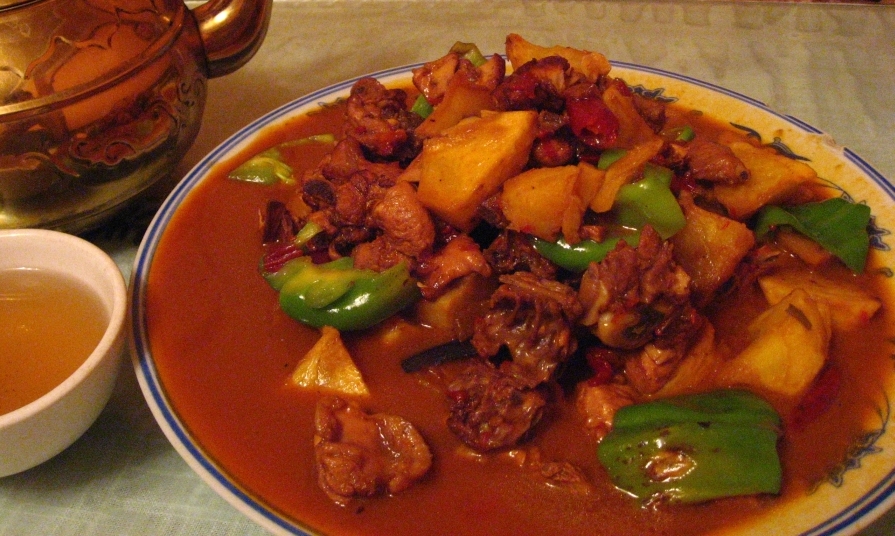
Da pan ji (Xinjiang big plate chicken)
Chinese · 1 h 50 min · 697 kcal