
Pizza Margherita
Vegetarian
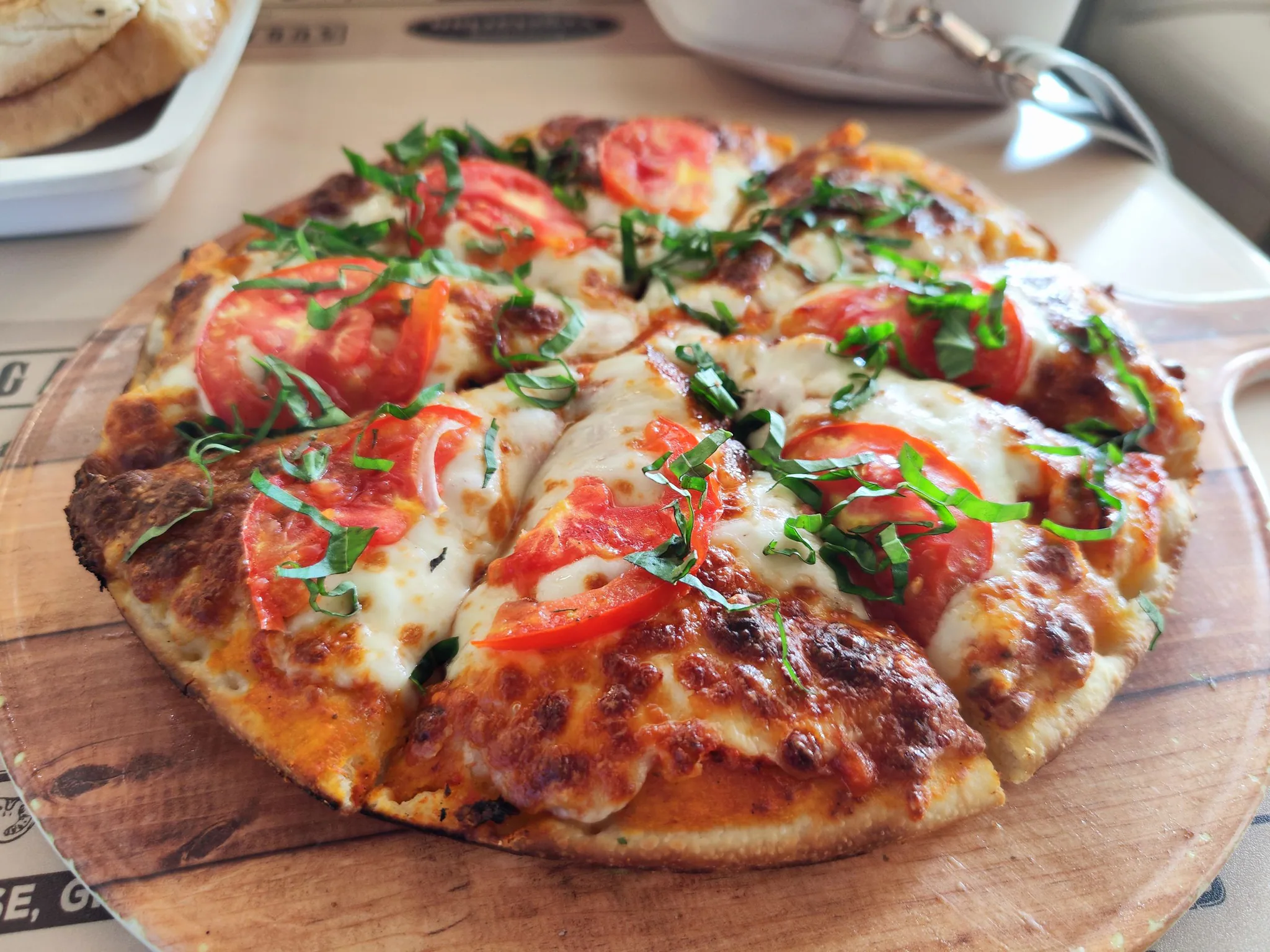
Neapolitan-style pizza with a blistered, chewy crust, simple raw tomato sauce, mozzarella and basil, adapted for a home oven.
Pizza Margherita is an Italian savoury bake from Italy, ready in about 3 hours 27 minutes and made with bread flour, tomato passata and mozzarella. It serves 4 and is rated intermediate to cook.
- Prep
- 25 min
- Cook
- 32 min
- Rest
- 2 h 30 min
- Total
- 3 h 27 min
- Serves
- 4
- Level
- Intermediate
- Calories
- 756
For more flavour, cold-prove the dough balls in the fridge for 24–48 hours.
Method
Step 1
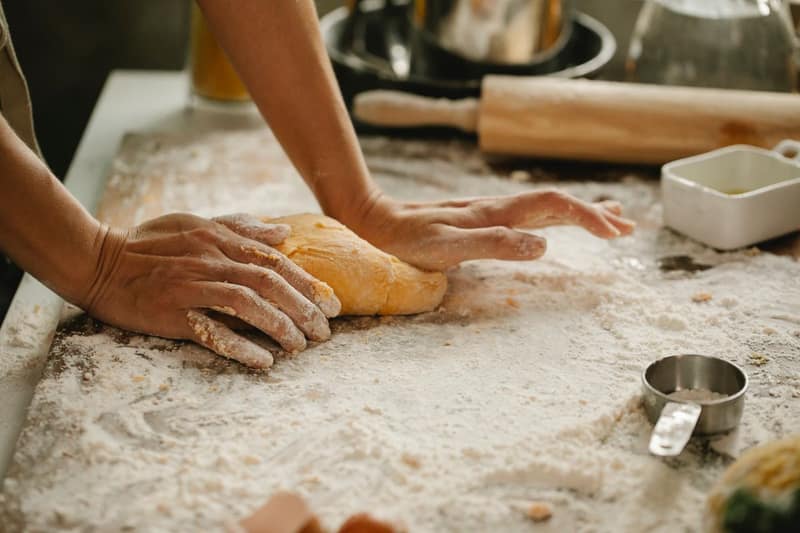
Mix the flour, yeast and water, then add the salt and oil. Knead for about 10 minutes until smooth and elastic.
- 12 min
How it looks · Photo: Klaus Nielsen on Pexels Step 2
Cover and leave to rise until doubled in size.
A warm kitchen speeds this up; a cool one slows it but improves flavour.
Step 3
Divide into 4 balls, cover and rest again until puffy and relaxed.
- 3 min
Step 4
Heat the oven (opens in a new tab) to its maximum with a heavy tray (or pizza stone) inside for at least 30 minutes. Season the passata with salt.
- 250°C · or as hot as your oven goes
- Oven (opens in a new tab)
- Baking tray / sheet (opens in a new tab)
Step 5
Stretch one ball by hand into a 25–28 cm round, leaving a thicker rim. Spread with a thin layer of sauce, scatter over a quarter of the mozzarella (opens in a new tab) and drizzle with oil.
- 3 min
How it looks · Photo: Klaus Nielsen on Pexels Step 6
Slide onto the hot tray and bake until the crust is puffed and spotted dark and the cheese has melted. Top with basil (opens in a new tab) and serve; repeat with the remaining dough.
- 8 min
- 250°C
About this dish
- Origin
- Campania (Naples), Italy · Well documentedAlso popular in United States, United Kingdom, Germany, BrazilMore food from Italy
- Dish
- Lunch · Dinner · Pizza & savoury pies · Main courses
- Cooking method
- Oven-baked
- Taste
- savoury, fresh, tangy, herby
- Diet
- Vegetarian (lacto-ovo) · No nut ingredients · High-proteinWorked out from the ingredients. How labels work
All labels
Vegetarian (lacto-ovo) · Eggetarian · Lacto-vegetarian · Pescatarian · Flexitarian-friendly · Egg-free · No nut ingredients · No added sugar · Alcohol-free · Pork-free · Beef-free · High-protein - Good for
- Child-friendly
- Cook more with
- Bread flour · Tomato passata · Mozzarella · Dried yeast · Basil
- Techniques
- Baking · Kneading · Fermentation
Allergens
- Contains: Milkfrom mozzarella
- Contains: Wheatfrom bread flour, semolina
- Contains: Glutenfrom bread flour, semolina
Based on typical versions of these ingredients and not verified allergen-free. Brands differ and cross-contact happens, so always check labels. For severe allergies, follow your clinician’s advice.
Nutrition
756 kcal per serving
Calculated1 serving ≈ 349 g · recipe makes 4
Where the energy comes from
- Protein 16%
- Carbohydrate 52%
- Fat 31%
| Nutrient | Per serving | Per 100 g* |
|---|---|---|
| Energy | 756 kcal | 216 kcal |
| Protein | 30.4 g | 8.7 g |
| Carbohydrate | 98.5 g | 28.2 g |
| Net carbohydrate | 93.9 g | 26.9 g |
| Sugars | 3.5 g | 1 g |
| Added sugars | 0 g | 0 g |
| Fibre | 4.5 g | 1.3 g |
| Fat | 26.2 g | 7.5 g |
| Saturated fat | 10.4 g | 3 g |
| Trans fat | — | — |
| Cholesterol | 49 mg | 14 mg |
| Sodium | 1347 mg | 385 mg |
| Salt equivalent | 3.4 g | 1 g |
Vitamins & minerals per serving
- Potassium
- 474 mg
- Calcium
- 359 mg
- Iron
- 7.1 mg
- Magnesium
- 62 mg
- Vitamin A (RAE)
- 134 µg
- Vitamin C
- 7 mg
- Vitamin D
- 0.3 µg
- Vitamin B12
- 1.4 µg
- Folate (DFE)
- 396 µg
How these numbers were made
- Calculated from USDA FoodData Central (SR Legacy) per-100 g values and the listed quantities.
- *Per 100 g of combined raw ingredients; the cooked dish may weigh more or less.
- Optional ingredients are not included: semolina.
- “—” means the value isn’t known for enough of the ingredients; it is never zero by default.
- Values are estimates for guidance, not for medical dosing. U.S. Department of Agriculture, Agricultural Research Service. FoodData Central, 2019. fdc.nal.usda.gov.
Good to know
Tips
- Patting the mozzarella dry stops the pizza going soggy.
- Use very little sauce — a thin layer gives a crisper base.
Common mistakes
- Rolling the dough with a pin, which knocks out the air that makes the rim puff.
Serve with
- Serve with a rocket salad.
Storage
- Unbaked dough balls keep in the fridge for 2 days or frozen for a month.
Reheating
- Reheat slices in a hot dry frying pan with a lid for a few minutes.
Variations
- Pizza marinara (Italy): Tomato, garlic, oregano and olive oil with no cheese.
History
The Margherita is traditionally linked to Queen Margherita of Savoy and an 1889 visit to Naples, though historians consider the story partly legendary.
Confidence: Origin disputed
Original editorial recipe · FriendsPantry editorial · Not yet independently reviewed · Added · Updated
Recipe DNA
How this dish is built
Baker’s notes
Customise in Bread & BakeryTimeline and readiness cues
Mix and knead · about 25 min
Weigh everything. Knead until smooth and elastic: a small piece stretches thin enough to see light through (the windowpane test).
First rise (bulk) · about 2 h
About doubled, domed, jiggly, with bubbles on the sides. A floured finger poked in leaves a dent that fills slowly.
Final proof · about 30 min
Poke test: the dent springs back slowly and only partly. Springs back fast = needs longer; doesn't spring back = over-proofed, bake now.
Bake · about 32 min at 250 °C
Deep golden; bread sounds hollow when tapped underneath, or reads 93–96 °C inside (enriched breads 88–90 °C).
- Start to finish: about 3 h 27 min. Times are a guide — warmth changes everything; follow the cues.
The dough
| Ingredient | Role | Weight | Baker’s % |
|---|---|---|---|
| Bread flour | Flour | 500 g | 100% |
| Water | Water | 325 g | 65% |
| Olive oil | Fat | 14 g | 2.7% |
| Salt | Salt | 9 g | 1.8% |
| Dried yeast | Yeast | 4 g | 0.8% |
- Total flour
- 500 g
- Hydration
- 65%
- With milk, eggs…
- 65%
- Wholegrain
- 0%
Hydration = water ÷ flour × 100. Milk is about 87% water and eggs about 75%, so they’re shown separately as “with milk, eggs…”.
- Soft, slightly sticky dough (65–75%) — open crumb; most rustic loaves.
- Salt 1.8% — normal for bread.
If something goes wrong
Spreads flat / no oven spring
Likely causes
- Over-proofed
- Weak shaping (no surface tension)
- Oven not hot enough
- Too much water for the flour
What to do
- Shorten the proof; bake when the poke springs back slowly
- Shape tightly so the skin is taut
- Preheat fully (30+ minutes; with a stone or Dutch oven, 45)
- Lower hydration or use bread flour
Pale crust
Likely causes
- Oven too cool
- Too little sugar or no milk/egg for browning
- Over-fermented (yeast ate the sugars)
What to do
- Check the oven with a thermometer
- Brush with egg wash or milk
- Shorten the fermentation
Burnt bottom
Likely causes
- Tray too close to the heat
- Dark tray absorbs more heat
- Too much sugar in the dough
What to do
- Bake on the middle shelf
- Double up trays or use a light-coloured one
- Lower the temperature 10–15 °C and bake a little longer
Crust too hard or thick
Likely causes
- Baked too long at too low a temperature
- No steam at the start
What to do
- Bake hotter for a shorter time
- Add steam for the first 15 minutes (tray of boiling water, or a covered Dutch oven)
- Cool under a tea towel for a softer crust
Reviews & corrections
Reviews come from signed-in cooks and appear after a moderator checks them. We never show made-up ratings.
You might also like
Eggplant parmigiana
 Italian · 2 h 15 min · 415 kcal · Vegetarian
Baked ziti
 American · 1 h 30 min · 487 kcal
Focaccia
Italian · 3 h 10 min · 319 kcal · Vegan
Malloreddus alla campidanese
Italian · 50 min · 796 kcal