
Sourdough country loaf (pain au levain)
Vegetarian
Pain au levain
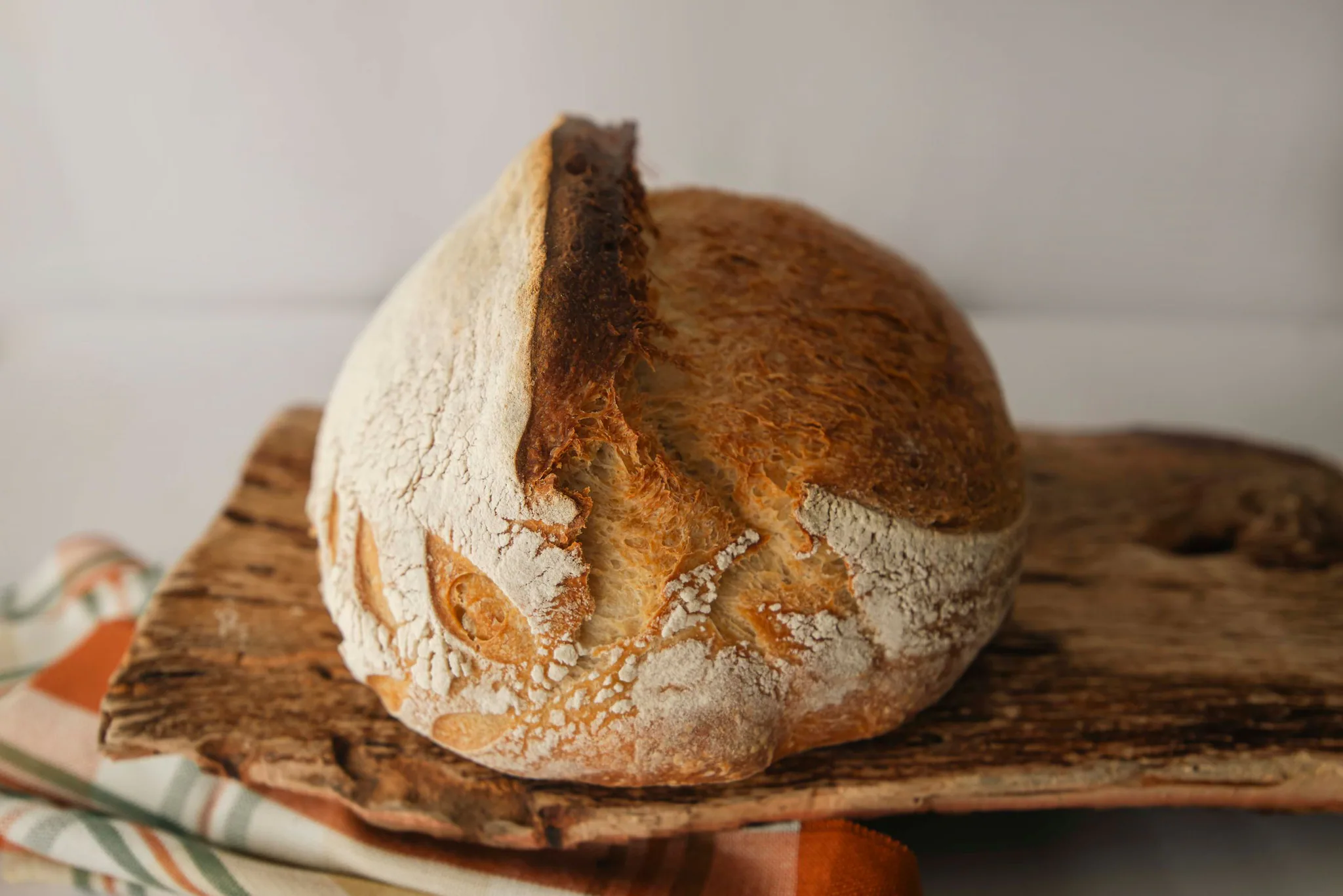
A crackly, deeply caramelised sourdough boule with an open, glossy crumb, made with nothing but flour, water, salt and an active starter, then cold-retarded overnight for flavour.
Sourdough country loaf (pain au levain) is a French bread from France, ready in about 22 hours 55 minutes and made with sourdough starter and bread flour. It serves 14 and is rated advanced to cook.
- Prep
- 30 min
- Cook
- 45 min
- Rest
- 21 h 40 min
- Total
- 22 h 55 min
- Serves
- 14
- Level
- Advanced
- Calories
- 141
Includes about 5 hours of autolyse and bulk fermentation, a 12–16 hour cold retard in the fridge and 2 hours' cooling. Feed the starter 4–8 hours beforehand.
Ingredients
Equipment
- Oven (opens in a new tab)
- Dutch oven / casserole pot (opens in a new tab)
- Kitchen scale (opens in a new tab)
- Mixing bowl (opens in a new tab)
- Proofing basket (banneton) (opens in a new tab)
- Bench scraper (opens in a new tab)
- Bread lame (opens in a new tab)
- Food thermometer (opens in a new tab)
- Cooling rack (opens in a new tab)
Method
Step 1
Autolyse: in a large bowl, mix the bread flour (opens in a new tab), wholemeal flour (opens in a new tab) and 350 g of the water until no dry flour remains. Cover and leave for 45 minutes so the flour hydrates and gluten starts forming on its own.
Check the starter is ready: a teaspoon of it should float in water.
Step 2
Add the starter and pinch and fold it through the dough for 2–3 minutes. Rest 20 minutes, then sprinkle over the salt with the remaining 25 g water and squeeze it in until the dough feels cohesive again. It will be sticky; that is normal at 75% hydration.
- 8 min

How it looks · Photo: Klaus Nielsen on Pexels Step 3
Bulk ferment, ideally at 24–26 °C, for 4–5 hours in total. During the first 2 hours do 4 sets of stretch-and-folds 30 minutes apart: with a wet hand lift one side of the dough, stretch it up and fold it over, turn the bowl a quarter and repeat on all four sides. Then leave it undisturbed. Bulk is done when the dough has risen by about 50–75%, is domed, jiggles when the bowl is shaken and shows bubbles on the sides and surface.
- 10 min
Cooler kitchen (21 °C)? Expect 6–7 hours. Watch the dough, not the clock.
Step 4
Tip the dough onto an unfloured worktop and preshape it into a loose round with a bench scraper (opens in a new tab), building a little tension. Rest uncovered for 20–30 minutes until it relaxes and spreads slightly.
Step 5
Final shape: lightly flour the top, flip it, fold the bottom third up, the sides in and the top down, then roll it towards you and drag it on the bench to tighten the skin into a taut ball. Place seam-side up in a banneton (or a bowl lined with a tea towel) dusted with rice flour (opens in a new tab). Cover and refrigerate for 12–16 hours at about 4 °C.
The cold retard deepens the flavour and makes the loaf much easier to score.
Step 6
Put the Dutch oven (opens in a new tab) with its lid into the oven and preheat to 250 °C (fan 230 °C) for 45 minutes. Turn the cold loaf out onto a piece of parchment, score one confident 1 cm-deep slash at a shallow angle along one side, and lower it into the pot.
- 50 min
- 250°C · fan 230 °C; preheat the pot for 45 minutes
- Oven (opens in a new tab)
- Dutch oven / casserole pot (opens in a new tab)
- Bread lame (opens in a new tab)
Food safety: The Dutch oven and lid are at 250 °C: use thick oven gloves and lower the dough in on parchment rather than by hand.
Step 7
Bake with the lid on for 20 minutes — the trapped steam lets the loaf spring and the scored 'ear' open. Remove the lid, lower the oven (opens in a new tab) to 230 °C (fan 210 °C) and bake a further 20–25 minutes until the crust is deep brown. The loaf should sound hollow when tapped underneath and read 96–98 °C in the centre.
- 45 min
- 230°C · fan 210 °C, lid off for the last 20–25 minutes
- Dutch oven / casserole pot (opens in a new tab)
- Food thermometer (opens in a new tab)
Step 8
Cool on a rack for at least 2 hours before slicing; the crumb is still setting and cutting early makes it gummy.
About this dish
- Origin
- France · Commonly attributedNaturally leavened bread is far older than any one country; the open-crumbed, high-hydration 'country loaf' baked in a Dutch oven is a modern home-baking style built on the French pain au levain tradition.Also popular in United Kingdom, United States, Germany, AustraliaMore food from France
- Dish
- Breakfast · Lunch · Dinner · Breads & flatbreads
- Cooking method
- Oven-baked, Fermented
- Taste
- sour, nutty, savoury, earthy
- Diet
- Vegan · Dairy-free · No nut ingredientsWorked out from the ingredients. How labels work
All labels
Vegan · Plant-based · Vegetarian (lacto-ovo) · Eggetarian · Lacto-vegetarian · Ovo-vegetarian · Pescatarian · Flexitarian-friendly · Dairy-free · Egg-free · No nut ingredients · No added sugar · Alcohol-free · Pork-free · Beef-free · Low-fat · DASH-style - Good for
- Make-ahead · Freezer-friendly
- Cook more with
- Sourdough starter · Bread flour · Whole-wheat flour
- Techniques
- Baking · Fermentation
Allergens
- Contains: Wheatfrom sourdough starter, bread flour, whole-wheat flour
- Contains: Glutenfrom sourdough starter, bread flour, whole-wheat flour
Based on typical versions of these ingredients and not verified allergen-free. Brands differ and cross-contact happens, so always check labels. For severe allergies, follow your clinician’s advice.
Nutrition
141 kcal per serving
Estimated1 serving ≈ 60 g · recipe makes 14
Where the energy comes from
- Protein 13%
- Carbohydrate 82%
- Fat 5%
| Nutrient | Per serving | Per 100 g |
|---|---|---|
| Energy | 141 kcal | 235 kcal |
| Protein | 4.7 g | 7.8 g |
| Carbohydrate | 28.6 g | 47.7 g |
| Net carbohydrate | 27.4 g | 45.6 g |
| Sugars | 0.1 g | 0.2 g |
| Added sugars | 0 g | 0 g |
| Fibre | 1.3 g | 2.1 g |
| Fat | 0.7 g | 1.1 g |
| Saturated fat | 0.1 g | 0.2 g |
| Trans fat | — | — |
| Cholesterol | 0 mg | 0 mg |
| Sodium | 278 mg | 464 mg |
| Salt equivalent | 0.7 g | 1.2 g |
Vitamins & minerals per serving
- Potassium
- 49 mg
- Calcium
- 9 mg
- Iron
- 1.7 mg
- Magnesium
- 14 mg
- Vitamin A (RAE)
- 0 µg
- Vitamin C
- 0 mg
- Vitamin D
- 0 µg
- Vitamin B12
- 0 µg
- Folate (DFE)
- 105 µg
How these numbers were made
- Calculated from USDA FoodData Central (SR Legacy) per-100 g values and the listed quantities.
- Optional ingredients are not included: rice flour.
- Sourdough starter: Modelled as a 100%-hydration starter: equal weights of flour and water, so half of white flour's values per gram.
- “—” means the value isn’t known for enough of the ingredients; it is never zero by default.
- Values are estimates for guidance, not for medical dosing. U.S. Department of Agriculture, Agricultural Research Service. FoodData Central, 2019. fdc.nal.usda.gov.
Good to know
Tips
- Keep notes of dough temperature and bulk time — it's the fastest way to get consistent loaves.
- No Dutch oven? Bake on a preheated tray or stone and pour a cup of boiling water into a hot roasting tin on the shelf below for the first 20 minutes.
Common mistakes
- Under-fermented bulk gives a tight crumb with a few big tunnels under the crust; let the dough rise properly.
- Using a sluggish starter — feed it twice a day for a couple of days before baking if it isn't doubling.
- Slicing while warm, which makes the crumb gummy.
Serve with
- With salted butter, as toast, or alongside soups, cheeses and charcuterie.
Storage
- Keeps 3–4 days cut-side down on a board or in a bread bag. Slice and freeze for up to 3 months.
Reheating
- Refresh a whole loaf in a 200 °C oven for 8–10 minutes, or toast slices from frozen.
Variations
- Seeded levain: Fold 80 g toasted sunflower and pumpkin seeds (soaked in 40 g water) into the dough during the second set of folds.
- Same-day loaf: Skip the fridge: proof shaped at room temperature for 1–2 hours until the poke test springs back slowly, then bake.
How do I know the final proof is right?
Press a floured fingertip 1 cm into the dough. If it springs back slowly and leaves a slight dent, bake. If it springs back instantly it needs longer; if the dent stays, it is over-proofed — bake straight away without scoring deeply.
Original editorial recipe · FriendsPantry editorial · Not yet independently reviewed · Added · Updated
Recipe DNA
How this dish is built
Grouped by each ingredient’s role in the dish. Each band’s width is its share of the dish by weight. Choose a component to see what it does.
What the dish is built around
Main ingredient
- Bread flour450 g
- Whole-wheat flour50 g
- Rice flour (optional)1 tbsp · 9.9 g
Baker’s notes
Customise in Bread & BakeryTimeline and readiness cues
Mix and knead · about 30 min
Mix, rest 30 minutes (autolyse), then add salt. Strengthen with sets of stretch-and-folds instead of long kneading.
First rise (bulk) · about 5 h 15 min
Risen 50–75%, domed and bubbly at the edges, wobbles when the bowl is shaken. Warmer kitchens are faster.
Rest · about 25 min
Covered so it doesn't dry out; relaxed dough rolls and shapes without springing back.
Final proof · about 14 h
Slow, partial spring-back from a floured poke. Cold-proofed dough can go straight from the fridge into the oven.
Bake · about 45 min at 250 °C
Deep golden; bread sounds hollow when tapped underneath, or reads 93–96 °C inside (enriched breads 88–90 °C).
Cool · about 2 h
Cool on a rack before slicing — the crumb is still setting; cutting hot bread makes it gummy.
- Start to finish: about 22 h 55 min. Times are a guide — warmth changes everything; follow the cues.
The dough
| Ingredient | Role | Weight | Baker’s % |
|---|---|---|---|
| Bread flour | Flour | 450 g | 81.8% |
| Whole-wheat flour | Flour | 50 g | 9.1% |
| Water | Water | 375 g | 68.2% |
| Sourdough starter | Starter | 100 g | 18.2% |
| Salt | Salt | 10 g | 1.8% |
- Total flour
- 550 g
- Hydration
- 77.3%
- With milk, eggs…
- 77.3%
- Wholegrain
- 9.1%
Hydration = water ÷ flour × 100. Milk is about 87% water and eggs about 75%, so they’re shown separately as “with milk, eggs…”. The starter’s own flour and water are included once in the totals.
- Wet dough (over 75%) — sticky; use wet hands and folds instead of kneading. Ciabatta, focaccia and open sourdough.
- Salt 1.8% — normal for bread.
- 9.1% of the flour comes from the starter (100 g at 100% hydration: 50 g flour + 50 g water, already included above).
If something goes wrong
Dense, heavy loaf
Likely causes
- Under-kneaded (weak gluten)
- Under-proofed
- Old or dead yeast/starter
- Too much wholegrain flour without extra water
What to do
- Knead to the windowpane stage
- Proof by the poke test, not the clock
- Test yeast in warm water with sugar; feed the starter and use it at its peak
- Add 5–10% more water for wholegrain flours and give them a rest
Gummy or wet crumb
Likely causes
- Under-baked
- Sliced while hot
- Hydration too high for the flour
What to do
- Bake to 93–96 °C inside (cakes: clean skewer)
- Cool completely on a rack before slicing
- Reduce water by 3–5% or use a stronger flour
Spreads flat / no oven spring
Likely causes
- Over-proofed
- Weak shaping (no surface tension)
- Oven not hot enough
- Too much water for the flour
What to do
- Shorten the proof; bake when the poke springs back slowly
- Shape tightly so the skin is taut
- Preheat fully (30+ minutes; with a stone or Dutch oven, 45)
- Lower hydration or use bread flour
Pale crust
Likely causes
- Oven too cool
- Too little sugar or no milk/egg for browning
- Over-fermented (yeast ate the sugars)
What to do
- Check the oven with a thermometer
- Brush with egg wash or milk
- Shorten the fermentation
Burnt bottom
Likely causes
- Tray too close to the heat
- Dark tray absorbs more heat
- Too much sugar in the dough
What to do
- Bake on the middle shelf
- Double up trays or use a light-coloured one
- Lower the temperature 10–15 °C and bake a little longer
Crust too hard or thick
Likely causes
- Baked too long at too low a temperature
- No steam at the start
What to do
- Bake hotter for a shorter time
- Add steam for the first 15 minutes (tray of boiling water, or a covered Dutch oven)
- Cool under a tea towel for a softer crust
Too sour
Likely causes
- Long, cool fermentation
- Starter used after its peak
- High proportion of wholegrain or rye in the starter
What to do
- Ferment warmer (24–26 °C) and shorter
- Use the starter at its peak
- Feed the starter with white flour, at a higher ratio (1:5:5)
Dough didn't rise
Likely causes
- Dead yeast (expired or killed by hot liquid)
- Kitchen too cold
- Salt in direct contact with fresh yeast
- Starter not active
What to do
- Liquid should be lukewarm (no hotter than 40 °C)
- Proof somewhere warm (an oven with just the light on)
- Mix the salt into the flour, not onto the yeast
- Feed the starter until it doubles in 4–8 hours
Over-proofed (sour smell, collapses when scored)
Likely causes
- Too warm
- Too much yeast
- Left too long
What to do
- Knock back, reshape and proof again briefly (yeast doughs)
- Use less yeast or a cooler proof
- Set a timer and check early with the poke test
Reviews & corrections
Reviews come from signed-in cooks and appear after a moderator checks them. We never show made-up ratings.
You might also like
Wholegrain sourdough tin loaf
International · 19 h 15 min · 120 kcal · Vegetarian
Pain de campagne
 French · 18 h · 141 kcal · Vegan
Baguettes with poolish
French · 17 h 15 min · 304 kcal · VeganFougasse
French · 3 h 13 min · 277 kcal · Vegan