
Ma'amoul with dates
Vegetarian
معمول · ma'amoul
Melt-in-the-mouth semolina shortbread cookies filled with spiced date paste and pressed into patterned moulds. Baked for Eid and Easter across the Levant.
Ma'amoul with dates is a Levantine sweet, ready in about 2 hours 8 minutes and made with semolina, butter and dates. It serves 24 and is rated intermediate to cook.
No licensed photograph of this dish yet.
- Prep
- 50 min
- Cook
- 18 min
- Rest
- 1 h
- Total
- 2 h 8 min
- Serves
- 24
- Level
- Intermediate
- Calories
- 148
Ingredients
For the filling
Method
Step 1
Rub the melted butter (opens in a new tab) into the semolina (opens in a new tab), flour, sugar (opens in a new tab) and baking powder (opens in a new tab) with your fingertips until every grain is coated. Cover and rest at least 1 hour (or overnight) so the semolina absorbs the fat.
Step 2
Knead the dates (opens in a new tab) with the soft butter (opens in a new tab) and cinnamon (opens in a new tab) into a smooth paste and roll into 24 balls of about 12 g.
- 10 min
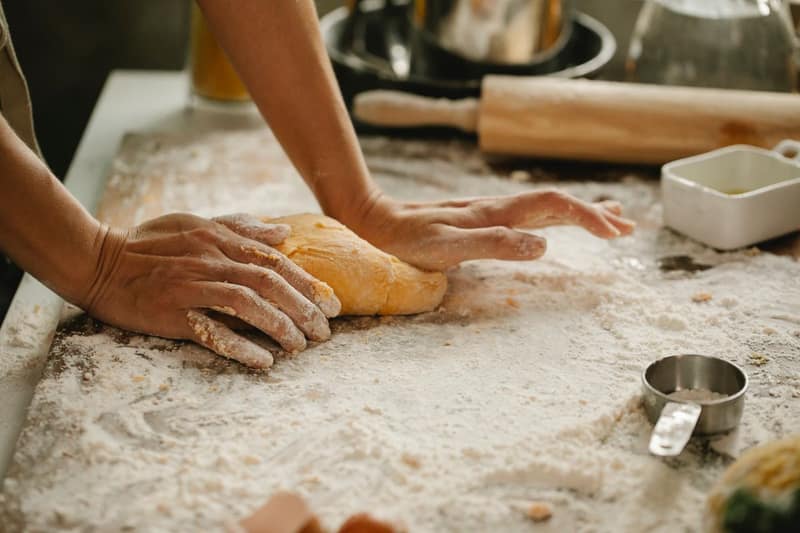
How it looks · Photo: Klaus Nielsen on Pexels Step 3
Sprinkle the milk (opens in a new tab), orange blossom and rose waters (opens in a new tab) over the semolina (opens in a new tab) mixture and knead gently just until it holds together like soft clay. Heat the oven (opens in a new tab) to 180 °C.
- 5 min
- 180°C
Step 4
Take 30 g of dough, flatten it into a cup in your palm, put in a date (opens in a new tab) ball and close the dough around it. Press into a floured ma'amoul mould and knock out, or shape into a dome and pattern with a fork or tweezers.
Step 5
Bake 15–18 minutes until the bases are golden but the tops are still pale. Cool completely on the tray — they are fragile while warm — then dust with icing sugar (opens in a new tab).
About this dish
- Origin
- Not attributed to one place · Origin disputedShared by Lebanese, Syrian, Palestinian, Jordanian and other Levantine traditions; no single origin is agreed.Also popular in Lebanon, Syria, Palestine, Jordan, Iraq, Egypt
- Dish
- Snack · Dessert · Sweets & confectionery · Desserts
- Cooking method
- Oven-baked
- Taste
- sweet, buttery, aromatic / warmly spiced
- Diet
- Vegetarian (lacto-ovo) · No nut ingredients · Low-carbWorked out from the ingredients. How labels work
All labels
Vegetarian (lacto-ovo) · Eggetarian · Lacto-vegetarian · Pescatarian · Flexitarian-friendly · Egg-free · No nut ingredients · Alcohol-free · Pork-free · Beef-free · Low-carb - Good for
- Festive & celebration · Make-ahead
- Cook more with
- Semolina · Butter · Dates · All-purpose flour · Sugar · Baking powder
Allergens
- Contains: Milkfrom butter, milk
- Contains: Wheatfrom semolina, all-purpose flour, baking powder
- Contains: Glutenfrom semolina, all-purpose flour, baking powder
Based on typical versions of these ingredients and not verified allergen-free. Brands differ and cross-contact happens, so always check labels. For severe allergies, follow your clinician’s advice.
Nutrition
148 kcal per serving
Estimated1 serving ≈ 38 g · recipe makes 24
Where the energy comes from
- Protein 6%
- Carbohydrate 56%
- Fat 38%
| Nutrient | Per serving | Per 100 g |
|---|---|---|
| Energy | 148 kcal | 396 kcal |
| Protein | 2.1 g | 5.7 g |
| Carbohydrate | 21.4 g | 57 g |
| Net carbohydrate | 20 g | 53.3 g |
| Sugars | — | — |
| Added sugars | 1 g | 2.8 g |
| Fibre | 1.4 g | 3.7 g |
| Fat | 6.5 g | 17.3 g |
| Saturated fat | — | — |
| Trans fat | — | — |
| Cholesterol | — | — |
| Sodium | 61 mg | 162 mg |
| Salt equivalent | 0.2 g | 0.4 g |
Vitamins & minerals per serving
- Potassium
- 116 mg
- Calcium
- 21 mg
- Iron
- 0.8 mg
- Magnesium
- 13 mg
- Vitamin A (RAE)
- 55 µg
- Vitamin C
- 0 mg
- Vitamin D
- 0 µg
- Vitamin B12
- —
- Folate (DFE)
- 42 µg
How these numbers were made
- Calculated from USDA FoodData Central (SR Legacy) per-100 g values and the listed quantities.
- Optional ingredients are not included: icing sugar.
- Orange blossom water: Water (FDC 174158); orange flower water is a distillate with negligible nutrients.
- Rose water: Water (FDC 174158); rose water is a distillate with negligible nutrients.
- “—” means the value isn’t known for enough of the ingredients; it is never zero by default.
- Values are estimates for guidance, not for medical dosing. U.S. Department of Agriculture, Agricultural Research Service. FoodData Central, 2019. fdc.nal.usda.gov.
Good to know
Tips
- Judge doneness by the underside; the tops of ma'amoul should stay pale.
Common mistakes
- Skipping the rest leaves the cookies gritty and prone to cracking.
Serve with
- Serve with Arabic coffee or mint tea.
Storage
- Airtight at room temperature for up to 2 weeks; freeze up to 3 months.
Variations
- Walnut ma'amoul: Fill with chopped walnuts, sugar and cinnamon, shaped in a round mould.
- Pistachio ma'amoul: Fill with ground pistachios bound with sugar and rose water, shaped in an oval mould.
Original editorial recipe · FriendsPantry editorial · Not yet independently reviewed · Added · Updated
Recipe DNA
How this dish is built
Baker’s notes
Customise in Bread & BakeryTimeline and readiness cues
Mix and knead · about 50 min
Mix only until no dry flour remains — overmixing makes it tough and tunnelled.
Rest · about 1 h
Covered so it doesn't dry out; relaxed dough rolls and shapes without springing back.
Bake · about 18 min at 180 °C
Risen and golden; a skewer in the centre comes out clean or with a few moist crumbs; the top springs back.
Cool · about 30 min
Cool on a rack before slicing — the crumb is still setting; cutting hot bread makes it gummy.
- Start to finish: about 2 h 38 min. Times are a guide — warmth changes everything; follow the cues.
If something goes wrong
Pale crust
Likely causes
- Oven too cool
- Too little sugar or no milk/egg for browning
- Over-fermented (yeast ate the sugars)
What to do
- Check the oven with a thermometer
- Brush with egg wash or milk
- Shorten the fermentation
Burnt bottom
Likely causes
- Tray too close to the heat
- Dark tray absorbs more heat
- Too much sugar in the dough
What to do
- Bake on the middle shelf
- Double up trays or use a light-coloured one
- Lower the temperature 10–15 °C and bake a little longer
Cracked or domed top
Likely causes
- Oven too hot (crust sets before the centre rises)
- Too much leavening
- Overmixed batter
What to do
- Lower the oven 10–15 °C
- Use the exact leavening amount
- Fold just until combined
Dry or crumbly
Likely causes
- Too much flour (scooped, not weighed)
- Over-baked
- Too little fat or sugar
What to do
- Weigh flour, or spoon it into the cup and level
- Check 5 minutes early
- Don't cut fat or sugar by more than a quarter without another moisture source
Reviews & corrections
Reviews come from signed-in cooks and appear after a moderator checks them. We never show made-up ratings.
You might also like
Sfouf
 Lebanese · 1 h 10 min · 232 kcal · Vegetarian
Kibbeh bil sanieh
Lebanese · 1 h 40 min · 491 kcal
Sfeeha
Lebanese · 1 h 50 min · 626 kcalJallab
Levantine · 10 min · 95 kcal · Vegan