
Kuy teav
Non-vegetarian
គុយទាវ · kŭytéav
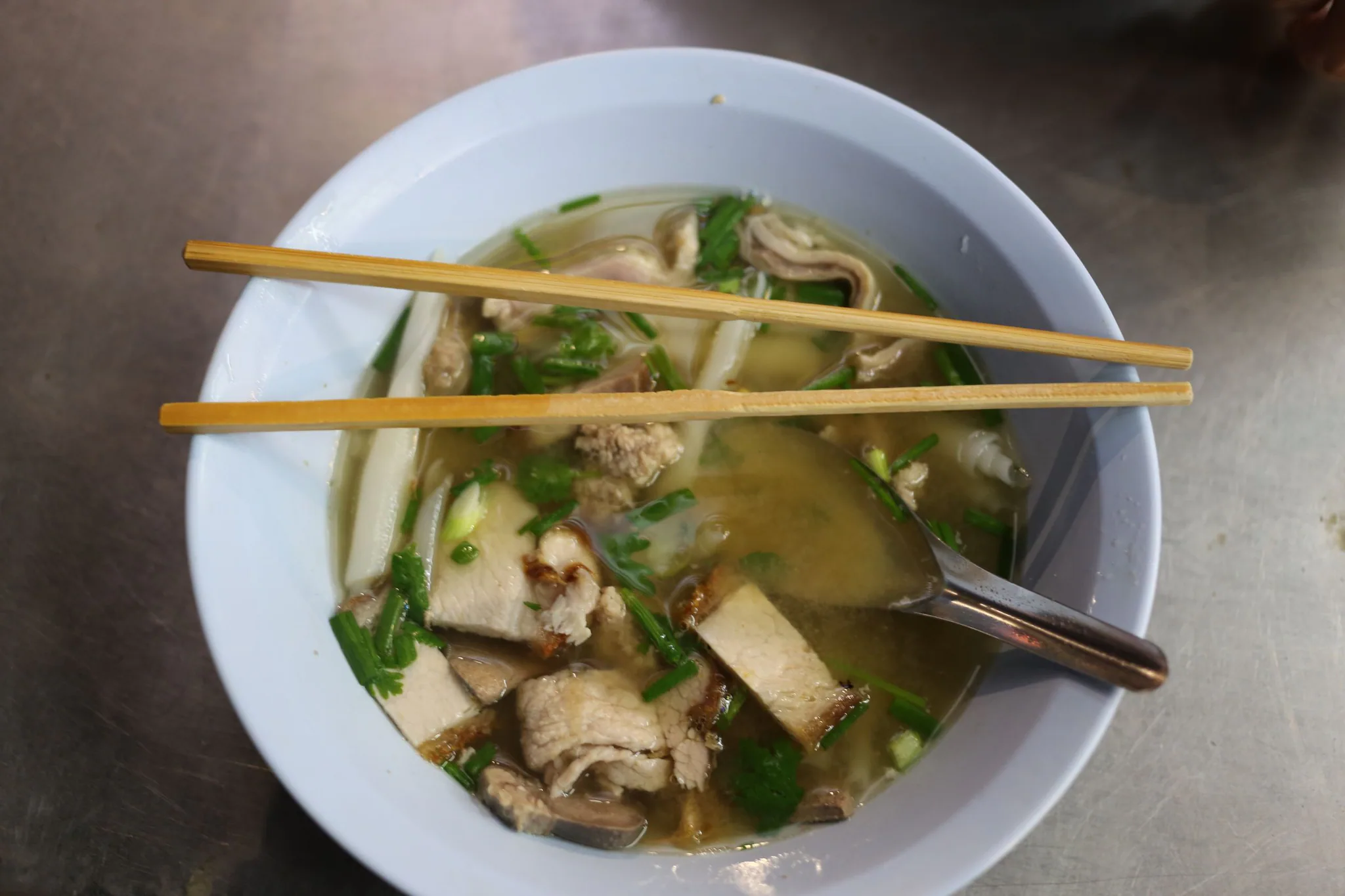
Cambodia's favourite breakfast: rice noodles in a clear, slightly sweet pork broth topped with minced pork, shrimp, bean sprouts and plenty of fried garlic.
Kuy teav is a Cambodian soup, ready in about 2 hours and made with pork spare ribs and rice noodles. It serves 4 and is rated intermediate to cook.
- Prep
- 20 min
- Cook
- 1 h 40 min
- Total
- 2 h
- Serves
- 4
- Level
- Intermediate
- Calories
- 918
Ingredients
For the broth
Method
Step 1
Blanch the pork ribs (opens in a new tab) in boiling water for 3 minutes, drain and rinse to keep the broth clear.
Step 2
Return the ribs to the pot with the fresh water, charred onion (opens in a new tab) and daikon (opens in a new tab). Simmer gently, skimming, until the meat is tender and the broth tastes rich. Season with the palm sugar (opens in a new tab), fish sauce (opens in a new tab) and salt.
- 90 min
- low heat
- Stockpot / large pot (opens in a new tab)
Food safety: Cook pork until the centre reaches at least 63 °C (71 °C for minced pork).
How it looks · Photo: Bachir Mamud on Pexels Step 3
Meanwhile fry the garlic (opens in a new tab) in the oil over medium-low heat until pale golden; tip into a bowl at once with its oil.
- 5 min
- medium-low heat
- Frying pan / skillet (opens in a new tab)
It keeps cooking off the heat, so stop just before it looks done.
Step 4
Poach the minced pork (opens in a new tab) in a ladle of broth, breaking it up, then the shrimp (opens in a new tab) until pink. Lift both out.
- 5 min
- medium heat
Food safety: Cook shrimp until pink and opaque all the way through.
Step 5
Dip the soaked noodles and bean sprouts (opens in a new tab) in boiling water for 20–30 seconds, drain and divide among bowls.
- 3 min
Step 6
Top with pork, shrimp (opens in a new tab) and a rib or two, ladle over boiling broth and finish with fried garlic (opens in a new tab) oil, spring onion (opens in a new tab), coriander, white pepper (opens in a new tab), lime (opens in a new tab) and chilli.
- 2 min
About this dish
- Origin
- Cambodia · Commonly attributedBrought by Teochew Chinese communities; related noodle soups are eaten across the region (hủ tiếu in Vietnam).Also popular in VietnamMore food from Cambodia
- Dish
- Breakfast · Lunch · Soups · Noodles
- Cooking method
- Simmered, Boiled
- Taste
- savoury, umami, garlicky, mild
- Diet
- No gluten ingredients · Dairy-free · No nut ingredients · High-proteinWorked out from the ingredients. How labels work
All labels
Non-vegetarian · No gluten ingredients · Dairy-free · Egg-free · No nut ingredients · Alcohol-free · Beef-free · High-protein - Good for
- Street food · Make-ahead
- Cook more with
- Pork spare ribs · Rice noodles · Onion · Daikon · Jaggery / palm sugar · Fish sauce
Allergens
- Contains: Fishfrom fish sauce
- Contains: Crustaceansfrom fish sauce, prawns / shrimp
Based on typical versions of these ingredients and not verified allergen-free. Brands differ and cross-contact happens, so always check labels. For severe allergies, follow your clinician’s advice.
Nutrition
918 kcal per serving
Estimated1 serving ≈ 1101 g · recipe makes 4
Where the energy comes from
- Protein 20%
- Carbohydrate 33%
- Fat 47%
| Nutrient | Per serving | Per 100 g* |
|---|---|---|
| Energy | 918 kcal | 83 kcal |
| Protein | 45.2 g | 4.1 g |
| Carbohydrate | 74.4 g | 6.8 g |
| Net carbohydrate | 70.4 g | 6.4 g |
| Sugars | — | — |
| Added sugars | 3.2 g | 0.3 g |
| Fibre | 4 g | 0.4 g |
| Fat | 47.6 g | 4.3 g |
| Saturated fat | 14.1 g | 1.3 g |
| Trans fat | — | — |
| Cholesterol | 217 mg | 20 mg |
| Sodium | 1349 mg | 123 mg |
| Salt equivalent | 3.4 g | 0.3 g |
Vitamins & minerals per serving
- Potassium
- 955 mg
- Calcium
- 191 mg
- Iron
- 3.5 mg
- Magnesium
- 111 mg
- Vitamin A (RAE)
- 14 µg
- Vitamin C
- 28 mg
- Vitamin D
- —
- Vitamin B12
- 0.9 µg
- Folate (DFE)
- 65 µg
How these numbers were made
- Calculated from USDA FoodData Central (SR Legacy) per-100 g values and the listed quantities.
- *Per 100 g of combined raw ingredients; the cooked dish may weigh more or less.
- Optional ingredients are not included: lime, fresh red chilli.
- Jaggery / palm sugar: Brown sugar (FDC 168833) used as a stand-in for unrefined cane jaggery and palm sugar.
- “—” means the value isn’t known for enough of the ingredients; it is never zero by default.
- Values are estimates for guidance, not for medical dosing. U.S. Department of Agriculture, Agricultural Research Service. FoodData Central, 2019. fdc.nal.usda.gov.
Good to know
Tips
- The broth can be made a day ahead; lift off the fat once chilled.
Common mistakes
- Boiling the broth hard, which makes it cloudy.
Serve with
- Serve with a dish of hoisin, chilli sauce and lime so everyone can season their own bowl.
Storage
- Store broth and toppings separately; broth keeps 3 days refrigerated or 3 months frozen.
Reheating
- Bring the broth back to a full boil before pouring over fresh noodles.
Variations
- Kuy teav kok: Served 'dry', with the broth on the side.
- Hủ tiếu Nam Vang (Vietnam): The Phnom Penh-style version popular in southern Vietnam.
Original editorial recipe · FriendsPantry editorial · Not yet independently reviewed · Added · Updated
Recipe DNA
How this dish is built
Built from the recipe’s own sections. Each band’s width is its share of the dish by weight. Choose a component to see what it does.
What the dish is built around
Main ingredient
- Rice noodles, dried thin rice sticks, soaked300 g
- Ground pork200 g
- Prawns / shrimp, peeled and deveined200 g
- Bean sprouts150 g
- Fresh red chilli, sliced (optional)2 piece · 12 g
Reviews & corrections
Reviews come from signed-in cooks and appear after a moderator checks them. We never show made-up ratings.
You might also like
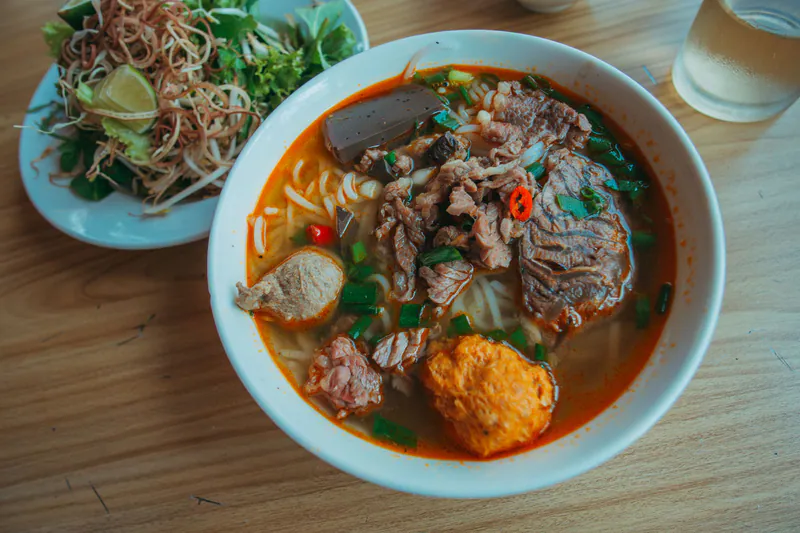
Bún bò Huế
 Vietnamese · 3 h · 669 kcal
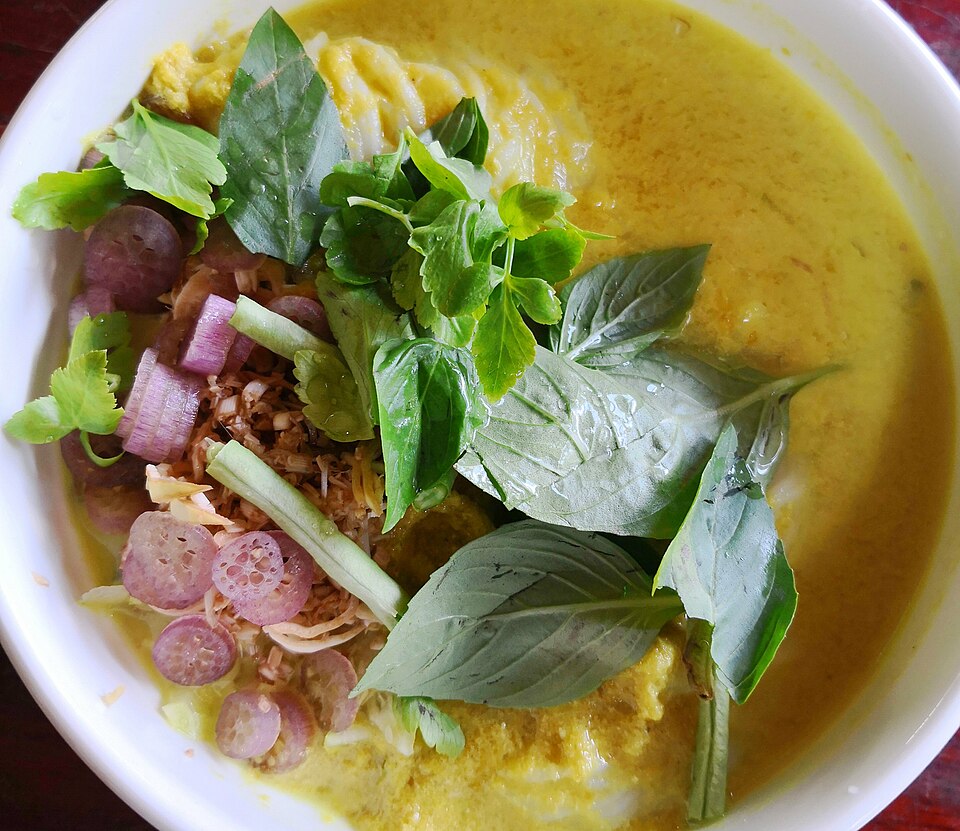
Nom banh chok
 Cambodian · 1 h · 714 kcal
Curry laksa
 Malaysian · 1 h 5 min · 950 kcal
Sundubu jjigae
 Korean · 30 min · 508 kcal