
 Lao · Thai · Cambodian · Desserts
Khao lam (sticky rice with coconut and black beans in bamboo)
Vegetarian
ເຂົ້າຫລາມ · khao lam
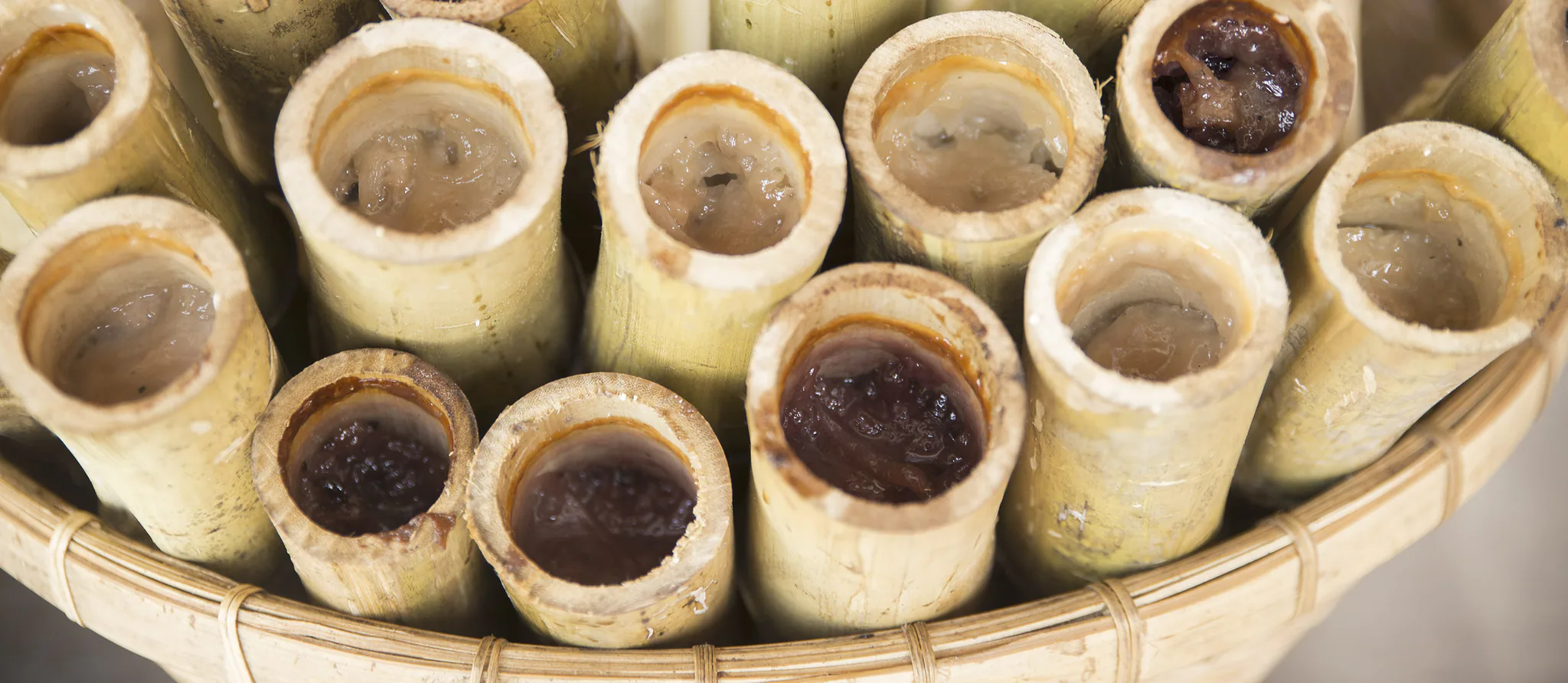
Sweet glutinous rice soaked in salted coconut milk with black beans, packed into bamboo tubes lined with banana leaf and roasted over embers until the rice is smoky and set. Popular in Laos, Thailand, Cambodia (kralan) and Myanmar; this home version uses jars or bamboo sections in the oven or steamer.
Khao lam (sticky rice with coconut and black beans in bamboo) is a Lao dessert from Laos, ready in about 2 hours 15 minutes and made with glutinous rice, black beans (dried) and coconut milk. It serves 8 and is rated intermediate to cook.
- Prep
- 25 min
- Cook
- 1 h 30 min
- Rest
- 20 min
- Total
- 2 h 15 min
- Serves
- 8
- Level
- Intermediate
- Calories
- 346
Plus overnight soaking of the rice and beans.
Main ingredients
Method
Step 1
Warm the coconut milk (opens in a new tab) with the sugar (opens in a new tab) and salt just until dissolved; do not boil. Cool slightly.
- 4 min
- low heat
- Saucepan (opens in a new tab)
Step 2
Mix the drained rice, cooked beans and grated coconut in a bowl. Pour over the sweetened coconut milk (opens in a new tab) and leave to soak for 15 minutes.
Step 3
Line bamboo sections (open at one end) or heatproof jars with rolled banana leaf. Spoon in the rice, filling to two-thirds, then top up with the coconut milk (opens in a new tab) until it just covers the rice. Plug the top with a twist of banana leaf or cover with foil.
- 10 min
Step 4
Traditionally the tubes are leaned against a charcoal fire and turned for 2–3 hours. At home, stand them upright in a deep tray and bake at 180 °C for 1½ hours, or steam the jars for 60–70 minutes, until the rice is tender and the liquid absorbed.
Over a grill, char the outside of the bamboo on all sides for a smoky flavour.
Step 5
Rest for 20 minutes. Split the bamboo lengthwise (or turn out the jars) and peel the rice log from the leaf. Slice and serve warm or at room temperature.
- 5 min

How it looks · Photo: Willians Huerta on Pexels
At a glance
 Glutinous rice
 Black beans (dried)
 Coconut milk
 Sugar
 Salt
 Desiccated coconut
 Banana leaves
About this dish
- Origin
- Laos and the wider Mekong region, Laos · Commonly attributedMade throughout mainland Southeast Asia. The Cambodian kralan, Thai khao lam and Burmese kaukhnyin kyidauk are the same dish; red or black glutinous rice is sometimes used.Also popular in Thailand, Cambodia, MyanmarMore food from Laos
Laos - Dish
- Snack · Dessert · Breakfast · Desserts · Sweets & confectionery · Street food
- Cooking method
- Steamed, Roasted
- Taste
- sweet, creamy, salty, smoky
- Diet
- Vegan · No gluten ingredients · Dairy-free · No nut ingredientsWorked out from the ingredients. How labels work
All labels
Vegan · Plant-based · Vegetarian (lacto-ovo) · Eggetarian · Lacto-vegetarian · Ovo-vegetarian · Pescatarian · Flexitarian-friendly · No gluten ingredients · Dairy-free · Egg-free · No nut ingredients · Alcohol-free · Pork-free · Beef-free - Good for
- Portable / lunchbox · Street food · Make-ahead
- Cook more with
- Glutinous rice · Black beans (dried) · Coconut milk · Sugar · Banana leaves
- Techniques
- Roasting · Baking · Charcoal grilling · Steaming
Allergens
None of the 14 major allergens appear in the listed ingredients.
Based on typical versions of these ingredients and not verified allergen-free. Brands differ and cross-contact happens, so always check labels. For severe allergies, follow your clinician’s advice.
Nutrition
346 kcal per serving
Estimated1 serving ≈ 117 g · recipe makes 8
Where the energy comes from
- Protein 7%
- Carbohydrate 65%
- Fat 28%
| Nutrient | Per serving | Per 100 g* |
|---|---|---|
| Energy | 346 kcal | 295 kcal |
| Protein | 6 g | 5.1 g |
| Carbohydrate | 56.9 g | 48.5 g |
| Net carbohydrate | — | — |
| Sugars | — | — |
| Added sugars | 10 g | 8.5 g |
| Fibre | — | — |
| Fat | 10.8 g | 9.2 g |
| Saturated fat | 9.4 g | 8 g |
| Trans fat | — | — |
| Cholesterol | 0 mg | 0 mg |
| Sodium | 302 mg | 257 mg |
| Salt equivalent | 0.8 g | 0.6 g |
Vitamins & minerals per serving
- Potassium
- 258 mg
- Calcium
- 24 mg
- Iron
- 2.8 mg
- Magnesium
- 47 mg
- Vitamin A (RAE)
- 0 µg
- Vitamin C
- 0 mg
- Vitamin D
- 0 µg
- Vitamin B12
- 0 µg
- Folate (DFE)
- 44 µg
How these numbers were made
- Calculated from USDA FoodData Central (SR Legacy) per-100 g values and the listed quantities.
- *Per 100 g of combined raw ingredients; the cooked dish may weigh more or less.
- Optional ingredients are not included: desiccated coconut.
- Not counted (tiny amounts or “to taste”): banana leaves.
- “—” means the value isn’t known for enough of the ingredients; it is never zero by default.
- Values are estimates for guidance, not for medical dosing. U.S. Department of Agriculture, Agricultural Research Service. FoodData Central, 2019. fdc.nal.usda.gov.
Good to know
Tips
- Bamboo sections are sold at some Asian grocers in the season around the dry-season festivals; any thick, untreated bamboo with one closed node will work.
Common mistakes
- Packing the rice tightly — it needs room to swell, or the centre stays hard.
Serve with
- Eat as a snack on its own, or with ripe mango or a little extra coconut cream poured over.
Food safety
- Cooked rice can carry Bacillus cereus spores that survive cooking; cool leftover rice quickly and refrigerate it within an hour.
Storage
- Keeps 1 day at room temperature in its leaf, or 3 days refrigerated.
Reheating
- Steam for 10 minutes to soften again.
Variations
- Kralan (Cambodia) (Cambodia): Often made with red beans and sold from roadside stalls in Battambang.
- Khao lam with taro (Thailand): Thai vendors in Nakhon Pathom add cubes of taro or use black sticky rice.
- Kaukhnyin kyidauk (Myanmar): Burmese bamboo sticky rice, often eaten during the Tabodwe full-moon festival.
Original editorial recipe · FriendsPantry editorial · source: TasteAtlas (dish facts) · Not yet independently reviewed · Added
Recipe DNA
How this dish is built
Grouped by each ingredient’s role in the dish. Each band’s width is its share of the dish by weight. Choose a component to see what it does.
What the dish is built around
Main ingredient
- Glutinous rice, soaked for at least 4 hours or overnight, drained400 g
- Black beans (dried), soaked overnight and boiled for 30–40 minutes until just tender60 g
- Desiccated coconut (optional)30 g
- Banana leaves, cut to fit the tubes or jars, softened over a flame4 sheet · 0 g
Reviews & corrections
Reviews come from signed-in cooks and appear after a moderator checks them. We never show made-up ratings.
You might also like
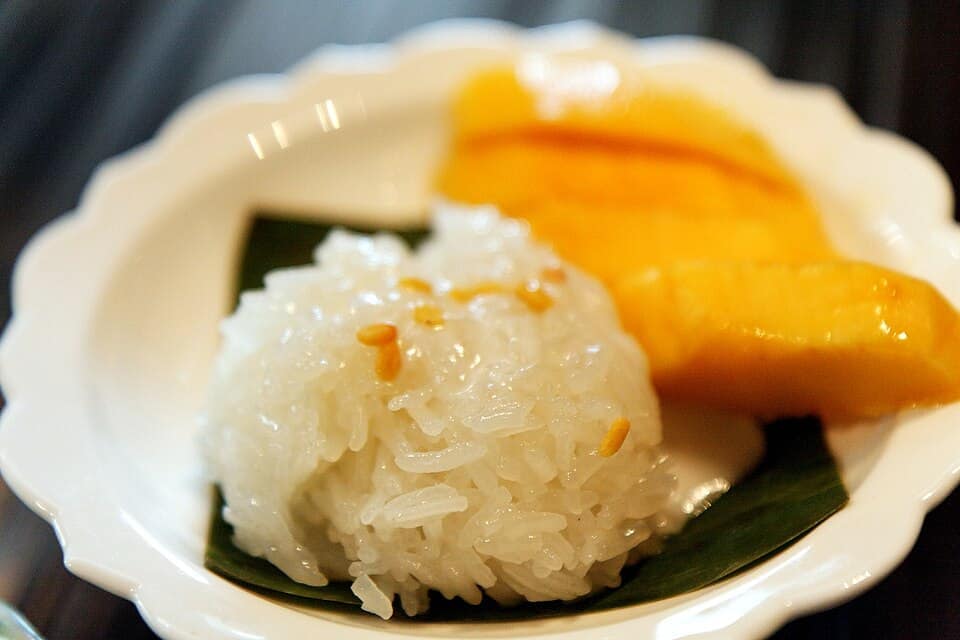
Mango sticky rice
 Thai · 5 h · 559 kcal · Vegan
Sticky rice with jeow mak len
Lao · 50 min · 422 kcalKhanom khrok (Thai coconut rice cups)
Thai · 1 h 15 min · 657 kcal · Vegan
Lard na (Lao rice noodles in gravy)
Lao · 40 min · 497 kcal