
 Uruguayan · Argentine · Pastries
Bolas de fraile (dulce de leche filled doughnuts)
Contains egg (no meat or fish)
Bolas de fraile
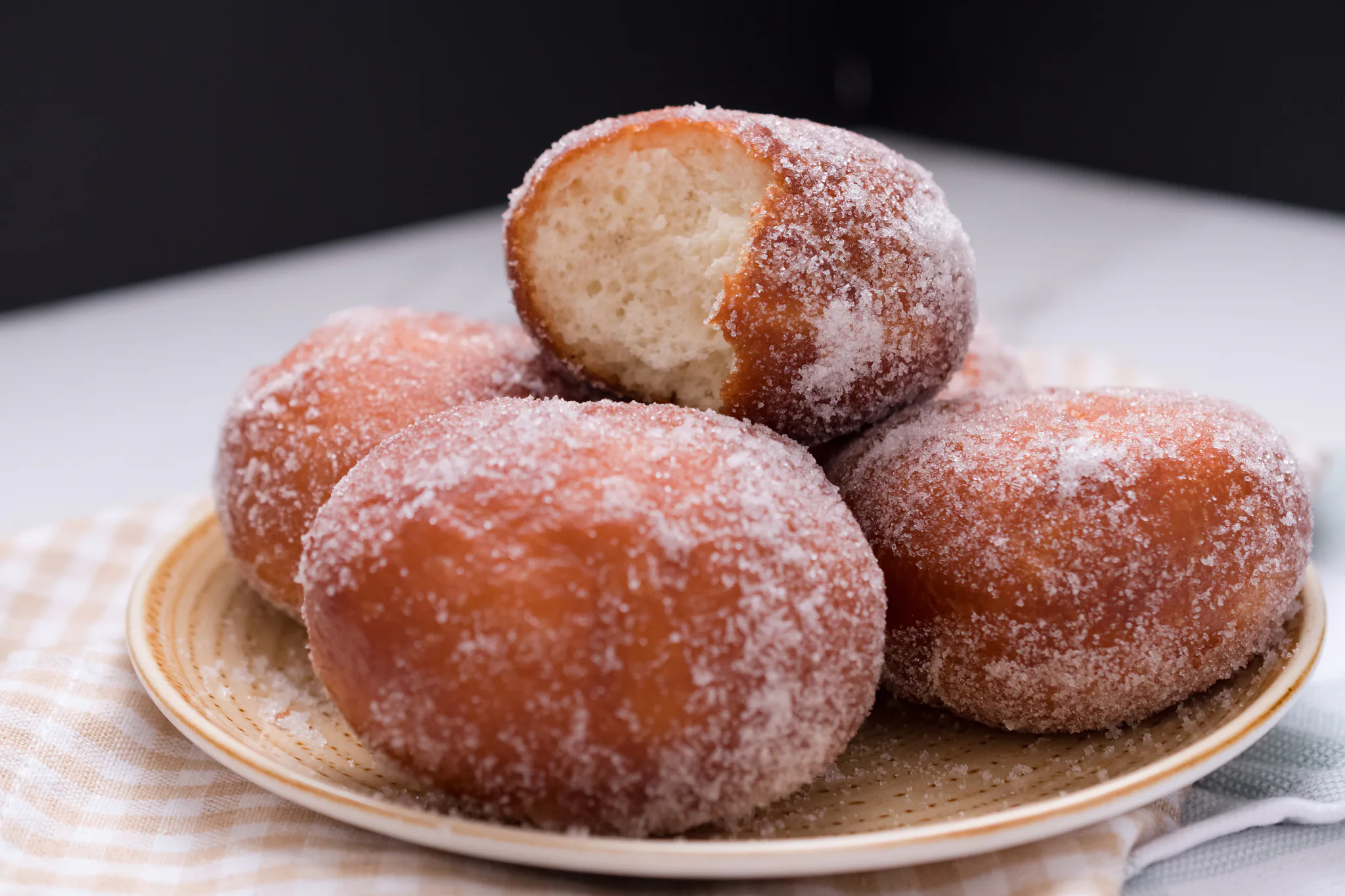
Soft, round yeast doughnuts without a hole, fried until golden, split or piped full of dulce de leche (or custard) and rolled in sugar. The bakery treat of Uruguay and Argentina is a descendant of the German Berliner brought by European immigrants.
Bolas de fraile (dulce de leche filled doughnuts) is an Uruguayan pastry, ready in about 2 hours 55 minutes and made with all-purpose flour and dulce de leche. It serves 14 and is rated intermediate to cook.
- Prep
- 30 min
- Cook
- 25 min
- Rest
- 2 h
- Total
- 2 h 55 min
- Serves
- 14
- Level
- Intermediate
- Calories
- 344
Main ingredients
Ingredients
For the dough
For frying
For the filling
For coating
Method
Dough
31 minStep 1
Mix the flour, yeast, sugar (opens in a new tab) and salt. Add the warm milk (opens in a new tab), eggs (opens in a new tab) and lemon zest (opens in a new tab) and knead for 5 minutes, then add the soft butter (opens in a new tab) a piece at a time and knead for another 8–10 minutes until smooth, elastic and slightly tacky.
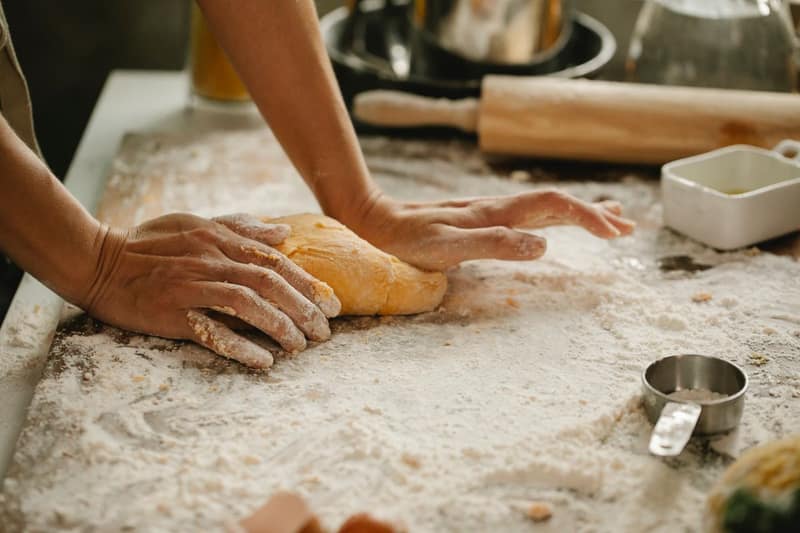
How it looks · Photo: Klaus Nielsen on Pexels Step 2
Cover and leave in a warm place for about 1 hour, until doubled.
Step 3
Knock back the dough and divide into 14 pieces of about 60 g. Roll each into a tight ball, place on floured baking paper squares, cover loosely and prove for 45–60 minutes until puffy.
- 12 min
Frying
20 minStep 4
Heat the oil to 170 °C. Slide in the balls on their paper (peel it off once they float) and fry 3–4 at a time for 2–3 minutes per side until deep golden with a pale ring round the middle. Drain on a rack.
- 20 min
- 170°C
- medium heat
- Dutch oven / casserole pot (opens in a new tab)
- Food thermometer (opens in a new tab)
- Slotted spoon (opens in a new tab)
Food safety: Never leave hot oil unattended; keep the pan's handle turned inwards and lower food in gently, away from you.
If the oil is too hot the outside browns before the centre cooks.
Filling
10 minStep 5
While still warm, roll the doughnuts in sugar (opens in a new tab). When cool enough to handle, slit each one along the side (or poke a hole) and pipe in a generous amount of dulce de leche (opens in a new tab).
At a glance
1 · Dough in a bowl
 All-purpose flour
 Instant yeast
 Sugar
 Salt
 Milk
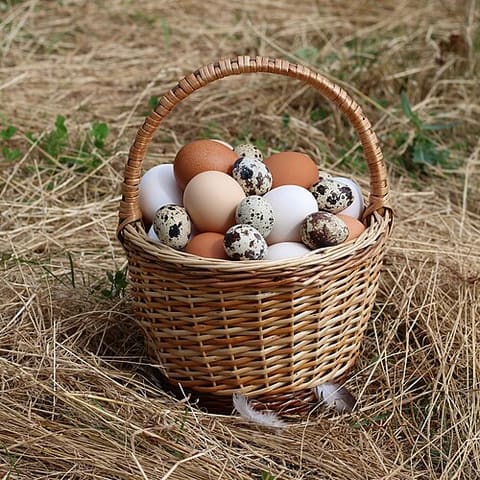 Egg
 Butter
 Lemon zest
then heat
2 · Frying in a pan
 Neutral vegetable oil
then roll
3 · Filling in a bowl
 Dulce de leche
About this dish
- Origin
- Río de la Plata (Uruguay and Argentina), Uruguay · Commonly attributedDerived from the Berliner; the irreverent names of many Río de la Plata pastries, including friars' balls, are often credited to anarchist bakers' unions of the late 19th century.Also popular in Argentina, ChileMore food from Uruguay
Uruguay - Dish
- Breakfast · Snack · Pastries · Sweets & confectionery · Desserts · Fried dough & doughnuts
- Cooking method
- Deep-fried
- Taste
- sweet, buttery, rich
- Diet
- Vegetarian (lacto-ovo) · No nut ingredientsWorked out from the ingredients. How labels work
All labels
Vegetarian (lacto-ovo) · Eggetarian · Pescatarian · Flexitarian-friendly · No nut ingredients · Alcohol-free · Pork-free · Beef-free - Good for
- Festive & celebration · Child-friendly
- Cook more with
- All-purpose flour · Dulce de leche · Instant yeast · Sugar · Milk · Egg
- Techniques
- Deep-frying · Kneading · Fermentation
Allergens
- Contains: Milkfrom milk, butter, dulce de leche
- Contains: Eggsfrom egg
- Contains: Wheatfrom all-purpose flour
- Contains: Glutenfrom all-purpose flour
Based on typical versions of these ingredients and not verified allergen-free. Brands differ and cross-contact happens, so always check labels. For severe allergies, follow your clinician’s advice.
Nutrition
344 kcal per serving
Calculated1 serving ≈ 101 g · recipe makes 14
Where the energy comes from
- Protein 8%
- Carbohydrate 60%
- Fat 32%
| Nutrient | Per serving | Per 100 g* |
|---|---|---|
| Energy | 344 kcal | 339 kcal |
| Protein | 6.8 g | 6.7 g |
| Carbohydrate | 51.5 g | 50.8 g |
| Net carbohydrate | 50.4 g | 49.7 g |
| Sugars | 22.9 g | 22.6 g |
| Added sugars | 20 g | 19.7 g |
| Fibre | 1.1 g | 1.1 g |
| Fat | 12.3 g | 12.1 g |
| Saturated fat | 4.2 g | 4.1 g |
| Trans fat | — | — |
| Cholesterol | 43 mg | 43 mg |
| Sodium | 239 mg | 236 mg |
| Salt equivalent | 0.6 g | 0.6 g |
Vitamins & minerals per serving
- Potassium
- 149 mg
- Calcium
- 81 mg
- Iron
- 1.8 mg
- Magnesium
- 15 mg
- Vitamin A (RAE)
- 63 µg
- Vitamin C
- 1 mg
- Vitamin D
- 0.4 µg
- Vitamin B12
- 0.2 µg
- Folate (DFE)
- 122 µg
How these numbers were made
- Calculated from USDA FoodData Central (SR Legacy) per-100 g values and the listed quantities.
- *Per 100 g of combined raw ingredients; the cooked dish may weigh more or less.
- Optional ingredients are not included: lemon zest.
- “—” means the value isn’t known for enough of the ingredients; it is never zero by default.
- Values are estimates for guidance, not for medical dosing. U.S. Department of Agriculture, Agricultural Research Service. FoodData Central, 2019. fdc.nal.usda.gov.
Good to know
Tips
- Frying on squares of baking paper keeps the risen balls from deflating when you move them into the oil.
Common mistakes
- Under-proving, which gives dense doughnuts that crack while frying.
Serve with
- Eat the same day with mate, coffee or hot chocolate.
Food safety
- Never leave hot oil unattended; keep the pan's handle turned inwards and lower food in gently, away from you.
Storage
- Best on the day they are made; keep 1 day in an airtight container.
Variations
- Bolas de fraile con crema pastelera (Argentina): Filled with vanilla pastry cream instead of dulce de leche.
- Berlines (Chile) (Chile): The Chilean name, often filled with manjar or custard.
Original editorial recipe · FriendsPantry editorial · source: TasteAtlas (dish facts) · Not yet independently reviewed · Added
Sauces, chutneys & dips for this dish
Recipe DNA
How this dish is built
Built from the recipe’s own sections. Each band’s width is its share of the dish by weight. Choose a component to see what it does.
Structure
For the dough
- All-purpose flour, strong bread flour or all-purpose500 g
- Instant yeast7 g
- Sugar60 g
- Salt1 tsp · 6 g
- Milk, lukewarm200 ml · 206 g
- Egg2 piece · 100 g
- Butter, softened60 g
- Lemon zest (optional)1 tsp · 2 g
Reviews & corrections
Reviews come from signed-in cooks and appear after a moderator checks them. We never show made-up ratings.
You might also like
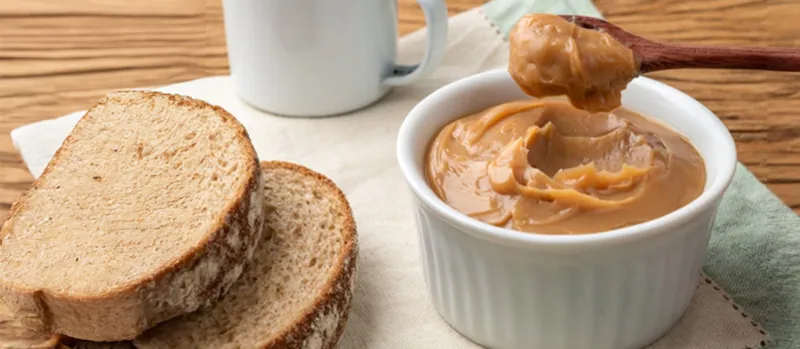
Homemade dulce de leche
 Argentine · 2 h 55 min · 88 kcal · Vegetarian
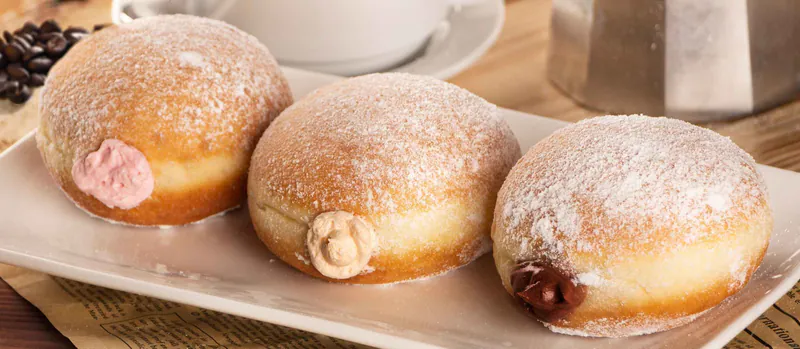
Bomboloni (Italian doughnuts)
 Italian · 4 h 20 min · 392 kcal · Contains egg
Pastafrola (quince lattice tart)
Argentine · 2 h 10 min · 441 kcal · Contains egg
Munkki (Finnish cardamom doughnuts)
 Finnish · 2 h 30 min · 286 kcal · Contains egg