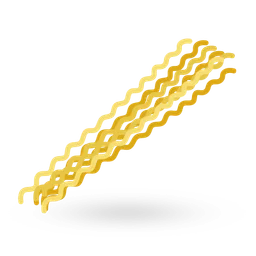
Long, hollow strands like thick spaghetti, thought to come from central Italy around Rome, with a name drawn from buco, the Italian for 'hole'. Traditionally extruded through bronze dies, the pasta is dense and chewy, and it holds up to robust sauces, above all amatriciana with tomato and guanciale.
Small hat-shaped stuffed pasta from Emilia-Romagna, whose name means 'little hats'. The filling was originally stewed beef with Parmigiano-Reggiano and spices and is still usually meat and cheese, and the parcels are typically served in chicken broth at Christmas and New Year.
A Sicilian pasta shape of short lengths that look rolled in on themselves, with a name meaning 'homemade'. The curled form traps both hearty and simple sauces well, and it is also good in baked pasta dishes because it is less likely to dry out.
A southern Italian pasta of semolina and warm salted water, made in Basilicata, Apulia and Calabria. Once served simply with oil and garlic, these small shells now go with sauces featuring olives, rocket or cream.
Lasagne are broad, flat sheets of pasta, classically made of just flour and water, that are layered into baked dishes. The name is usually traced to the Greek laganon, a flat strip of dough, or to a Greek and Roman word for a cooking pot.
Linguine, meaning little tongues, are flat, thin strands of durum wheat pasta from Liguria, also called trenette or bavette. They are classically served with pesto, sometimes cooked together with green beans and potatoes, and also suit seafood sauces.
Small ear-shaped pasta from Puglia in southern Italy. The cupped form gives a soft centre with slightly chewy rims, and some historians link the shape to the cone roofs of the region's trulli houses. Typical partners are broccoli, ricotta, meatballs or a tomato sauce.
A short Italian pasta shaped like grains of rice, best made from hard durum wheat. Its name also means barley in Italian. Vegetables are sometimes added to colour and flavour the dough, and the small shape makes it especially good in soups as well as salads and baked dishes.
Broad, flat ribbons of egg pasta associated with Tuscany and central Italy. The egg dough makes them rich, and the name comes from the Tuscan verb pappare, to eat with relish. Their width suits thick, hearty meat ragùs.
Dried pasta from Gragnano near Naples, a town that has made macaroni in family workshops since the late sixteenth century. It must be produced within the town using only durum wheat semolina and local water, and the old mills of the Valle dei Mulini still recall the trade.
Thick, hand-rolled pasta from southern Tuscany, like a chunky spaghetti and usually made without egg. It suits hearty meat or mushroom sauces, and locally it is served with garlicky tomato sauce, with fried breadcrumbs, or cacio e pepe style with cheese and black pepper.
Short, flat ribbons of pasta from the Valtellina valley in Lombardy, made from a mix of buckwheat and wheat flour, which gives their dark colour. They are cooked with potatoes, cabbage, butter and local cheese in pizzoccheri alla valtellinese, the area's signature dish.
Italian filled pasta made by sealing a filling between two thin sheets of dough, usually of wheat flour and egg. Fillings range from meat and cheese to vegetables. Ravioli are boiled and dressed with sauce for a first course, or served in broth during winter.
Long, thin strands of pasta made in their simplest form from durum wheat flour and water; the name means little strings. Its ancestor, itriyya, was made in medieval Arab-ruled Sicily, and modern spaghetti is pushed through a die, with names varying by thickness.
Hand-rolled, twisted pasta made across central Italy, notably Umbria, Tuscany, Emilia-Romagna and Marche, from wheat flour, semolina, water and sometimes egg. The name translates as priest strangler, and its chewy twists suit hearty meat or vegetable sauces.
Flat ribbon pasta from Emilia-Romagna, made today with wheat flour and eggs, though flour-and-water versions once existed. The name comes from tagliare, to cut, and the thinner version is known as tagliolini; once kept for special days, it is now everyday food.
Thin egg pasta from northern Italy, especially Piedmont and Emilia-Romagna, narrower than tagliatelle yet wider than spaghetti. Based on durum wheat flour enriched with egg, its smooth, slightly firm strands hold onto light sauces such as butter-based ones.
Small rings of egg pasta wrapped around a filling and folded into a shape often compared to a navel. They are associated with Modena and Bologna in Emilia-Romagna, with written mentions going back to the 17th century, and are classically served in broth.
Larger cousins of tortellini from Emilia-Romagna, folded into the same ring shape but bigger. Typical fillings include ricotta and spinach, walnuts or porcini, and they are often simply dressed with melted butter and sage.
Short, twisted pasta from Liguria made by hand from durum wheat flour and water, each piece rolled on a board and then twisted. It is the classic partner for pesto, and its name is thought to come from a local word meaning to rub, describing how it is shaped.
An Istrian pasta formed by folding two corners of a diamond of dough together and pinching them shut, made from durum wheat flour, eggs, oil and salt. It is classically served with veal sauce or chicken goulash, but also with mushroom, prosciutto, tomato or truffle sauces.
Handmade Istrian pasta, also known as makaruni, shaped by rolling dough between the palms. The dough contains flour, salt, hot water and some oil, and each piece is thin at the ends and plump in the middle. It is usually served with meat sauces.
Dried egg pasta from Alsace in France, made with durum wheat and fresh eggs at 320 grams of egg per kilo of wheat. The eggs help it hold together in the pot and add flavour. Packs have a clear window so the pasta can be seen.
Soft egg noodles from Swabia in Baden-Württemberg, made from wheat flour, eggs and salt and long regarded as a regional dish. Getting the dough and cooking just right is hard to standardise, so local know-how passed down through families remains central to making them.
Cretan home cooks make these egg pasta strips or little squares from flour, eggs, milk or water, olive oil and salt, traditionally in late summer. The pieces are sun-dried and stored for winter, then often served with tomato sauce and grated myzithra.
Japanese wheat noodles made with flour, water, salt and kansui, an alkaline water that makes them springy, glossy and pale yellow. The dough is allowed to rest before rolling. They form the base of tonkotsu, shio, miso and curry ramen.
Kesme are hand-cut egg noodles from Turkic-speaking lands, from Turkiye to Central Asia, where they also go by names such as kespe and kesma. A firm dough is rolled into sheets and sliced into strips, and the noodles often go into meat and vegetable soups.
What PDO, PGI and TSG mean
These are the European Union’s protected food names (the UK and Switzerland run matching schemes). A registered name can only go on products made the registered way — so “Parmigiano Reggiano” on a label is a promise about place and method, not just a style.
PDOProtected Designation of OriginProtected Designation of Origin
Every stage — producing the raw material, processing and preparing it — happens in one defined area, following a registered method. The strongest link between a food and its place.
At least one stage of making the food happens in the named area, and its reputation or character comes from that place. Raw materials may come from elsewhere.
Protects a traditional recipe or method rather than a place: it can be made anywhere, as long as the registered method is followed.
On packs you will often see the local abbreviation instead: DOP (Italy, Spain, Portugal), AOP or AOC (France, Switzerland), IGP for PGI, and wine terms such as DOC and DOCG. We show both. Slow Food Presidia and the Ark of Taste are listed too: they mark endangered traditional foods, not legal name protection.