
Haemul pajeon
Non-vegetarian
해물파전 · haemul-pajeon
A thin, crisp-edged pancake of whole spring onions bound in a light batter with shrimp and squid, served with a soy-vinegar dipping sauce.
Haemul pajeon is a Korean starter from South Korea, ready in about 35 minutes and made with all-purpose flour and spring onion. It serves 3 and is rated intermediate to cook.
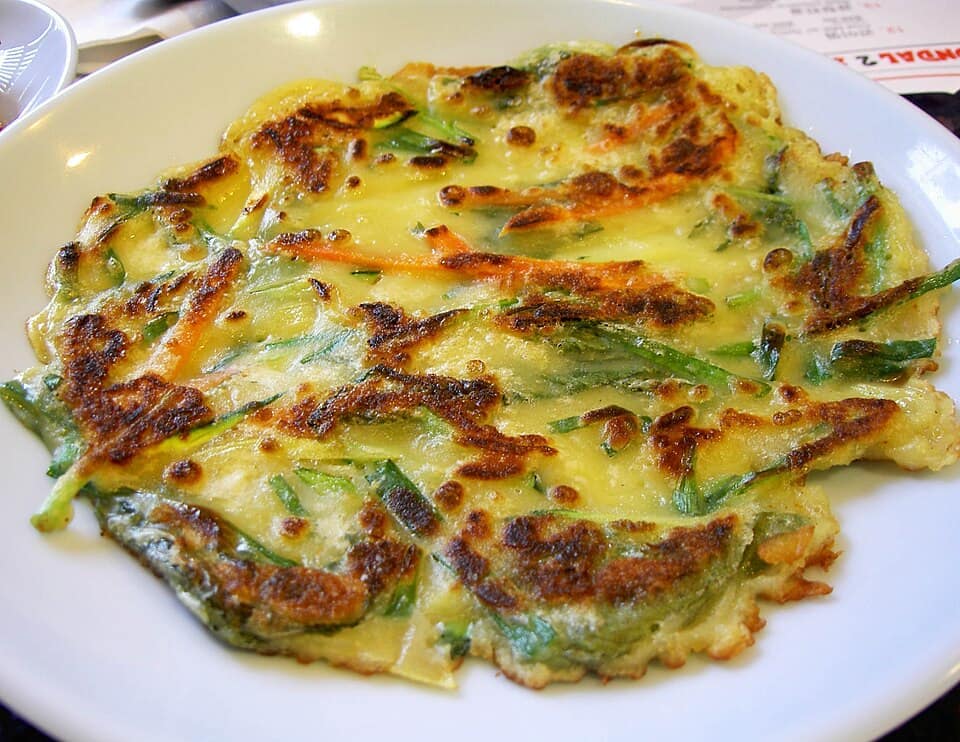
- Prep
- 15 min
- Cook
- 20 min
- Total
- 35 min
- Serves
- 3
- Level
- Intermediate
- Calories
- 449
Ingredients
For the dipping sauce
Method
Step 1
Mix the dipping sauce ingredients in a small bowl.
- 2 min
Step 2
Whisk (opens in a new tab) the flour, rice flour (opens in a new tab), salt, egg (opens in a new tab) and ice-cold water into a thin, smooth batter.
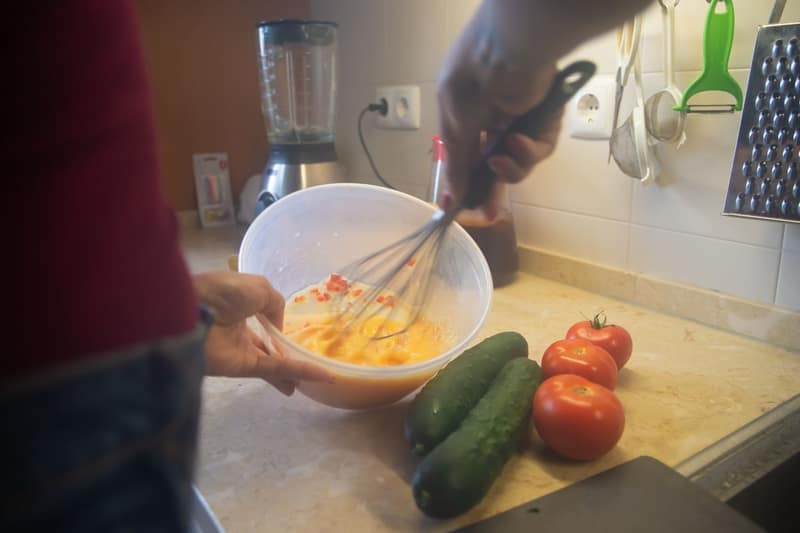
How it looks · Photo: Kampus Production on Pexels Step 3
Heat 2 tbsp oil in a large frying pan. Lay half the spring onions (opens in a new tab) in the pan side by side and pour a thin layer of batter over them.
- 2 min
- medium-high heat
- Frying pan / skillet (opens in a new tab)
Step 4
Scatter half the shrimp (opens in a new tab), squid (opens in a new tab) and chilli over the top, then drizzle with a little more batter to bind. Cook until the underside is crisp and golden.
- 4 min
- medium heat
How it looks · Photo: Klaus Nielsen on Pexels Step 5
Flip, add a little more oil around the edge and press lightly. Cook until the seafood is opaque and the second side is crisp. Repeat for the second pancake.
- 8 min
- medium heat
Food safety: Seafood is cooked when opaque and firm.
Step 6
Cut into squares and serve hot with the dipping sauce.
- 1 min
How it looks · Photo: Willians Huerta on Pexels
About this dish
- Origin
- South Korea · Well documentedEspecially associated with Dongnae in Busan.More food from South Korea
- Dish
- Lunch · Dinner · Snack · Appetizers & starters · Main courses
- Cooking method
- Pan-fried, Shallow-fried
- Taste
- savoury, umami, fresh, spicy (chilli heat)
- Diet
- Pescatarian · Dairy-free · No nut ingredients · High-proteinWorked out from the ingredients. How labels work
All labels
Pescatarian · Non-vegetarian · Dairy-free · No nut ingredients · No added sugar · Alcohol-free · Pork-free · Beef-free · High-protein · Calorie-conscious - Cook more with
- All-purpose flour · Spring onion · Rice flour · Egg · Prawns / shrimp · Squid
- Techniques
- Pan-frying · Shallow-frying
Allergens
- Contains: Eggsfrom egg
- Contains: Crustaceansfrom prawns / shrimp
- Contains: Molluscsfrom squid
- Contains: Wheatfrom all-purpose flour, soy sauce
- Contains: Glutenfrom all-purpose flour, soy sauce
- Contains: Soyfrom soy sauce
- Contains, can be adapted: Sesamefrom sesame seeds
Based on typical versions of these ingredients and not verified allergen-free. Brands differ and cross-contact happens, so always check labels. For severe allergies, follow your clinician’s advice.
Nutrition
449 kcal per serving
Estimated1 serving ≈ 286 g · recipe makes 3
Where the energy comes from
- Protein 18%
- Carbohydrate 39%
- Fat 42%
| Nutrient | Per serving | Per 100 g* |
|---|---|---|
| Energy | 449 kcal | 157 kcal |
| Protein | 20.6 g | 7.2 g |
| Carbohydrate | 44.1 g | 15.4 g |
| Net carbohydrate | — | — |
| Sugars | — | — |
| Added sugars | 0 g | 0 g |
| Fibre | — | — |
| Fat | 21.1 g | 7.4 g |
| Saturated fat | 2.1 g | 0.8 g |
| Trans fat | — | — |
| Cholesterol | 193 mg | 68 mg |
| Sodium | 1099 mg | 385 mg |
| Salt equivalent | 2.7 g | 1 g |
Vitamins & minerals per serving
- Potassium
- 437 mg
- Calcium
- 96 mg
- Iron
- 3.5 mg
- Magnesium
- 57 mg
- Vitamin A (RAE)
- —
- Vitamin C
- —
- Vitamin D
- —
- Vitamin B12
- —
- Folate (DFE)
- —
How these numbers were made
- Calculated from USDA FoodData Central (SR Legacy) per-100 g values and the listed quantities.
- *Per 100 g of combined raw ingredients; the cooked dish may weigh more or less.
- Optional ingredients are not included: fresh red chilli, sesame seeds.
- Rice vinegar: Distilled vinegar (FDC 172237) used as a stand-in for unseasoned rice vinegar.
- Red chilli flakes: Ground cayenne (FDC 170932) used as a stand-in for dried chilli flakes such as pul biber or Aleppo pepper.
- “—” means the value isn’t known for enough of the ingredients; it is never zero by default.
- Values are estimates for guidance, not for medical dosing. U.S. Department of Agriculture, Agricultural Research Service. FoodData Central, 2019. fdc.nal.usda.gov.
Good to know
Tips
- Ice-cold batter and generous oil give the lacy, crisp edges.
Common mistakes
- A thick batter makes a doughy pancake — it should be thin enough to just coat the spring onions.
- Too little oil: the edges need to fry, not dry-cook, to get crisp.
Serve with
- Traditionally eaten with makgeolli (rice wine) on rainy days.
Storage
- Best eaten immediately; refrigerate leftovers for 1 day.
Reheating
- Re-crisp in a dry hot pan.
Variations
- Kimchi jeon: Swap the spring onion and seafood for chopped kimchi and a little of its juice.
- Yachae jeon: Mixed vegetable pancake with courgette, onion and carrot.
Original editorial recipe · FriendsPantry editorial · Not yet independently reviewed · Added · Updated
Sauces, chutneys & dips for this dish
Recipe DNA
How this dish is built
Built from the recipe’s own sections. Each band’s width is its share of the dish by weight. Choose a component to see what it does.
What the dish is built around
Main ingredient
- All-purpose flour120 g
- Rice flour30 g
- Egg1 piece · 50 g
- Spring onion, trimmed to fit the pan; thick ones halved lengthways10 piece · 150 g
- Prawns / shrimp, peeled and roughly chopped100 g
- Squid, cut into thin strips100 g
- Fresh red chilli, thinly sliced (optional)1 piece · 6 g
Reviews & corrections
Reviews come from signed-in cooks and appear after a moderator checks them. We never show made-up ratings.
You might also like
Tteokbokki
 Korean · 25 min · 473 kcal
Sundubu jjigae
Korean · 30 min · 508 kcal
Korean fried chicken (yangnyeom)
Korean · 55 min · 683 kcal
Tteokguk (rice cake soup)
Korean · 1 h · 522 kcal