
Akara
Vegetarian
Àkàrà
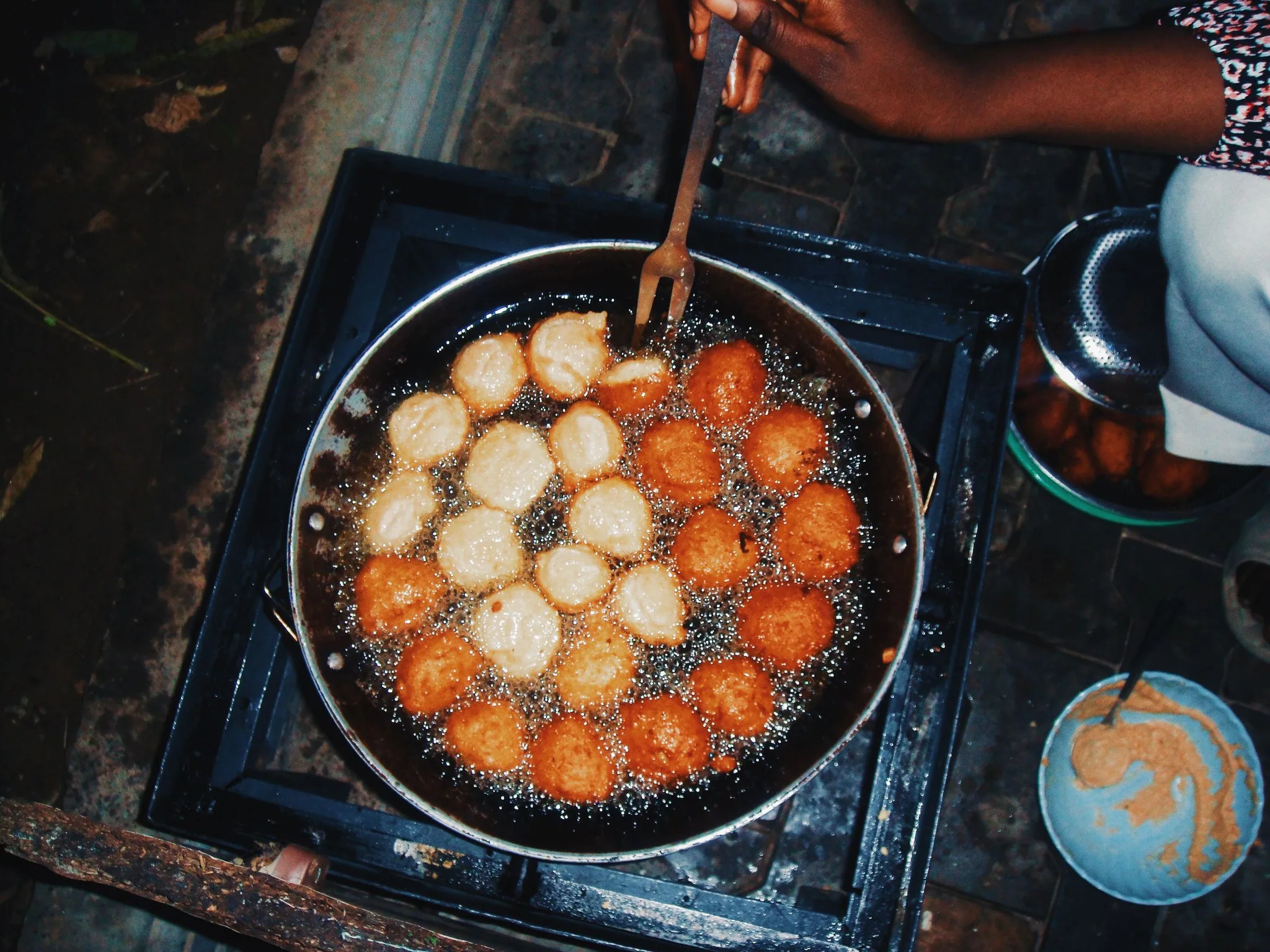
Light, crisp fritters of whipped black-eyed pea batter with onion and scotch bonnet, deep-fried until golden. A favourite breakfast and street snack across West Africa.
Akara is a Nigerian street food, ready in about 55 minutes and made with black-eyed peas (dried), onion and fresh red chilli. It serves 4 and is rated intermediate to cook.
- Prep
- 30 min
- Cook
- 25 min
- Total
- 55 min
- Serves
- 4
- Level
- Intermediate
- Calories
- 338
Plus at least 4 hours (or overnight) soaking the peas.
Method
Step 1
Soak the peas for at least 4 hours, then rub off and float away the skins in several changes of water.
- 20 min
Step 2
Blend the peeled peas with the onion (opens in a new tab), scotch bonnet and just enough water to make a thick, smooth paste.
Step 3
Beat the paste vigorously with a wooden spoon for 3–4 minutes until it lightens and turns fluffy, then beat in the salt just before frying.
- 4 min
Whipping air into the batter is what makes akara light.
Step 4
Heat the oil to 175 °C. Drop in tablespoons of batter, a few at a time, and fry, turning, until deep golden all over.
- 20 min
- 175°C
- medium-high heat
- Wok (opens in a new tab)
- Food thermometer (opens in a new tab)
Food safety: Never leave hot oil unattended; keep a lid nearby and dry the spoon between drops to prevent spitting.

About this dish
- Origin
- Nigeria · Commonly attributedEaten widely across West Africa — known as koose in Ghana and kosai in northern Nigeria.Also popular in Ghana, SenegalMore food from Nigeria
- Dish
- Breakfast · Snack · Street food · Finger food
- Cooking method
- Deep-fried, Blended
- Taste
- savoury, spicy (chilli heat), nutty
- Diet
- Vegan · No gluten ingredients · Dairy-free · No nut ingredients · High-fibreWith the listed swaps: Whole-food focusedWorked out from the ingredients. How labels work
All labels
Vegan · Plant-based · Vegetarian (lacto-ovo) · Eggetarian · Lacto-vegetarian · Ovo-vegetarian · Pescatarian · Flexitarian-friendly · No gluten ingredients · Dairy-free · Egg-free · No nut ingredients · No added sugar · Alcohol-free · Pork-free · Beef-free · High-fibre · DASH-style - Good for
- Street food · Portable / lunchbox
- Cook more with
- Black-eyed peas (dried) · Onion · Fresh red chilli
- Techniques
- Deep-frying · Wet grinding · Emulsification
Allergens
None of the 14 major allergens appear in the listed ingredients.
Based on typical versions of these ingredients and not verified allergen-free. Brands differ and cross-contact happens, so always check labels. For severe allergies, follow your clinician’s advice.
Nutrition
338 kcal per serving
Calculated1 serving ≈ 108 g · recipe makes 4
Where the energy comes from
- Protein 17%
- Carbohydrate 45%
- Fat 38%
| Nutrient | Per serving | Per 100 g* |
|---|---|---|
| Energy | 338 kcal | 314 kcal |
| Protein | 14.9 g | 13.8 g |
| Carbohydrate | 38.9 g | 36.2 g |
| Net carbohydrate | 32.1 g | 29.8 g |
| Sugars | 5 g | 4.6 g |
| Added sugars | 0 g | 0 g |
| Fibre | 6.9 g | 6.4 g |
| Fat | 14.6 g | 13.5 g |
| Saturated fat | 1.2 g | 1.1 g |
| Trans fat | 0.1 g | 0.1 g |
| Cholesterol | 0 mg | 0 mg |
| Sodium | 448 mg | 416 mg |
| Salt equivalent | 1.1 g | 1 g |
Vitamins & minerals per serving
- Potassium
- 720 mg
- Calcium
- 74 mg
- Iron
- 5.2 mg
- Magnesium
- 117 mg
- Vitamin A (RAE)
- 3 µg
- Vitamin C
- 4 mg
- Vitamin D
- 0 µg
- Vitamin B12
- 0 µg
- Folate (DFE)
- 399 µg
How these numbers were made
- Calculated from USDA FoodData Central (SR Legacy) per-100 g values and the listed quantities.
- *Per 100 g of combined raw ingredients; the cooked dish may weigh more or less.
- “—” means the value isn’t known for enough of the ingredients; it is never zero by default.
- Values are estimates for guidance, not for medical dosing. U.S. Department of Agriculture, Agricultural Research Service. FoodData Central, 2019. fdc.nal.usda.gov.
Good to know
Tips
- Fry a test fritter first: it should float, puff and turn golden in about 3 minutes.
Common mistakes
- A runny batter spreads and absorbs oil — add water sparingly.
Serve with
- Serve with ogi/pap, or tucked into bread (akara and bread) with pepper sauce.
Storage
- Best eaten fresh; refrigerate leftovers up to 2 days.
Reheating
- Re-crisp in a hot oven or air fryer for a few minutes.
Variations
- Acarajé (Brazil): The Afro-Brazilian descendant from Bahia, fried in dendê oil and split and filled with spicy shrimp paste.
Original editorial recipe · FriendsPantry editorial · Not yet independently reviewed · Added · Updated
Recipe DNA
How this dish is built
Grouped by each ingredient’s role in the dish. Each band’s width is its share of the dish by weight. Choose a component to see what it does.
What the dish is built around
Main ingredient
- Black-eyed peas (dried), soaked, skinned and drained250 g
- Fresh red chilli, stemmed1 piece · 6 g
Reviews & corrections
Reviews come from signed-in cooks and appear after a moderator checks them. We never show made-up ratings.
You might also like
Moi moi
 Nigerian · 1 h 40 min · 263 kcal · Vegetarian
Puff-puff
Nigerian · 1 h 40 min · 303 kcal · Vegan
Kuli-kuli
 Beninese · 1 h 15 min · 396 kcal · Vegan
Jollof rice
West African · 1 h 35 min · 537 kcal