
Œufs en cocotte (baked eggs with cream)
Non-vegetarian
Œufs en cocotte
Eggs baked gently in buttered ramekins over a spoonful of cream in a water bath, until the whites just set and the yolks stay runny — for dipping toast soldiers.
Œufs en cocotte (baked eggs with cream) is a French egg dish from France, ready in about 20 minutes and made with egg and heavy cream. It serves 4 and is rated easy to cook.
- Prep
- 5 min
- Cook
- 15 min
- Total
- 20 min
- Serves
- 4
- Level
- Easy
- Calories
- 214
Method
Step 1
Heat the oven (opens in a new tab) to 180 °C (fan 160 °C) and boil a kettle (opens in a new tab). Butter four ramekins and put a spoonful of cream, a little ham (opens in a new tab) and cheese if using, and seasoning in each.
Step 2
Crack an egg (opens in a new tab) into each ramekin. Set them in a baking dish (opens in a new tab) and pour in boiling water to come halfway up the sides.
Food safety: Carry the dish to the oven before adding the water, or pour it in with the dish on the oven shelf.
Step 3
Bake 12–15 minutes until the whites are set but the yolks still wobble. Scatter with chives (opens in a new tab) and serve with toast soldiers.
- 15 min
- 180°C · fan 160 °C, in a water bath
- Oven (opens in a new tab)
Take them out a minute early — the hot ramekin keeps cooking the egg.

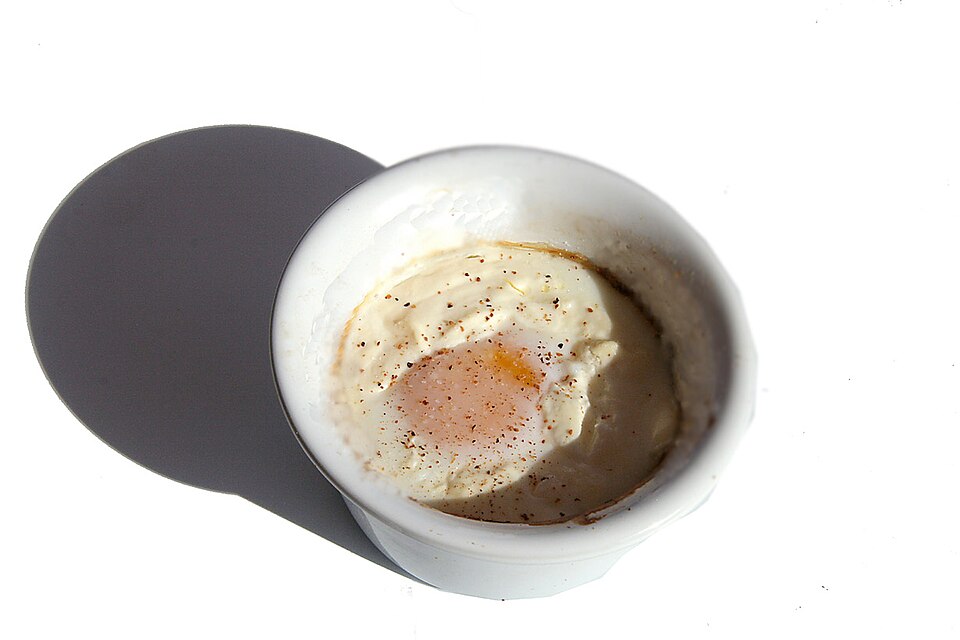
How it looks · Photo: Klaus Nielsen on Pexels
About this dish
- Origin
- France · Commonly attributedAlso popular in United KingdomMore food from France
- Dish
- Breakfast · Brunch · Egg dishes
- Cooking method
- Oven-baked
- Taste
- creamy, rich, mild
- Diet
- No nut ingredients · Low-carbWithout the optional extras: Vegetarian (lacto-ovo), Eggetarian, Pescatarian, Pork-freeWorked out from the ingredients. How labels work
All labels
Non-vegetarian · Flexitarian-friendly · No nut ingredients · No added sugar · Alcohol-free · Beef-free · Low-carb - Cook more with
- Egg · Heavy cream · Unsalted butter · Chives · White bread
Allergens
- Contains: Milkfrom heavy cream, unsalted butter, gruyère, white bread
- Contains: Eggsfrom egg, white bread
- Contains: Wheatfrom white bread
- Contains: Glutenfrom white bread
- May contain: Soyfrom white bread
- May contain: Sesamefrom white bread
Based on typical versions of these ingredients and not verified allergen-free. Brands differ and cross-contact happens, so always check labels. For severe allergies, follow your clinician’s advice.
Nutrition
214 kcal per serving
Estimated1 serving ≈ 96 g · recipe makes 4
Where the energy comes from
- Protein 17%
- Carbohydrate 28%
- Fat 55%
| Nutrient | Per serving | Per 100 g* |
|---|---|---|
| Energy | 214 kcal | 223 kcal |
| Protein | 9.2 g | 9.6 g |
| Carbohydrate | 14.7 g | 15.3 g |
| Net carbohydrate | 13.9 g | 14.4 g |
| Sugars | 2.2 g | 2.3 g |
| Added sugars | 0 g | 0 g |
| Fibre | 0.8 g | 0.8 g |
| Fat | 13.1 g | 13.6 g |
| Saturated fat | 6.4 g | 6.7 g |
| Trans fat | 0.2 g | 0.2 g |
| Cholesterol | 208 mg | 217 mg |
| Sodium | — | — |
| Salt equivalent | — | — |
Vitamins & minerals per serving
- Potassium
- 121 mg
- Calcium
- 79 mg
- Iron
- 1.9 mg
- Magnesium
- 14 mg
- Vitamin A (RAE)
- 160 µg
- Vitamin C
- 1 mg
- Vitamin D
- 1.2 µg
- Vitamin B12
- 0.5 µg
- Folate (DFE)
- 73 µg
How these numbers were made
- Calculated from USDA FoodData Central (SR Legacy) per-100 g values and the listed quantities.
- *Per 100 g of combined raw ingredients; the cooked dish may weigh more or less.
- Optional ingredients are not included: gruyère, ham.
- Not counted (tiny amounts or “to taste”): salt, black pepper — so sodium is shown as unknown.
- “—” means the value isn’t known for enough of the ingredients; it is never zero by default.
- Values are estimates for guidance, not for medical dosing. U.S. Department of Agriculture, Agricultural Research Service. FoodData Central, 2019. fdc.nal.usda.gov.
Good to know
Food safety
- Runny or lightly cooked eggs: the UK Food Standards Agency says hen eggs with the British Lion mark or from the Laid in Britain scheme can be eaten lightly cooked by everyone, including young children, pregnant people and older adults (but not people who are severely immunocompromised). Otherwise — and following USDA advice in the US — cook eggs until white and yolk are firm for vulnerable groups, or use pasteurised eggs. Duck, goose and quail eggs should always be cooked through.
Storage
- Serve immediately.
Original editorial recipe · FriendsPantry editorial · Not yet independently reviewed · Added · Updated
Recipe DNA
How this dish is built
Grouped by each ingredient’s role in the dish. Each band’s width is its share of the dish by weight. Choose a component to see what it does.
What the dish is built around
Main ingredient
- Egg4 piece · 200 g
- Heavy cream4 tbsp · 59 g
- Unsalted butter10 g
- Gruyère, finely grated (optional)20 g
- Ham, chopped (optional)2 slice · 56 g
- White bread4 slice · 112 g
Reviews & corrections
Reviews come from signed-in cooks and appear after a moderator checks them. We never show made-up ratings.
You might also like
Poached Eggs
International · 13 min · 144 kcal · Contains egg
Cheese soufflé
 French · 50 min · 333 kcal · Contains egg
Quiche Lorraine
French · 2 h 5 min · 598 kcal
Œufs mayonnaise
French · 29 min · 363 kcal · Contains egg