
Buttermilk cornbread
Contains egg (no meat or fish)
A golden, crumbly quick bread of cornmeal and buttermilk baked in a sizzling hot pan for crisp edges. Lightly sweetened here; many Southern cooks leave the sugar out.
Buttermilk cornbread is a Southern US bread from United States, ready in about 37 minutes and made with cornmeal and buttermilk. It serves 8 and is rated easy to cook.
No licensed photograph of this dish yet.
- Prep
- 10 min
- Cook
- 22 min
- Rest
- 5 min
- Total
- 37 min
- Serves
- 8
- Level
- Easy
- Calories
- 225
Method
Step 1
Put the butter (opens in a new tab) in a 25 cm cast-iron or ovenproof frying pan and place it in the oven (opens in a new tab) while it heats to 220 °C.
Step 2
Whisk (opens in a new tab) the cornmeal (opens in a new tab), flour, sugar (opens in a new tab), baking powder (opens in a new tab), baking soda (opens in a new tab) and salt in a bowl. In another bowl whisk the buttermilk (opens in a new tab) and eggs (opens in a new tab).
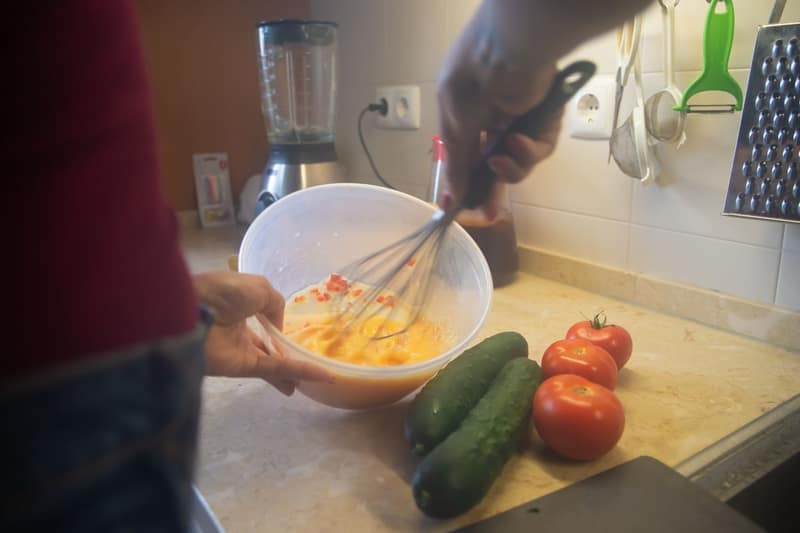
How it looks · Photo: Kampus Production on Pexels Step 3
Carefully take out the hot pan, swirl the melted butter (opens in a new tab) around and pour most of it into the buttermilk (opens in a new tab) mixture. Stir wet into dry until just combined.
- 2 min
Food safety: The pan handle will be very hot — use an oven glove.
Step 4
Pour the batter into the hot pan (it should sizzle) and bake until golden and a skewer comes out clean.
- 20 min
- 220°C
- Oven (opens in a new tab)
Step 5
Rest for 5 minutes, then cut into wedges.
- 5 min
About this dish
- Origin
- American South, United States · Well documentedBuilds on Indigenous corn breads of North America.More food from United States
- Dish
- Lunch · Dinner · Breads & flatbreads · Side dishes
- Cooking method
- Oven-baked
- Taste
- buttery, sweet, mild
- Diet
- Vegetarian (lacto-ovo) · No nut ingredientsWorked out from the ingredients. How labels work
All labels
Vegetarian (lacto-ovo) · Eggetarian · Pescatarian · Flexitarian-friendly · No nut ingredients · Alcohol-free · Pork-free · Beef-free - Good for
- Budget-friendly · Child-friendly
- Cook more with
- Cornmeal · Buttermilk · Butter · All-purpose flour · Sugar · Baking powder
- Techniques
- Baking
Allergens
- Contains: Milkfrom butter, buttermilk
- Contains: Eggsfrom egg
- Contains: Wheatfrom all-purpose flour, baking powder
- Contains: Glutenfrom all-purpose flour, baking powder
Based on typical versions of these ingredients and not verified allergen-free. Brands differ and cross-contact happens, so always check labels. For severe allergies, follow your clinician’s advice.
Nutrition
225 kcal per serving
Calculated1 serving ≈ 98 g · recipe makes 8
Where the energy comes from
- Protein 11%
- Carbohydrate 56%
- Fat 34%
| Nutrient | Per serving | Per 100 g* |
|---|---|---|
| Energy | 225 kcal | 228 kcal |
| Protein | 6 g | 6.2 g |
| Carbohydrate | 31.7 g | 32.3 g |
| Net carbohydrate | 29.9 g | 30.5 g |
| Sugars | 5.4 g | 5.5 g |
| Added sugars | 3.1 g | 3.2 g |
| Fibre | 1.8 g | 1.8 g |
| Fat | 8.5 g | 8.7 g |
| Saturated fat | 4.6 g | 4.7 g |
| Trans fat | — | — |
| Cholesterol | 64 mg | 65 mg |
| Sodium | 619 mg | 630 mg |
| Salt equivalent | 1.5 g | 1.6 g |
Vitamins & minerals per serving
- Potassium
- 148 mg
- Calcium
- 122 mg
- Iron
- 1.7 mg
- Magnesium
- 33 mg
- Vitamin A (RAE)
- 79 µg
- Vitamin C
- 0 mg
- Vitamin D
- 0.3 µg
- Vitamin B12
- 0.2 µg
- Folate (DFE)
- 58 µg
How these numbers were made
- Calculated from USDA FoodData Central (SR Legacy) per-100 g values and the listed quantities.
- *Per 100 g of combined raw ingredients; the cooked dish may weigh more or less.
- “—” means the value isn’t known for enough of the ingredients; it is never zero by default.
- Values are estimates for guidance, not for medical dosing. U.S. Department of Agriculture, Agricultural Research Service. FoodData Central, 2019. fdc.nal.usda.gov.
Good to know
Tips
- Preheating the pan is what gives cornbread its crunchy crust.
Common mistakes
- Overmixing makes a dense, tough crumb.
Serve with
- Serve warm with butter and honey alongside chili or collard greens.
Storage
- Wrap and keep at room temperature for 2 days, or freeze up to 2 months.
Reheating
- Warm wedges in a 180 °C oven for 5–8 minutes.
Variations
- Jalapeño cheddar cornbread: Fold grated cheddar and chopped jalapeño into the batter.
Original editorial recipe · FriendsPantry editorial · Not yet independently reviewed · Added · Updated
Recipe DNA
How this dish is built
Grouped by each ingredient’s role in the dish. Each band’s width is its share of the dish by weight. Choose a component to see what it does.
What the dish is built around
Main ingredient
- Butter60 g
- Cornmeal150 g
- All-purpose flour125 g
- Buttermilk300 ml · 309 g
- Egg2 piece · 100 g
Baker’s notes
Customise in Bread & BakeryTimeline and readiness cues
Mix and knead · about 10 min
Mix only until no dry flour remains — overmixing makes it tough and tunnelled.
Bake · about 22 min at 220 °C
Risen and golden; a skewer in the centre comes out clean or with a few moist crumbs; the top springs back.
Cool · about 5 min
Cool on a rack before slicing — the crumb is still setting; cutting hot bread makes it gummy.
- Start to finish: about 37 min. Times are a guide — warmth changes everything; follow the cues.
If something goes wrong
Gummy or wet crumb
Likely causes
- Under-baked
- Sliced while hot
- Hydration too high for the flour
What to do
- Bake to 93–96 °C inside (cakes: clean skewer)
- Cool completely on a rack before slicing
- Reduce water by 3–5% or use a stronger flour
Collapsed or sunken middle
Likely causes
- Oven door opened too early
- Too much leavening or sugar
- Under-baked centre
- Over-proofed yeast dough
What to do
- Don't open the oven for the first two-thirds of baking
- Measure leaveners exactly with spoons, levelled
- Test the centre before removing
- Proof less
Pale crust
Likely causes
- Oven too cool
- Too little sugar or no milk/egg for browning
- Over-fermented (yeast ate the sugars)
What to do
- Check the oven with a thermometer
- Brush with egg wash or milk
- Shorten the fermentation
Burnt bottom
Likely causes
- Tray too close to the heat
- Dark tray absorbs more heat
- Too much sugar in the dough
What to do
- Bake on the middle shelf
- Double up trays or use a light-coloured one
- Lower the temperature 10–15 °C and bake a little longer
Crust too hard or thick
Likely causes
- Baked too long at too low a temperature
- No steam at the start
What to do
- Bake hotter for a shorter time
- Add steam for the first 15 minutes (tray of boiling water, or a covered Dutch oven)
- Cool under a tea towel for a softer crust
Big holes or tunnels
Likely causes
- Overmixed batter (cakes, muffins)
- Air trapped while shaping bread
- Uneven proof
What to do
- Mix quick breads only until no dry flour shows
- Degas gently and shape tightly
- Proof covered in an even, warm place
Dry or crumbly
Likely causes
- Too much flour (scooped, not weighed)
- Over-baked
- Too little fat or sugar
What to do
- Weigh flour, or spoon it into the cup and level
- Check 5 minutes early
- Don't cut fat or sugar by more than a quarter without another moisture source
Reviews & corrections
Reviews come from signed-in cooks and appear after a moderator checks them. We never show made-up ratings.
You might also like
Chili con carne
 Tex-Mex · 1 h 30 min · 434 kcal

Shrimp and grits
Southern US · 50 min · 495 kcalSouthern buttermilk biscuits
Southern US · 45 min · 224 kcal · Vegetarian
Chicken and waffles
Southern US · 1 h · 1025 kcal