
Salted caramel sauce
Vegetarian
Caramel au beurre salé
Sugar cooked to deep amber, then made smooth with warm cream and butter and seasoned with flaky sea salt. Rich, bittersweet and glossy.
Salted caramel sauce is a French sauce from France, ready in about 35 minutes and made with sugar and heavy cream. It serves 12 and is rated intermediate to cook.
No licensed photograph of this dish yet.
- Prep
- 5 min
- Cook
- 15 min
- Rest
- 15 min
- Total
- 35 min
- Serves
- 12
- Level
- Intermediate
- Calories
- 143
Method
Step 1
Warm the cream in a small pan or the microwave until hot but not boiling, and have the butter and salt ready. Everything must be to hand before the sugar (opens in a new tab) starts to colour.
- 3 min
- low heat
- Saucepan (opens in a new tab)
Step 2
Put the sugar (opens in a new tab) and water in a heavy, light-coloured saucepan (opens in a new tab) over medium heat and stir gently only until the sugar dissolves. Then stop stirring; brush down any crystals on the sides with a wet pastry brush (opens in a new tab).
- 3 min
- medium heat
- Saucepan (opens in a new tab)
- Pastry brush (opens in a new tab)
Step 3
Boil without stirring, swirling the pan gently once colour appears, for 8–10 minutes until the caramel is a deep amber, like a copper coin, and just starting to smoke (about 180 °C).
- 9 min
- 180°C · Deep amber; stop before it turns dark brown.
- medium-high heat
- Food thermometer (opens in a new tab)
Food safety: Molten sugar is far hotter than boiling water (160–180 °C) and sticks to skin. Use a deep pan, keep children away, and add cream slowly because it bubbles up violently.
Step 4
Take off the heat and pour in the warm cream in a slow stream, whisking — it will bubble up furiously. Whisk (opens in a new tab) in the butter, cube by cube, then the salt. If any hard lumps form, return to low heat and whisk until smooth.
- 3 min
- low heat
- Whisk (opens in a new tab)
Food safety: Molten sugar is far hotter than boiling water (160–180 °C) and sticks to skin. Use a deep pan, keep children away, and add cream slowly because it bubbles up violently.
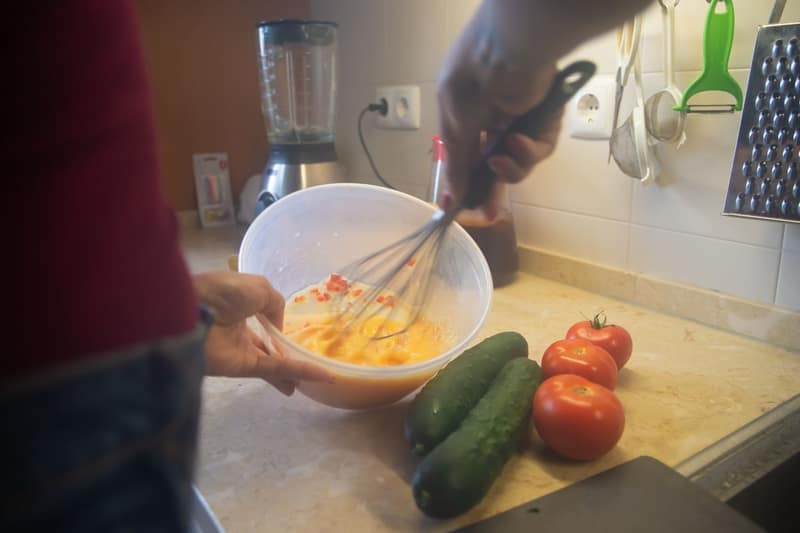
How it looks · Photo: Kampus Production on Pexels Step 5
Cool for 15 minutes; it thickens as it cools. Pour into a clean jar.
About this dish
- Origin
- Brittany, France · Commonly attributedBrittany's salted-butter caramel is usually credited to the chocolatier Henri Le Roux of Quiberon (1977), who popularised salted caramel; Bretons cooked with salted butter long before.Also popular in United Kingdom, United StatesMore food from France
- Dish
- Dessert · Sauces
- Cooking method
- Boiled
- Taste
- sweet, salty, buttery, bitter
- Diet
- Vegetarian (lacto-ovo) · No gluten ingredients · No nut ingredients · Low-carbWorked out from the ingredients. How labels work
All labels
Vegetarian (lacto-ovo) · Eggetarian · Lacto-vegetarian · Pescatarian · Flexitarian-friendly · No gluten ingredients · Egg-free · No nut ingredients · Alcohol-free · Pork-free · Beef-free · Low-carb - Good for
- Make-ahead · Festive & celebration
- Cook more with
- Sugar · Heavy cream · Unsalted butter
- Techniques
- Boiling · Emulsification
Allergens
- Contains: Milkfrom heavy cream, unsalted butter
Based on typical versions of these ingredients and not verified allergen-free. Brands differ and cross-contact happens, so always check labels. For severe allergies, follow your clinician’s advice.
Nutrition
143 kcal per serving
Calculated1 serving ≈ 35 g · recipe makes 12
Where the energy comes from
- Protein 1%
- Carbohydrate 46%
- Fat 53%
| Nutrient | Per serving | Per 100 g |
|---|---|---|
| Energy | 143 kcal | 408 kcal |
| Protein | 0.4 g | 1.1 g |
| Carbohydrate | 17 g | 48.6 g |
| Net carbohydrate | 17 g | 48.6 g |
| Sugars | 17 g | 48.6 g |
| Added sugars | 16.7 g | 47.6 g |
| Fibre | 0 g | 0 g |
| Fat | 8.6 g | 24.5 g |
| Saturated fat | 5.4 g | 15.4 g |
| Trans fat | — | — |
| Cholesterol | 25 mg | 71 mg |
| Sodium | 133 mg | 381 mg |
| Salt equivalent | 0.3 g | 1 g |
Vitamins & minerals per serving
- Potassium
- 13 mg
- Calcium
- 10 mg
- Iron
- 0 mg
- Magnesium
- 1 mg
- Vitamin A (RAE)
- 86 µg
- Vitamin C
- 0 mg
- Vitamin D
- 0.2 µg
- Vitamin B12
- 0 µg
- Folate (DFE)
- 1 µg
How these numbers were made
- Calculated from USDA FoodData Central (SR Legacy) per-100 g values and the listed quantities.
- “—” means the value isn’t known for enough of the ingredients; it is never zero by default.
- Values are estimates for guidance, not for medical dosing. U.S. Department of Agriculture, Agricultural Research Service. FoodData Central, 2019. fdc.nal.usda.gov.
Good to know
Tips
- Judge by colour as well as temperature: a pale caramel tastes only sweet; a deep amber one has the bittersweet edge that balances the salt.
Common mistakes
- Stirring the syrup once it boils, which makes it crystallise.
- Adding cold cream, which seizes the caramel and spits violently.
Serve with
- Crêpes, waffles and apple tarts such as tarte Tatin.
- Ice cream, cheesecake and brownies.
- Drizzled over popcorn or stirred into coffee.
Food safety
- Molten sugar is far hotter than boiling water (160–180 °C) and sticks to skin. Use a deep pan, keep children away, and add cream slowly because it bubbles up violently.
Storage
- Refrigerate in a covered jar for up to 2 weeks.
Reheating
- Warm gently in short microwave bursts or over hot water to make it pourable again.
Variations
- Dry caramel method (France): Sugar melted on its own without water; it is faster but needs more attention to avoid burning.
- Dulce de leche (Argentina): Milk and sugar slowly cooked together until caramelised; a different, milkier caramel.
Original editorial recipe · FriendsPantry editorial · Not yet independently reviewed · Added · Updated
Goes with
Recipe DNA
How this dish is built
Grouped by each ingredient’s role in the dish. Each band’s width is its share of the dish by weight. Choose a component to see what it does.
What the dish is built around
Main ingredient
- Heavy cream, warmed150 ml · 150 g
- Unsalted butter, cut into cubes, at room temperature60 g
Make it milder, swap ingredients for your diet, change the batch size or thickness — the original stays as it is.
Customise in Sauce & DrizzleReviews & corrections
Reviews come from signed-in cooks and appear after a moderator checks them. We never show made-up ratings.
You might also like
Butterscotch sauce
 British · 22 min · 188 kcal · Vegetarian
Chocolate sauce
 French · 12 min · 180 kcal · Vegetarian
Homemade dulce de leche
 Argentine · 2 h 55 min · 88 kcal · Vegetarian
Chocolate éclairs
French · 3 h 30 min · 342 kcal · Contains egg