
Thai basil eggplant stir-fry
Vegetarian
ผัดมะเขือยาว · phat makhuea yao
Long purple aubergine stir-fried until silky with garlic and chilli in a sweet-salty soy glaze, finished with a big handful of Thai basil.
Thai basil eggplant stir-fry is a Thai side dish from Thailand, ready in about 20 minutes and made with eggplant and basil. It serves 3 and is rated easy to cook.
No licensed photograph of this dish yet.
- Prep
- 10 min
- Cook
- 10 min
- Total
- 20 min
- Serves
- 3
- Level
- Easy
- Calories
- 191
Method
Step 1
Heat 2 tablespoons of oil in a wok (opens in a new tab) over high heat and fry the aubergine (opens in a new tab), tossing, until browned in places and starting to soften.
- 5 min
- high heat
- Wok (opens in a new tab)
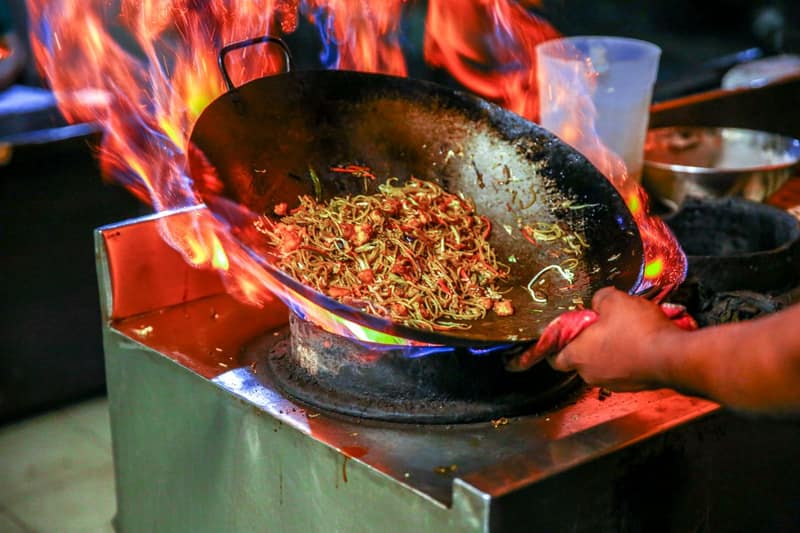
How it looks · Photo: Aesthos AR. Photography on Pexels Step 2
Push the aubergine (opens in a new tab) aside, add the remaining oil, the garlic (opens in a new tab) and chilli and fry for 20 seconds.
- 1 min
- high heat
Step 3
Add the soy sauce (opens in a new tab), sweet soy, sugar (opens in a new tab) and water, cover for a minute so the aubergine (opens in a new tab) steams through, then toss until glossy and silky.
- 3 min
- medium-high heat
Step 4
Toss in the basil (opens in a new tab) until just wilted and serve with rice.

How it looks · Photo: Willians Huerta on Pexels
About this dish
- Origin
- Thailand · Commonly attributedAlso popular in United StatesMore food from Thailand
- Dish
- Lunch · Dinner · Side dishes · Main courses
- Cooking method
- Stir-fried
- Taste
- sweet & savoury, garlicky, herby, spicy (chilli heat)
- Diet
- Vegan · Dairy-free · No nut ingredients · Low-carbWorked out from the ingredients. How labels work
All labels
Vegan · Plant-based · Vegetarian (lacto-ovo) · Eggetarian · Lacto-vegetarian · Ovo-vegetarian · Pescatarian · Flexitarian-friendly · Dairy-free · Egg-free · No nut ingredients · Alcohol-free · Pork-free · Beef-free · Low-carb · DASH-style · Carb-conscious - Good for
- Everyday · One-pan · Budget-friendly
- Cook more with
- Eggplant · Basil · Garlic · Fresh red chilli · Soy sauce · Kecap manis (sweet soy sauce)
- Techniques
- Stir-frying
Allergens
- Contains: Wheatfrom soy sauce, kecap manis (sweet soy sauce)
- Contains: Glutenfrom soy sauce, kecap manis (sweet soy sauce)
- Contains: Soyfrom soy sauce, kecap manis (sweet soy sauce), tofu
Based on typical versions of these ingredients and not verified allergen-free. Brands differ and cross-contact happens, so always check labels. For severe allergies, follow your clinician’s advice.
Nutrition
191 kcal per serving
Estimated1 serving ≈ 218 g · recipe makes 3
Where the energy comes from
- Protein 6%
- Carbohydrate 31%
- Fat 63%
| Nutrient | Per serving | Per 100 g* |
|---|---|---|
| Energy | 191 kcal | 88 kcal |
| Protein | 3.1 g | 1.4 g |
| Carbohydrate | 15.5 g | 7.1 g |
| Net carbohydrate | 10.4 g | 4.8 g |
| Sugars | 8.3 g | 3.8 g |
| Added sugars | 3.5 g | 1.6 g |
| Fibre | 5.1 g | 2.3 g |
| Fat | 14.2 g | 6.5 g |
| Saturated fat | 1.1 g | 0.5 g |
| Trans fat | 0.1 g | 0 g |
| Cholesterol | 0 mg | 0 mg |
| Sodium | 541 mg | 248 mg |
| Salt equivalent | 1.4 g | 0.6 g |
Vitamins & minerals per serving
- Potassium
- 456 mg
- Calcium
- 47 mg
- Iron
- 1 mg
- Magnesium
- 37 mg
- Vitamin A (RAE)
- 26 µg
- Vitamin C
- 16 mg
- Vitamin D
- 0 µg
- Vitamin B12
- 0 µg
- Folate (DFE)
- 42 µg
How these numbers were made
- Calculated from USDA FoodData Central (SR Legacy) per-100 g values and the listed quantities.
- *Per 100 g of combined raw ingredients; the cooked dish may weigh more or less.
- Optional ingredients are not included: tofu, long-grain white rice.
- Kecap manis (sweet soy sauce): Hoisin sauce (FDC 172886) used as a stand-in for this thick palm-sugar-sweetened soy sauce; sugar and sodium differ by brand.
- “—” means the value isn’t known for enough of the ingredients; it is never zero by default.
- Values are estimates for guidance, not for medical dosing. U.S. Department of Agriculture, Agricultural Research Service. FoodData Central, 2019. fdc.nal.usda.gov.
Good to know
Tips
- Many Thai cooks add a spoonful of fermented soybean paste, oyster sauce or minced pork; this version keeps it plant-based.
Common mistakes
- Adding too much oil at the start — aubergine soaks it up; a little water and a lid soften it instead.
Serve with
- Serve with rice and a Thai omelette or crispy tofu.
Storage
- Refrigerate for up to 2 days.
Reheating
- Reheat briefly in a pan or microwave.
Variations
- With minced pork: Brown 150 g minced pork with the garlic and add 1 tablespoon oyster sauce.
Original editorial recipe · FriendsPantry editorial · Not yet independently reviewed · Added · Updated
Recipe DNA
How this dish is built
Grouped by each ingredient’s role in the dish. Each band’s width is its share of the dish by weight. Choose a component to see what it does.
What the dish is built around
Main ingredient
- Eggplant, long Asian aubergines, cut into 5 cm batons450 g
- Fresh red chilli, pounded or chopped3 piece · 18 g
- Tofu, firm, cubed and pan-fried (optional)200 g
- Long-grain white rice (optional)200 g
Reviews & corrections
Reviews come from signed-in cooks and appear after a moderator checks them. We never show made-up ratings.
You might also like
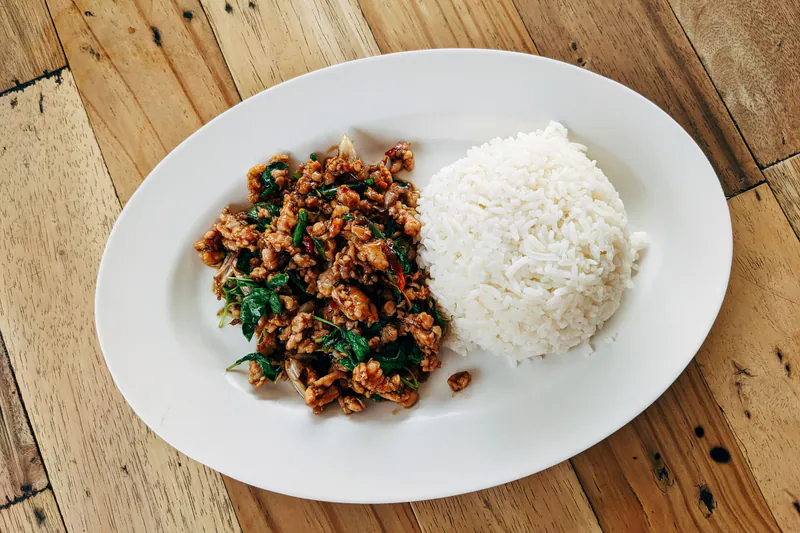
Pad kra pao gai
 Thai · 22 min · 430 kcal
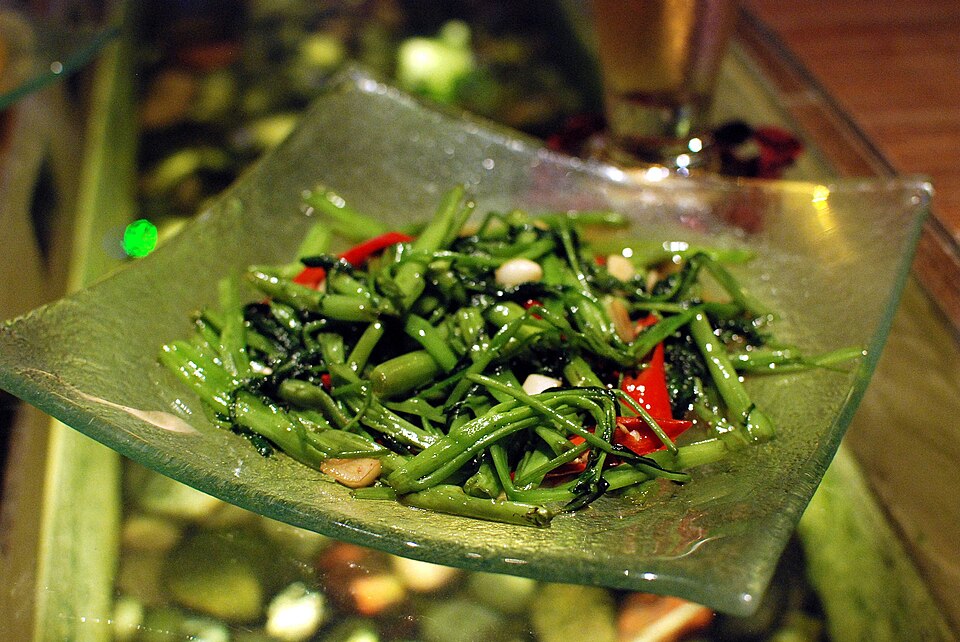
Pad pak boong fai daeng
Thai · 8 min · 129 kcal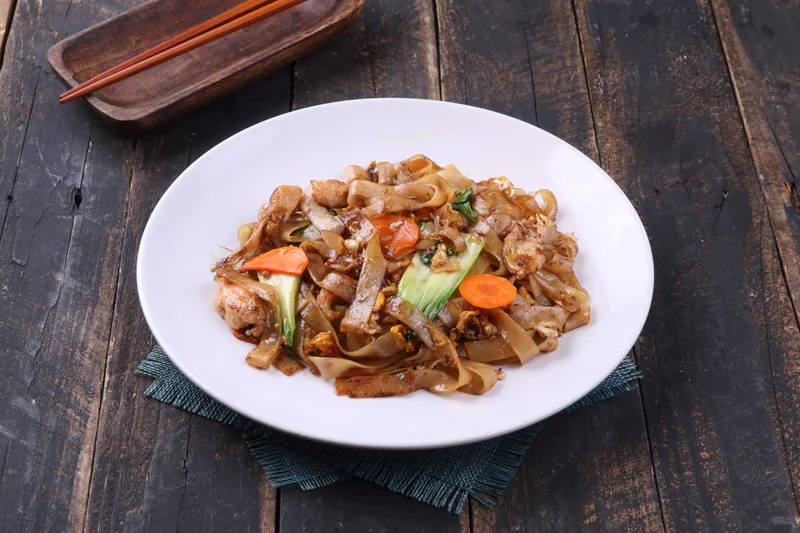
Pad see ew
Thai · 35 min · 856 kcal
Thai green curry with chicken
Thai · 55 min · 679 kcal