
Crossing-the-bridge rice noodles
Non-vegetarian
过桥米线 · guòqiáo mǐxiàn
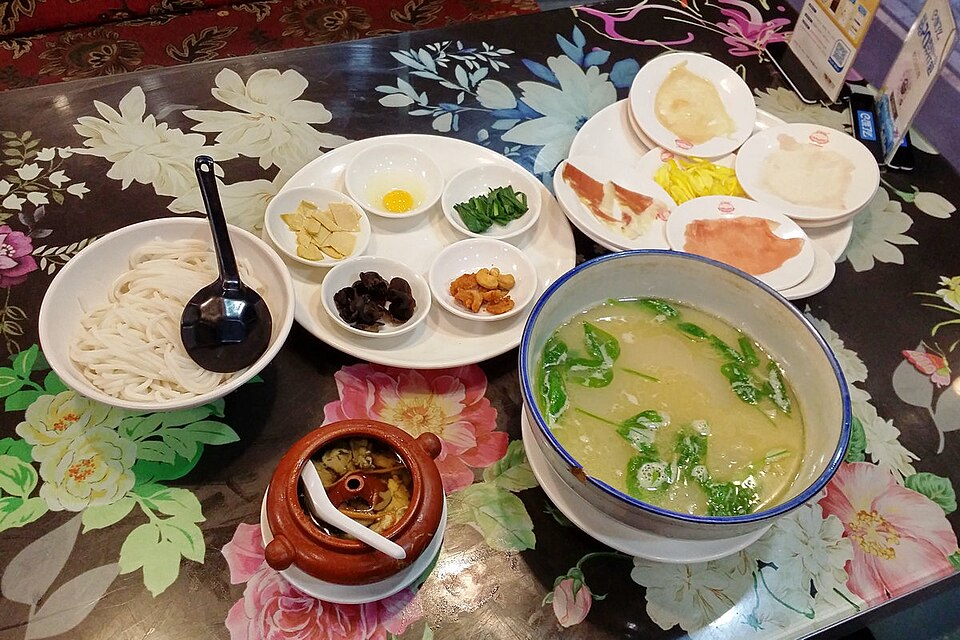
A bowl of scalding rich broth brought to the table with raw paper-thin meat, egg, vegetables and rice noodles, which diners slide in to cook in the heat of the soup. Yunnan's most famous dish.
Crossing-the-bridge rice noodles is a Chinese noodle dish from China, ready in about 40 minutes and made with chicken stock and rice noodles. It serves 2 and is rated intermediate to cook.
- Prep
- 25 min
- Cook
- 15 min
- Total
- 40 min
- Serves
- 2
- Level
- Intermediate
- Calories
- 758
Method
Step 1
Bring the stock to a hard boil with the salt and white pepper (opens in a new tab). Meanwhile warm two large, heavy bowls with boiling water.
- 8 min
- high heat
- Stockpot / large pot (opens in a new tab)
Step 2
Arrange the chicken, ham (opens in a new tab), fish, eggs (opens in a new tab), greens, sprouts, chives (opens in a new tab) and drained noodles on small plates for each person.
- 10 min
Food safety: Keep raw meat and fish chilled until serving and slice it very thinly so it cooks fully in the broth.
Step 3
Empty the bowls, fill with the boiling stock and float the oil on top to hold in the heat.
- 2 min
Step 4
At the table, add the meat and fish first and stir, then crack in the eggs (opens in a new tab), then add the vegetables and finally the noodles. Leave a minute or two before eating, topped with spring onion (opens in a new tab) and chilli oil (opens in a new tab).
- 3 min
Food safety: The broth must be at a rolling boil when served so the raw ingredients cook — check the chicken is white throughout before eating.
About this dish
- Origin
- Yunnan (Mengzi), China · Well documentedThe popular story of a wife carrying soup across a bridge to her scholar husband is legend.More food from China
- Dish
- Lunch · Dinner · Noodles · Soups
- Cooking method
- Boiled, Poached
- Taste
- savoury, umami, mild
- Diet
- No gluten ingredients · Dairy-free · High-proteinWithout the optional extras: No nut ingredientsWorked out from the ingredients. How labels work
All labels
Non-vegetarian · No gluten ingredients · Dairy-free · No added sugar · Alcohol-free · Beef-free · High-protein · Low-fat - Good for
- Festive & celebration
- Cook more with
- Chicken stock · Rice noodles · White pepper · Chicken breast · Ham · Egg
Allergens
- Contains: Eggsfrom egg
- Contains, can be adapted: Fishfrom white fish fillet
- May contain: Peanutsfrom chilli oil
- May contain: Soyfrom chilli oil
- May contain: Sesamefrom chilli oil
- May contain: Celeryfrom chicken stock
Based on typical versions of these ingredients and not verified allergen-free. Brands differ and cross-contact happens, so always check labels. For severe allergies, follow your clinician’s advice.
Nutrition
758 kcal per serving
Calculated1 serving ≈ 921 g · recipe makes 2
Where the energy comes from
- Protein 23%
- Carbohydrate 49%
- Fat 27%
| Nutrient | Per serving | Per 100 g* |
|---|---|---|
| Energy | 758 kcal | 82 kcal |
| Protein | 43.2 g | 4.7 g |
| Carbohydrate | 91.5 g | 9.9 g |
| Net carbohydrate | 88.1 g | 9.6 g |
| Sugars | 12.7 g | 1.4 g |
| Added sugars | 0 g | 0 g |
| Fibre | 3.4 g | 0.4 g |
| Fat | 22.5 g | 2.4 g |
| Saturated fat | 4.5 g | 0.5 g |
| Trans fat | — | — |
| Cholesterol | 252 mg | 27 mg |
| Sodium | 1880 mg | 204 mg |
| Salt equivalent | 4.7 g | 0.5 g |
Vitamins & minerals per serving
- Potassium
- 1197 mg
- Calcium
- 144 mg
- Iron
- 4.2 mg
- Magnesium
- 82 mg
- Vitamin A (RAE)
- 226 µg
- Vitamin C
- 37 mg
- Vitamin D
- 1.1 µg
- Vitamin B12
- 0.6 µg
- Folate (DFE)
- 137 µg
How these numbers were made
- Calculated from USDA FoodData Central (SR Legacy) per-100 g values and the listed quantities.
- *Per 100 g of combined raw ingredients; the cooked dish may weigh more or less.
- Optional ingredients are not included: white fish fillet, chilli oil.
- “—” means the value isn’t known for enough of the ingredients; it is never zero by default.
- Values are estimates for guidance, not for medical dosing. U.S. Department of Agriculture, Agricultural Research Service. FoodData Central, 2019. fdc.nal.usda.gov.
Good to know
Tips
- If unsure about cooking raw meat at the table, briefly poach the chicken slices in the boiling stock before serving.
Common mistakes
- Stock that is merely hot, not boiling, won't cook the raw chicken and fish — it must go into pre-heated bowls straight off a hard boil.
- Adding the noodles before the meat; the meat needs the hottest stock.
Storage
- Eat at once. Leftover stock keeps 3 days in the fridge; don't keep stock that has had raw meat cooked in it at the table.
Original editorial recipe · FriendsPantry editorial · Not yet independently reviewed · Added · Updated
Recipe DNA
How this dish is built
Grouped by each ingredient’s role in the dish. Each band’s width is its share of the dish by weight. Choose a component to see what it does.
What the dish is built around
Main ingredient
- Rice noodles, dried; soaked and boiled until just tender160 g
- Chicken breast, sliced paper-thin100 g
- Ham, thin slices40 g
- Egg2 piece · 100 g
- Bok choy, leaves separated100 g
- Bean sprouts, rinsed, straggly roots picked off80 g
- White fish fillet, sliced paper-thin (optional)80 g
Reviews & corrections
Reviews come from signed-in cooks and appear after a moderator checks them. We never show made-up ratings.
You might also like
Talumein soup
 Indian · 35 min · 357 kcal
Hot and sour soup
 Chinese · 30 min · 267 kcal
Wonton soup
Cantonese · 55 min · 508 kcal
Yangzhou fried rice
Chinese · 27 min · 464 kcal