
Staka me avga (Cretan eggs in staka cream)
Contains egg (no meat or fish)
Στάκα με αβγά · stáka me avgá
Eggs fried in staka, a rich Cretan cream cooked down with a little flour until it thickens and starts to release its butter. Soft eggs, savoury cream and plenty of bread for mopping make it a hearty mountain breakfast.
Staka me avga (Cretan eggs in staka cream) is a Greek egg dish from Greece, ready in about 30 minutes and made with heavy cream and egg. It serves 2 and is rated easy to cook.
No licensed photograph of this dish yet.
- Prep
- 5 min
- Cook
- 25 min
- Total
- 30 min
- Serves
- 2
- Level
- Easy
- Calories
- 1057
Main ingredients
Ingredients
For the staka
For the eggs
To serve
Method
Staka
18 minStep 1
Warm the cream with the salt in a wide frying pan over medium-low heat until it simmers. Simmer gently, stirring often, until it reduces by about a third, 8–10 minutes.
- 10 min
- medium-low heat
- Frying pan / skillet (opens in a new tab)
- Wooden spoon (opens in a new tab)
Step 2
Sprinkle in the flour while whisking constantly, and keep stirring over low heat until the staka thickens to a paste and drops of golden butter begin to separate around the edges, 6–8 minutes.
- 8 min
- low heat
- Whisk (opens in a new tab)
The butter separating is the sign that the staka is ready; keep the heat low so it does not catch.
Eggs
5 minStep 3
Make four hollows in the staka and crack an egg (opens in a new tab) into each. Cover and cook gently for 4–5 minutes, until the whites are set and the yolks still runny. Season with black pepper (opens in a new tab).
- 5 min
- low heat
To serve
1 minStep 4
Bring the pan to the table and eat straight away with bread or rusks to scoop up the staka.
- 1 min
At a glance
1 · Staka in a pan
 Heavy cream
 All-purpose flour
 Salt
then make
2 · Eggs in a pan
 Egg
 Black pepper
then bring
3 · To serve in a pan
 Crusty bread / baguette
About this dish
- Origin
- Chania and the mountain villages of western Crete, Greece · Well documentedStaka is made by Cretan shepherds from the cream skimmed off sheep's and goat's milk; the butter that separates from it (stakovoutyro) is prized for cooking pilaf.More food from Greece
Greece - Dish
- Breakfast · Brunch · Egg dishes · Main courses · Breakfast dishes
- Cooking method
- Simmered, Pan-fried
- Taste
- rich, creamy, buttery, salty
- Diet
- Vegetarian (lacto-ovo) · No nut ingredients · High-proteinWorked out from the ingredients. How labels work
All labels
Vegetarian (lacto-ovo) · Eggetarian · Pescatarian · Flexitarian-friendly · No nut ingredients · No added sugar · Alcohol-free · Pork-free · Beef-free · High-protein - Good for
- One-pan
- Cook more with
- Heavy cream · Egg · All-purpose flour · Crusty bread / baguette
- Techniques
- Pan-frying · Simmering · Reduction
Allergens
- Contains: Milkfrom heavy cream
- Contains: Eggsfrom egg
- Contains: Wheatfrom all-purpose flour, crusty bread / baguette
- Contains: Glutenfrom all-purpose flour, crusty bread / baguette
- May contain: Sesamefrom crusty bread / baguette
Based on typical versions of these ingredients and not verified allergen-free. Brands differ and cross-contact happens, so always check labels. For severe allergies, follow your clinician’s advice.
Nutrition
1057 kcal per serving
Calculated1 serving ≈ 384 g · recipe makes 2
Where the energy comes from
- Protein 10%
- Carbohydrate 19%
- Fat 70%
| Nutrient | Per serving | Per 100 g* |
|---|---|---|
| Energy | 1057 kcal | 275 kcal |
| Protein | 27 g | 7 g |
| Carbohydrate | 51.9 g | 13.5 g |
| Net carbohydrate | 49.9 g | 13 g |
| Sugars | 9.5 g | 2.5 g |
| Added sugars | 0 g | 0 g |
| Fibre | 1.9 g | 0.5 g |
| Fat | 83.5 g | 21.7 g |
| Saturated fat | 49.6 g | 12.9 g |
| Trans fat | 2.5 g | 0.7 g |
| Cholesterol | 598 mg | 156 mg |
| Sodium | 1492 mg | 388 mg |
| Salt equivalent | 3.7 g | 1 g |
Vitamins & minerals per serving
- Potassium
- 427 mg
- Calcium
- 228 mg
- Iron
- 5.3 mg
- Magnesium
- 52 mg
- Vitamin A (RAE)
- 982 µg
- Vitamin C
- 1 mg
- Vitamin D
- 5.2 µg
- Vitamin B12
- 1.2 µg
- Folate (DFE)
- 208 µg
How these numbers were made
- Calculated from USDA FoodData Central (SR Legacy) per-100 g values and the listed quantities.
- *Per 100 g of combined raw ingredients; the cooked dish may weigh more or less.
- “—” means the value isn’t known for enough of the ingredients; it is never zero by default.
- Values are estimates for guidance, not for medical dosing. U.S. Department of Agriculture, Agricultural Research Service. FoodData Central, 2019. fdc.nal.usda.gov.
Good to know
Tips
- Pour off and keep any butter that separates; it is wonderful in rice or for frying potatoes.
Common mistakes
- Cooking over high heat, which scorches the cream before it thickens.
Serve with
- Serve with fried apaki (Cretan smoked pork), fried potatoes or a tomato salad, and a glass of tsikoudia for the brave.
Food safety
- Cook the eggs until the whites are fully set; cook the yolks firm for pregnant women, young children and the elderly.
Storage
- Best eaten immediately. Plain staka keeps 3 days refrigerated.
Variations
- Staka with apaki: Slices of smoked pork are fried and served with the eggs.
- Staka as a spread: Plain staka is eaten warm on bread or with fried potatoes.
Original editorial recipe · FriendsPantry editorial · source: TasteAtlas (dish facts) · Not yet independently reviewed · Added
Recipe DNA
How this dish is built
Built from the recipe’s own sections. Each band’s width is its share of the dish by weight. Choose a component to see what it does.
What the dish is built around
For the eggs
- Egg4 piece · 200 g
- Black pepper0.25 tsp · 0.6 g
Reviews & corrections
Reviews come from signed-in cooks and appear after a moderator checks them. We never show made-up ratings.
You might also like
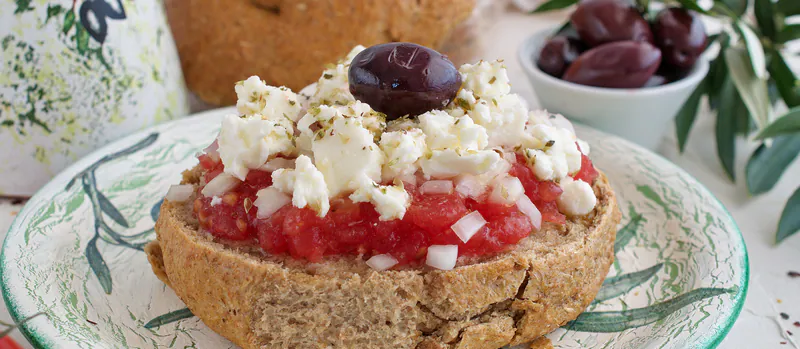
Dakos (Cretan barley rusk salad)
 Greek · 20 min · 439 kcal · Vegetarian
Kalitsounia (Cretan cheese pastries)
Greek · 1 h 45 min · 343 kcal · Contains egg
Shakshuka
 Tunisian · 40 min · 337 kcal · Contains egg
Patates me avga (Cypriot potatoes and eggs)
 Cypriot · 32 min · 442 kcal · Contains egg