
Gibanica
Contains egg (no meat or fish)
Гибаница · Gibanica
A tall, soft cheese pie of crumpled filo sheets soaked in a mixture of eggs, white cheese and yogurt. Served warm for breakfast and at every Serbian celebration.
Gibanica is a Serbian savoury bake, ready in about 1 hour 10 minutes and made with filo pastry and feta. It serves 8 and is rated easy to cook.
No licensed photograph of this dish yet.
- Prep
- 20 min
- Cook
- 40 min
- Rest
- 10 min
- Total
- 1 h 10 min
- Serves
- 8
- Level
- Easy
- Calories
- 477
Method
Step 1
Heat the oven (opens in a new tab) to 200 °C and oil a 25 × 35 cm baking dish (opens in a new tab). Whisk (opens in a new tab) the eggs (opens in a new tab), yogurt (opens in a new tab), sparkling water (opens in a new tab), half the oil, salt and crumbled cheese together.
- 5 min
- 200°C
- Whisk (opens in a new tab)
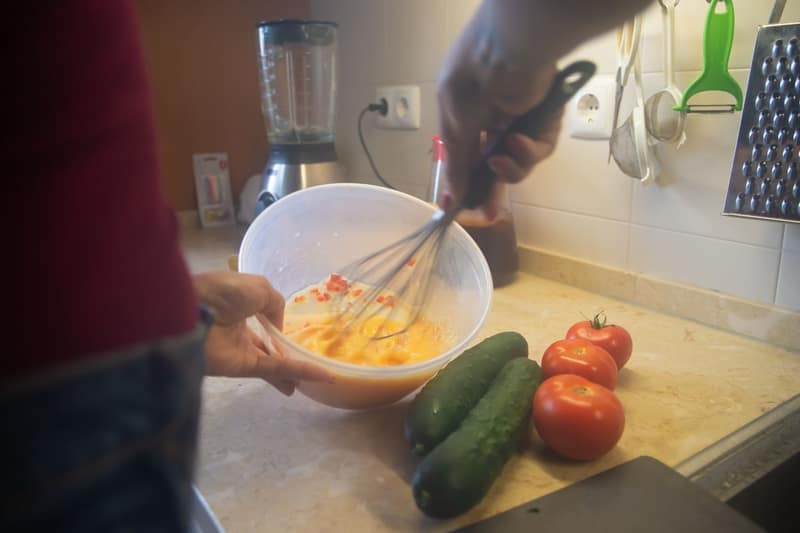
How it looks · Photo: Kampus Production on Pexels Step 2
Lay 2 filo (opens in a new tab) sheets flat in the dish and brush with oil. Dip each remaining sheet briefly in the cheese mixture, crumple it loosely and pack it into the dish.
- 12 min
Step 3
Pour any remaining mixture over, drizzle with the rest of the oil and bake for 35–40 minutes until puffed and deep golden.
- 40 min
- 200°C
- Oven (opens in a new tab)
Food safety: Bake until the egg mixture in the centre is set.
Step 4
Cover with a clean tea towel for 10 minutes so the top softens slightly, then cut into squares.
- 10 min
About this dish
- Origin
- Serbia · Commonly attributedVery similar to Bulgarian banitsa; layered Ottoman-era pies are made throughout the Balkans.Also popular in Bosnia and Herzegovina, MontenegroMore food from Serbia
- Dish
- Breakfast · Brunch · Snack · Pizza & savoury pies · Pastries
- Cooking method
- Oven-baked
- Taste
- salty, savoury, creamy, mild
- Diet
- Vegetarian (lacto-ovo) · No nut ingredientsWorked out from the ingredients. How labels work
All labels
Vegetarian (lacto-ovo) · Eggetarian · Pescatarian · Flexitarian-friendly · No nut ingredients · No added sugar · Alcohol-free · Pork-free · Beef-free · Calorie-conscious - Good for
- Festive & celebration · Make-ahead · Portable / lunchbox
- Cook more with
- Filo pastry · Feta · Egg · Yogurt · Sparkling water
- Techniques
- Baking
Allergens
- Contains: Milkfrom feta, yogurt
- Contains: Eggsfrom egg
- Contains: Wheatfrom filo pastry
- Contains: Glutenfrom filo pastry
Based on typical versions of these ingredients and not verified allergen-free. Brands differ and cross-contact happens, so always check labels. For severe allergies, follow your clinician’s advice.
Nutrition
477 kcal per serving
Calculated1 serving ≈ 207 g · recipe makes 8
Where the energy comes from
- Protein 13%
- Carbohydrate 31%
- Fat 56%
| Nutrient | Per serving | Per 100 g* |
|---|---|---|
| Energy | 477 kcal | 230 kcal |
| Protein | 15.8 g | 7.6 g |
| Carbohydrate | 36.5 g | 17.6 g |
| Net carbohydrate | 35.3 g | 17.1 g |
| Sugars | 1.7 g | 0.8 g |
| Added sugars | 0 g | 0 g |
| Fibre | 1.2 g | 0.6 g |
| Fat | 29.4 g | 14.2 g |
| Saturated fat | 10.2 g | 4.9 g |
| Trans fat | — | — |
| Cholesterol | 142 mg | 69 mg |
| Sodium | 1073 mg | 519 mg |
| Salt equivalent | 2.7 g | 1.3 g |
Vitamins & minerals per serving
- Potassium
- 163 mg
- Calcium
- 308 mg
- Iron
- 2.8 mg
- Magnesium
- 26 mg
- Vitamin A (RAE)
- 111 µg
- Vitamin C
- 0 mg
- Vitamin D
- —
- Vitamin B12
- 1.2 µg
- Folate (DFE)
- 116 µg
How these numbers were made
- Calculated from USDA FoodData Central (SR Legacy) per-100 g values and the listed quantities.
- *Per 100 g of combined raw ingredients; the cooked dish may weigh more or less.
- “—” means the value isn’t known for enough of the ingredients; it is never zero by default.
- Values are estimates for guidance, not for medical dosing. U.S. Department of Agriculture, Agricultural Research Service. FoodData Central, 2019. fdc.nal.usda.gov.
Good to know
Tips
- Crumple the sheets loosely rather than laying them flat — the air pockets make gibanica tall and soft.
Common mistakes
- Soaking the filo sheets too long in the egg mixture; they tear and the pie turns heavy.
Serve with
- Serve with a glass of yogurt or kefir for a classic Serbian breakfast.
Storage
- Refrigerate within 2 hours (it contains egg and cheese) and keep up to 4 days.
Reheating
- Warm in a 170 °C oven for 10 minutes.
Variations
- Gibanica with spinach: Wilted spinach mixed into the cheese filling.
Original editorial recipe · FriendsPantry editorial · Not yet independently reviewed · Added · Updated
Recipe DNA
How this dish is built
Baker’s notes
Customise in Bread & BakeryTimeline and readiness cues
Mix and knead · about 20 min
Knead until smooth and soft; it should feel like an earlobe.
Rest · about 10 min
Covered so it doesn't dry out; relaxed dough rolls and shapes without springing back.
Bake · about 40 min at 200 °C
Puffed with golden-brown spots on both sides.
- Start to finish: about 1 h 10 min. Times are a guide — warmth changes everything; follow the cues.
If something goes wrong
Pale crust
Likely causes
- Oven too cool
- Too little sugar or no milk/egg for browning
- Over-fermented (yeast ate the sugars)
What to do
- Check the oven with a thermometer
- Brush with egg wash or milk
- Shorten the fermentation
Burnt bottom
Likely causes
- Tray too close to the heat
- Dark tray absorbs more heat
- Too much sugar in the dough
What to do
- Bake on the middle shelf
- Double up trays or use a light-coloured one
- Lower the temperature 10–15 °C and bake a little longer
Crust too hard or thick
Likely causes
- Baked too long at too low a temperature
- No steam at the start
What to do
- Bake hotter for a shorter time
- Add steam for the first 15 minutes (tray of boiling water, or a covered Dutch oven)
- Cool under a tea towel for a softer crust
Reviews & corrections
Reviews come from signed-in cooks and appear after a moderator checks them. We never show made-up ratings.
You might also like
Pljeskavica
 Serbian · 1 h 25 min · 429 kcal
Prebranac (baked beans with onions)
Serbian · 14 h 40 min · 422 kcal · VeganCheese burek
Balkan · 1 h 15 min · 416 kcal · Contains egg
Banitsa
 Bulgarian · 1 h 15 min · 468 kcal · Contains egg