
Funge
Vegetarian
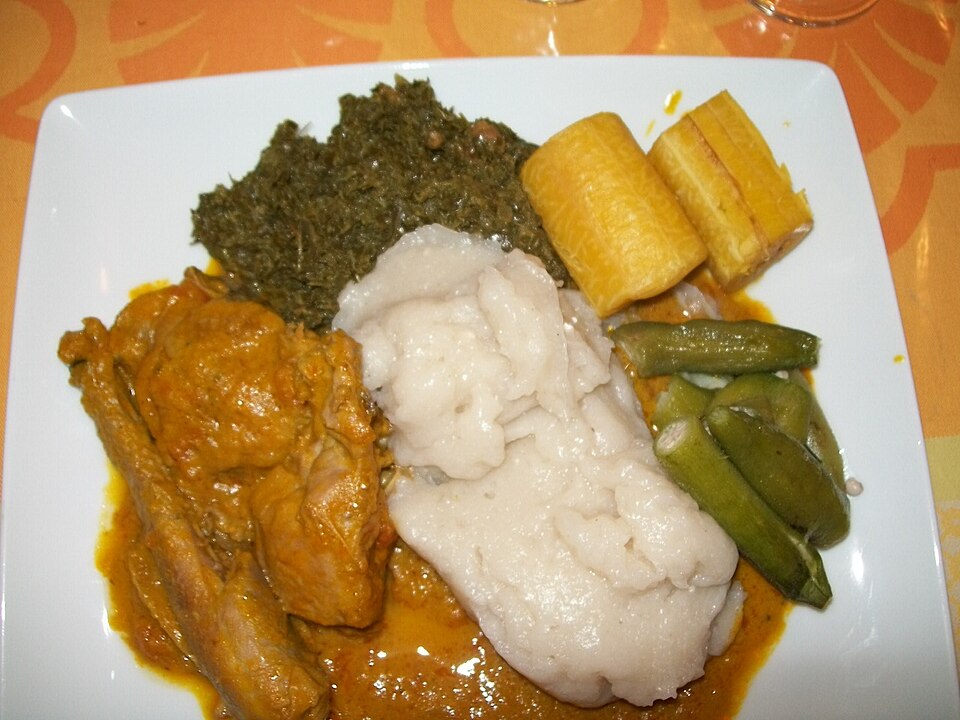
A smooth, elastic cassava-flour paste beaten in a pot until glossy — Angola's essential staple for scooping up muamba, calulu and other sauces.
Funge is an Angolan side dish, ready in about 12 minutes and made with cassava flour. It serves 4 and is rated intermediate to cook.
- Prep
- 2 min
- Cook
- 10 min
- Total
- 12 min
- Serves
- 4
- Level
- Intermediate
- Calories
- 269
Method
Step 2
Lower the heat and rain in the cassava flour (opens in a new tab) while stirring constantly with a strong wooden spoon (a 'pau de funge').
- 2 min
- medium-low heat
Step 3
Beat vigorously, folding and pressing the paste against the side of the pot, until it turns smooth, translucent, stretchy and comes away from the pot.
- 5 min
- low heat
Wet the spoon now and then so the paste does not stick to it.
Step 4
Shape into a mound with a wet bowl and serve immediately.
- 1 min

How it looks · Photo: Willians Huerta on Pexels
About this dish
- Origin
- Angola · Well documentedNorthern Angola favours cassava funge; the south often uses maize (funge de milho / pirão).More food from Angola
- Dish
- Lunch · Dinner · Side dishes · Porridge & cereals
- Cooking method
- Boiled
- Taste
- mild, sour
- Diet
- Vegan · No gluten ingredients · Dairy-free · No nut ingredientsWorked out from the ingredients. How labels work
All labels
Vegan · Plant-based · Vegetarian (lacto-ovo) · Eggetarian · Lacto-vegetarian · Ovo-vegetarian · Pescatarian · Flexitarian-friendly · No gluten ingredients · Dairy-free · Egg-free · No nut ingredients · No added sugar · Alcohol-free · Pork-free · Beef-free · Low-fat · Low-sodium · DASH-style - Good for
- Everyday · Budget-friendly
- Cook more with
- Cassava flour
- Techniques
- Boiling
Allergens
None of the 14 major allergens appear in the listed ingredients.
Based on typical versions of these ingredients and not verified allergen-free. Brands differ and cross-contact happens, so always check labels. For severe allergies, follow your clinician’s advice.
Nutrition
269 kcal per serving
Estimated1 serving ≈ 300 g · recipe makes 4
Where the energy comes from
- Protein 0%
- Carbohydrate 100%
- Fat 0%
| Nutrient | Per serving | Per 100 g* |
|---|---|---|
| Energy | 269 kcal | 90 kcal |
| Protein | 0.1 g | 0 g |
| Carbohydrate | 66.5 g | 22.2 g |
| Net carbohydrate | 65.8 g | 21.9 g |
| Sugars | 2.5 g | 0.8 g |
| Added sugars | 0 g | 0 g |
| Fibre | 0.7 g | 0.2 g |
| Fat | 0 g | 0 g |
| Saturated fat | 0 g | 0 g |
| Trans fat | — | — |
| Cholesterol | 0 mg | 0 mg |
| Sodium | 5 mg | 2 mg |
| Salt equivalent | 0 g | 0 g |
Vitamins & minerals per serving
- Potassium
- 8 mg
- Calcium
- 38 mg
- Iron
- 1.2 mg
- Magnesium
- 5 mg
- Vitamin A (RAE)
- 0 µg
- Vitamin C
- 0 mg
- Vitamin D
- 0 µg
- Vitamin B12
- 0 µg
- Folate (DFE)
- 3 µg
How these numbers were made
- Calculated from USDA FoodData Central (SR Legacy) per-100 g values and the listed quantities.
- *Per 100 g of combined raw ingredients; the cooked dish may weigh more or less.
- Cassava flour: Dry pearl tapioca (FDC 169717) used as a stand-in; cassava flour is the whole dried root so it has a little more fibre, but energy and carbohydrate are very close.
- “—” means the value isn’t known for enough of the ingredients; it is never zero by default.
- Values are estimates for guidance, not for medical dosing. U.S. Department of Agriculture, Agricultural Research Service. FoodData Central, 2019. fdc.nal.usda.gov.
Good to know
Tips
- Keep a kettle of hot water handy: if the funge is too stiff, add a splash and keep beating.
Common mistakes
- Adding the flour too fast to water that is not boiling — it goes lumpy.
Serve with
- Serve with muamba de galinha, calulu, or grilled fish with a tomato and onion sauce.
Storage
- Best eaten freshly made.
Original editorial recipe · FriendsPantry editorial · Not yet independently reviewed · Added · Updated
Recipe DNA
How this dish is built
Grouped by each ingredient’s role in the dish. Each band’s width is its share of the dish by weight. Choose a component to see what it does.
Reviews & corrections
Reviews come from signed-in cooks and appear after a moderator checks them. We never show made-up ratings.
You might also like
Muamba de galinha
 Angolan · 1 h 20 min · 637 kcal
Calulu
Angolan · 1 h 10 min · 313 kcal
Ugali
 Kenyan · 17 min · 272 kcal · Vegan
Cocada amarela
Angolan · 1 h 40 min · 352 kcal · Contains egg