Advanced food science · intermediate
Foams and gels
Foams trap air in a liquid or solid; gels trap liquid in a network. Both depend on proteins or long-chain carbohydrates.
What happens
A foam is gas bubbles held in a liquid or solid. Whipping egg whites unfolds their proteins, which then line each bubble and link up into a stable film; sugar and a little acid (cream of tartar or lemon) strengthen it, while even a trace of fat or yolk interferes. Whipped cream is a different foam, held up by partly solid fat droplets that cluster around the bubbles, so it must be cold and contain enough fat (usually about 30% or more). A gel is liquid trapped in a three-dimensional network of long molecules. Gelatin, a protein from animal collagen, dissolves in warm liquid and sets as it cools, then melts again near body temperature. Agar, from seaweed, dissolves only near boiling, sets at about 32–45 °C and stays firm until about 85 °C.
Why it matters in the kitchen
Meringues, mousses, soufflés, whipped cream, jellies, panna cotta and falooda jelly all depend on these structures; knowing what supports or destroys them prevents flat meringues and runny jellies.
Temperatures and conditions
- Whip cream cold 2–8 °C · Warm cream doesn't hold air and turns greasy.
- Egg whites whip fastest 18–25 °C · Room-temperature whites foam more easily.
- Gelatin sets 5–15 °C
- Gelatin melts 25–35 °C · Melts in the mouth; softens on a hot day.
- Agar sets 32–45 °C
- Agar dissolves / remelts 85–100 °C · Must be boiled to dissolve.
In practice
- Meringue, pavlova, macarons and soufflé.
- Whipped cream and mousse.
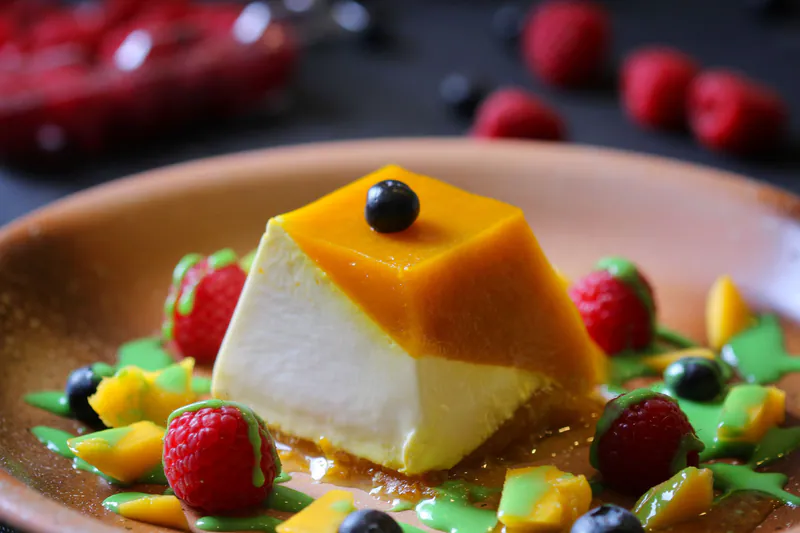
- Panna cotta and jelly set with gelatin.
- Agar jellies, falooda jelly and vegetarian set desserts.
- Aquafaba (chickpea water) whipped as an egg-free meringue.
Myths and facts
Myth: Agar and gelatin swap one for one.
Fact: Agar sets much more firmly at the same weight, sets and melts at higher temperatures, and gives a firmer, more brittle texture. Use roughly a fraction of the gelatin quantity and follow the packet, as strengths vary.
Myth: Jelly made with fresh pineapple, kiwi or papaya just needs longer to set.
Fact: These fruits contain protein-digesting enzymes (bromelain, actinidin, papain) that break gelatin down so it never sets. Cooked or canned fruit is fine, or use agar, which is not a protein.
Myth: Gelatin is vegetarian.
Fact: Gelatin comes from animal collagen. Agar, carrageenan and pectin are plant or seaweed-derived alternatives.
Use it to cook better
- Whip egg whites in a spotless, grease-free bowl; separate eggs cold and let whites warm a little.
- Add sugar to egg whites gradually after soft peaks form, and stop at stiff, glossy peaks; overbeaten whites turn grainy and weep.
- Chill cream, bowl and whisk for whipped cream and stop at soft or medium peaks; keep going and it becomes butter.
- Bloom gelatin in cold liquid, then dissolve it in warm (not boiling) liquid.
- Boil agar for a minute or two to dissolve fully; it sets quickly as it cools, so pour promptly.
Try it at home
Fresh pineapple versus cooked
You need: Gelatin for 500 ml jelly, Fresh pineapple, chopped, Canned or cooked pineapple, chopped, 2 small cups, Fridge
- Make up the gelatin following the packet and divide it between the two cups.
- Add fresh pineapple to one and cooked pineapple to the other.
- Refrigerate for 4 hours or overnight.
What you’ll see: The cooked-pineapple jelly sets; the fresh-pineapple one stays runny because bromelain digests the gelatin. Heat in cooking or canning destroys the enzyme.
Going deeper
Copper bowls stabilise egg foams because copper ions bind to a protein (conalbumin) and make it more resistant to over-beating; cream of tartar works similarly by lowering pH. Gelatin gels are 'thermoreversible' and their strength is graded by 'bloom' number. Agar's large gap between setting and melting temperatures (hysteresis) makes it useful for warm-served gels and in hot climates. Foams collapse as liquid drains from bubble walls; stabilisers such as sugar, starch or gelatin thicken the liquid and slow drainage.
Ingredients it affects most
Techniques that rely on it
Worth double-checking
- Agar-to-gelatin conversion depends on the product's strength; ratios from about 1:3 to 1:8 by weight are quoted, so follow packets.
- Setting and melting points vary with concentration, sugar and acid.
 Mauritian · 1 h 15 min · 230 kcal ·
 Lebanese · 30 min · 293 kcal ·
 Cantonese · 4 h 18 min · 130 kcal
 Turkish · 1 h 55 min · 357 kcal ·
 Afghan · 2 h 45 min · 784 kcal
 Georgian · 2 h · 957 kcal ·
 Italian · 4 h 20 min · 432 kcal
 Bolivian · 6 h 15 min · 646 kcal